


Decoding Hazardous Class in UPS Battery Shipping: Which Category Do You Belong To?
UPS Battery Shipping is not only about moving a backup power battery from one place to another. In logistics, a UPS battery may be treated as a regulated item because it can contain stored electrical energy, corrosive electrolyte, lithium chemistry, or heavy industrial battery modules. For this article, “UPS” means Uninterruptible Power Supply, not the courier company.

Many people think a battery is simply a “restricted item.” However, in international transport, battery classification depends on chemistry, energy rating, packaging form, and whether the battery is shipped alone, packed with equipment, or installed in equipment. This is why sending one small phone battery is very different from exporting a full industrial UPS battery bank.
What Makes a UPS Battery a Dangerous Good?
A battery becomes a dangerous good when it presents a transport risk under UN, IATA, IMDG, ADR, or local hazardous materials rules. Common risks involve:
•Lithium batteries may pose a fire risk if short circuited and/or damaged or if thermal runaway occurs
•Lead-acid batteries pose a corrosion risk if wet with battery acid
•Damaged or poorly packed batteries may pose a risk of pressure and/or leakage
•Exposed battery terminals may pose an electrical short circuit risk
•Industrial UPS battery modules may pose a mass risk as they are heavy and packed in bulk
For lithium cells and batteries, IATA states that battery types may not be transported until they have passed the UN Manual of Tests and Criteria and Evaluation Criteria, Part III, Subsection 38.3. Lead-acid wet batteries are most often associated with UN2794 or UN2800 depending on whether they are dangerous goods in transport when filled with acid or are non-spillable.
Dangerous Goods vs. Restricted Items
In UPS Battery Shipping, these two are sometimes confused with one another.
Dangerous Goods are products that are officially deemed dangerous and hazardous under the rules for hazardous materials. They need correct UN numbers, proper shipping names, packaging, labels, declarations, trained personnel, and sometimes carrier approval.
Restricted Items are products a carrier, platform, or country limits for business, safety, customs, or operational reasons. A restricted item may not always be a dangerous good, but it still may need extra review.
For example:
•A lithium-ion battery may be both a dangerous good and a restricted item.
•A small alkaline battery may be restricted by a courier but not handled as fully regulated dangerous goods in many cases.
•Even with the relevant documentation, many carriers may refuse to accept damaged lithium batteries.
This distinction matters because “restricted” mainly means carrier acceptance control, while “dangerous goods” means legal transport classification.

UPS Battery Classification Table
| Battery Type Used in UPS Systems | Common UN Number | Typical Proper Shipping Name | Main Transport Risk | Wh / Lithium Content Reference | Common Notes |
| Lithium-ion battery shipped alone | UN3480 | Lithium ion batteries | Fire / thermal runaway | ≤100 Wh often treated as small battery threshold; >100 Wh usually fully regulated | Air shipments of UN3480 are highly controlled; UPS carrier accepts UN3480 by air only as fully regulated dangerous goods. |
| Lithium-ion battery packed with equipment | UN3481 | Lithium ion batteries packed with equipment | Fire / short circuit | Common small battery threshold: ≤20 Wh per cell, ≤100 Wh per battery | Used when replacement UPS battery is shipped with a UPS unit but not installed |
| Lithium-ion battery contained in equipment | UN3481 | Lithium ion batteries contained in equipment | Fire / hidden battery risk | Common small battery threshold: ≤20 Wh per cell, ≤100 Wh per battery | Used when the UPS unit already contains the lithium battery |
| Lithium metal battery shipped alone | UN3090 | Lithium metal batteries | Fire / lithium metal reactivity | ≤1 g lithium per cell, ≤2 g lithium per battery often used as small battery threshold | Less common in UPS systems, but may appear in backup modules or specialty devices |
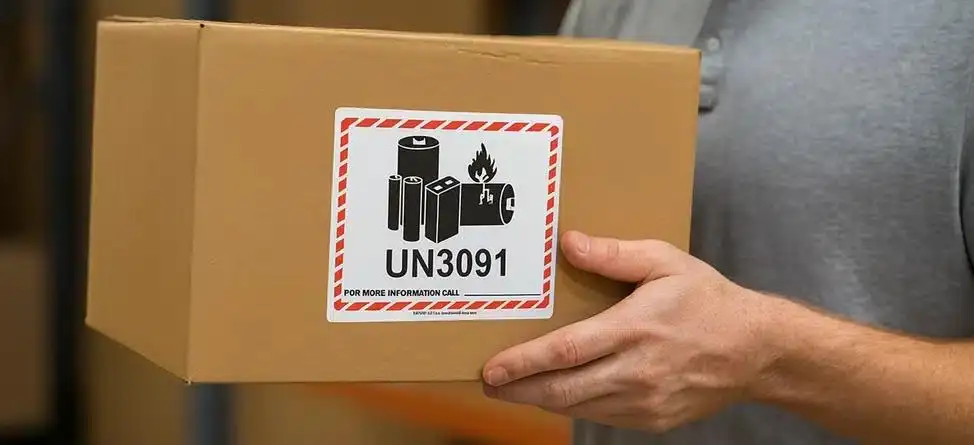
| Lithium metal battery packed with / contained in equipment | UN3091 | Lithium metal batteries packed with or contained in equipment | Fire / short circuit | ≤1 g lithium per cell, ≤2 g lithium per battery | Classification depends on whether installed or packed separately |
| Wet lead-acid battery | UN2794 | Batteries, wet, filled with acid, electric storage | Corrosive acid leakage | No Wh threshold as the main limit; acid/corrosion classification applies | Common in traditional UPS systems; generally Class 8 corrosive |
| Wet non-spillable lead-acid battery | UN2800 | Batteries, wet, non-spillable, electric storage | Leakage / corrosion if damaged | No Wh threshold as the main limit; must meet non-spillable conditions | Often used for sealed lead-acid UPS replacement batteries |
| Nickel-metal hydride battery | UN3496 | Batteries, nickel-metal hydride | Heat / short circuit in bulk | Wh is not usually the core lithium-style limit | Often less restricted than lithium, but large shipments still need correct packaging and documentation |
Lead-Acid Batteries in UPS Battery Shipping
Lead-acid batteries remain common in UPS backup systems, especially for offices, telecom rooms, data centers, and industrial power protection. They are usually divided into:
Wet Lead-Acid Batteries: UN2794
These batteries contain liquid acid. The major transport hazard is corrosion, not lithium fire risk. They may require:
•Acid-resistant packaging
•Upright positioning
•Protection against short circuits
•Class 8 corrosive labels
•Dangerous goods declaration for regulated shipments
Non-Spillable Lead-Acid Batteries: UN2800
Sealed lead-acid or valve-regulated lead-acid batteries may qualify as non-spillable when they meet test and packaging conditions. Even then, they are not “ordinary goods.” The shipper must still confirm terminal protection, leakage resistance, and carrier acceptance.
Lithium-Ion UPS Batteries: UN3480 and UN3481
Lithium-ion UPS battery systems are growing because they offer lighter weight, higher energy density, longer cycle life, and lower maintenance than many traditional lead-acid systems. However, lithium batteries bring stricter transport rules.
The key question is: How is the battery shipped?
•Battery alone: UN3480
•Battery packed with UPS equipment: UN3481
•Batteries installed inside the UPS unit: UN3481
This difference changes packaging, labeling, paperwork, and carrier acceptance. For air transport, lithium-ion batteries shipped alone under UN3480 face stricter controls than batteries contained in equipment. UPS carrier guidance also states that lithium-ion or lithium metal batteries shipped alone by air are accepted only as fully regulated dangerous goods.
Lithium Metal Batteries: UN3090 and UN3091
Lithium metal batteries are less common in larger UPS power systems, but they may appear in control modules, backup memory systems, or specialty equipment. Unlike lithium-ion batteries, lithium metal classification often depends on lithium content, not Wh.
Typical small-battery reference points include:
•≤1 g lithium per cell
•≤2 g lithium per battery
Above these levels, transport requirements become more demanding. Shippers must also separate lithium metal batteries shipped alone from those packed with or contained in equipment.
Nickel-Metal Hydride Batteries: UN3496
Nickel-metal hydride batteries are not usually the first choice for modern UPS systems, but they may appear in certain backup devices. Compared with lithium batteries, NiMH batteries usually have lower fire-risk attention, but bulk shipments still need short-circuit protection, strong packaging, and correct classification.
The risk is often linked to:
•High quantity in one carton
•Poor insulation
•Heat buildup
•Mixed battery types in one shipment
Why a Phone Battery and an Industrial UPS Battery Follow Different Processes
A consumer may ship one small replacement phone battery, while a factory may export a pallet of UPS battery modules. Both are batteries, but the logistics process is not the same.
A small consumer shipment may involve:
•One or two cells
•Lower Wh rating
•Small package weight
•Simpler lithium battery mark
•Carrier retail restrictions
An industrial UPS Battery Shipping project may involve:
•High-capacity battery modules
•Multiple cartons or pallets
•Dangerous goods declaration
•MSDS / SDS
•UN38.3 test summary for lithium batteries
•Class labels and cargo aircraft restrictions
•Factory packing records
•Customs review
•Trained dangerous goods shipper involvement
The difference is not only size. It is also energy concentration, shipment quantity, risk exposure, and legal responsibility.
Practical Checklist Before Shipping Batteries with UPS
•Please check the items below before you arrange UPS Battery Shipping.
•Type of battery chemistry: lead-acid, lithium ion, lithium metal, NiMH
•UN number: UN3480, UN3481, UN3090, UN3091, UN2794, UN2800, UN3496
•Form of battery: by itself, packed with other devices, or within other equipment
•Wh rating or lithium content
•Condition of battery: new, used, damaged, defective, recalled, or for recycling
•Mode of transport: air, sea, road, or multimodal
•Documents: SDS, test summary, invoice, packing list, DG declaration
•Battery protection for transport: terminal protection, cushioning, inner separation, strength of outer carton
•Marking: lithium battery mark, Class 8 label and Cargo Aircraft Only label, when applicable
Final Thoughts: Know Your Class, Ship with Confidence
The answer to “Which category do you belong to?” is not for formalities. It plays an important role in safety and compliance. For the majority of companies, UPS Battery Shipping means lithium-ion (UN3480) and non-spillable lead-acid (UN2800) batteries. It is highly recommended that you dedicate 15 minutes of your time to the UPS Dangerous Goods Guide and measure your batteries to avoid returned shipments and penalties.
If you have questions, the Fexbuy team is here to help. You can’t do battery logistics without great classification.
FAQ: Shipping Batteries with UPS
Q1: Can I ship one lithium-ion battery with UPS by air?
A: Yes, but only if it is in compliance with UN3480/UN3481, Wh requirements, and the packaging and other requirements of the shipping line. Small batteries intended for personal use have a much simpler law, but fully regulate industrial modules.
Q2: What distinguishes UN3480 from UN3481?
A: Where UN3480 concerns lithium-ion batteries shipped by themselves, UN3481 covers lithium-ion batteries which are packed with or contained in equipment. UN3480 and UN3481 present different documentation and packaging requirements.
Q3: Are lead-acid batteries used in UPS systems classified as dangerous goods?
A: Yes. Wet lead-acid batteries are classified as UN2794 (when filled with acid) and UN2800 (when non-spillable). Their potential for corrosion and leakage necessitates special packaging and labeling.
Q4: Can you ship different battery types with UPS?
A: No. Lithium Ion, Lithium Metal, Lead Acid, and NiMH batteries are assigned different UN codes. Therefore they have different shipping regulations and packaging. Since they would all be shipped together, it would mean that the regulations would be violated.
Q5: Is there a punishment for misclassifying UPS batteries?
A: There are many negative consequences such as fines, shipping bans, and even confiscation of the shipment. Unquestionably the correct packaging for the given transport is used must be verified by the UN number.


