


2026 Latest Regulations for Backup Power Supply Shipping: IMO, IATA & ADR Updates Explained
Three major regulatory frameworks: IMO (sea), IATA (air), and ADR (road) will fundamentally change Backup Power Supply Shipping from January 1, 2026. These changes will disrupt the transport of Lithium-Ion and Sodium-Ion Batteries across all transport modes. UPS Systems, home battery backups and industrial battery backup systems will require the transporters to understand and comply with the new requirements to ensure safety and avoid financial loss. In this article, we will take a look at the changes to the IMO IMDG Code, IATA DGR & BSR, and ADR as they apply in 2026.
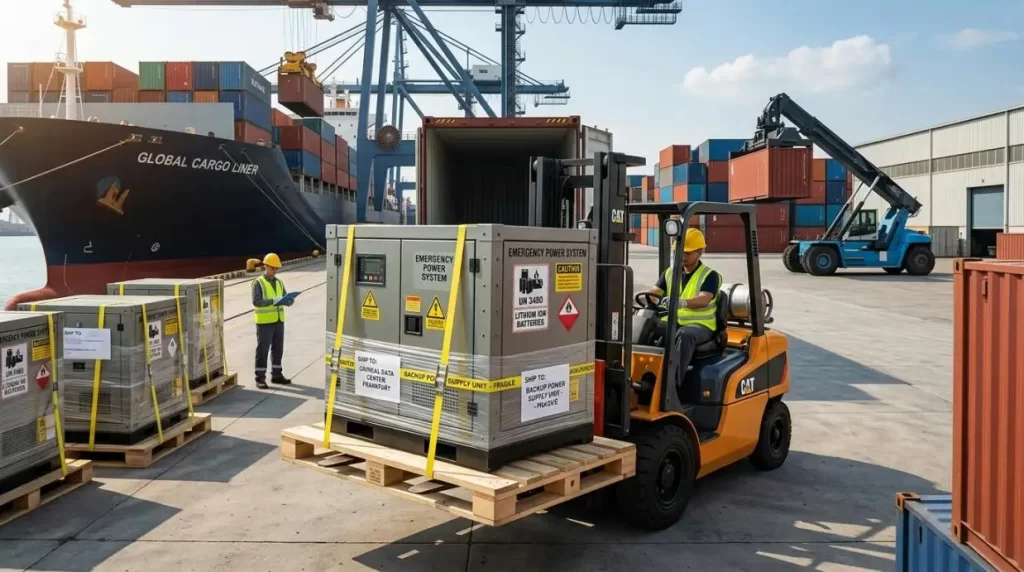
2026 Will Change Backup Power Supply Systems Shipping
The international trade of Backup Power Supply systems has reached new heights. The international air transport of Lithium Batteries alone has an average increase of 25% (IATA) on an annual basis. Coupled with the increased incidents of overheating, the transport of Backup Power Supply systems has never been more challenging, with stringent requirements on classification, packaging, and controls.
The upcoming changes in 2026 will impact how goods are transported across three main transport modes. These are as follows:
•Sea (IMO IMDG Code Amendment 42-24) – January 1, 2026
•Air (IATA DGR 67th Edition and BSR 13th Edition) – January 1, 2026
•Road (ADR 2026) – January 1, 2026
Let’s discuss these in more detail.
Sea Freight Backup Power Supply – Changes to IMO IMDG Code 42-24
The International Maritime Organization (IMO) has published Amendment 42-24 to the International Maritime Dangerous Goods (IMDG) Code. Compliance for all countries will be as of January 1, 2026, while countries will be permitted to apply the amendment voluntarily starting January 2025. Compliance will be monitored and enforced by Port Authorities. Noncompliance will result in delays and/or rejection of the cargo. The AD Ports Group and other port authorities are enforcing these amendments.
New UN Numbers for Sodium-Ion Batteries
Sodium-ion batteries have been formally incorporated into Class 9 Dangerous Goods. The new entries include:
•UN 3551 — Sodium-ion batteries (with organic electrolyte)
•UN 3552 — Sodium-ion batteries contained in or packed with equipment
For Backup Power Supply Shipping, this means manufacturers using sodium-ion chemistry must now assign these new UN numbers, update all shipping documentation, and ensure packaging meets the newly specified requirements.
Battery-Powered Vehicle Classification—No More “One Size Fits All“
One of the most significant changes affects how battery-powered equipment and vehicles are classified. Many battery-powered vehicles were categorized under the specific UN 3171 entry prior to the new IMDG 41-22 Amendment. This changes beginning January 2026:
•UN 3171 is now restricted to vehicles containing wet batteries, sodium metal, and sodium alloy batteries.
•Lithium-ion battery vehicles will now require UN 3556.
•Lithium-metal battery vehicles will require UN 3557.
•Sodium-ion battery vehicles will require UN 3558.
For those companies that involve Backup Power Supply Shipping, any backup systems that are either mounted on a vehicle chassis or built within mobile equipment now must be classified differently. There have already been issues with customs and fines in major ports due to customers not complying with the UN numbers, especially with this specific topic.

Packaging & Stowage: Stricter Rules for Large Battery Systems
Amendment 42-24 also tightens packaging and stowage requirements:
New packaging instruction P912 has been introduced for UN 3556, UN 3557, and UN 3558, specifying mandatory lashing, battery insulation, and fire prevention labeling.
UN 3536 (Lithium batteries installed in cargo transport units) is now assigned to Stowage Category D, meaning on-deck only—and prohibited on passenger ships carrying more than 25 passengers.
For large battery packs transported under packing instruction LP903, multiple large batteries may now be loaded in bulk packaging, provided they meet the newly clarified vibration resistance standards.
Also, all documentation for the shipping of Backup Power Supplies must reference the correct IMDG 42-24 classification. Section 14 of the Safety Data Sheet must be updated, and the transport certificate must be updated to the 2026 edition.
IATA DGR & BSR 2026: Air Freight Gets Stronger Controls
The International Air Transport Association has released the 67th Edition of the Dangerous Goods Regulations (DGR) and the 13th Edition of the Battery Shipping Regulations (BSR) , both effective January 1, 2026. Nearly 100 revisions have been introduced, with battery-related updates taking center stage.
�� State of Charge (SoC) Limits—Now Mandatory
One of the most critical changes for Backup Power Supply Shipping by air is the mandatory State of Charge limit:
•For lithium-ion batteries packed with equipment: Stricter charge limits now apply.
•For lithium-ion battery cells and packs exceeding 2.7 Wh: Transport is permitted only with a State of Charge not exceeding 30% of rated capacity, or an indicated charge not exceeding 25%.
•For vehicles powered by lithium or sodium batteries: The batteries must be shipped with an SoC not exceeding 30% of rated capacity.
These limits are designed to reduce the risk of thermal runaway during air transit and represent a significant operational adjustment for suppliers of Backup Power Supply Shipping solutions. Pre-shipment SoC verification must now be documented and auditable.
�� Sodium-Ion Batteries Formally Included
IATA has updated the lithium battery marking rules to explicitly include sodium-ion batteries. The battery marking must now show the correct UN number:
•UN 3090 — Lithium metal batteries
•UN 3480 — Lithium-ion batteries
•UN 3551 — Sodium-ion batteries
A transition period continues in effect until December 31, 2026 to allow continued use of DGR 63rd Edition lithium battery marks. Shippers are advised to adopt the 2026 specifications early to reduce confusion.
�� New Shipper Compliance Checklist
A new compliance checklist has been included as part of the 2026 BSR for battery shipments. Shippers wishing to transport batteries by air must now control the limits of the charge state, the integrity of the package, the marking, and supporting documentation by way of a standardized checklist. This is being added to help focus on the safety concern of the declaration of the shipment being improper, which has been highlighted in several incidents of overheating power banks on flights.
�� New Exception for Tracking Devices
The 2026 DGR introduces a new exception for data loggers and cargo tracking devices that contain lithium batteries (with a maximum capacity of 20 Wh), that are used during transport and are attached to the shipping unit. This offers new options to logistics providers who need real-time monitoring of Backup Power Supply Shipping consignments.
ADR 2026: Road Transport Compliance Tightens Across Europe
Changes that have been enacted for 2026 in the European Agreement concerning the International Carriage of Dangerous Goods by Road (ADR) are being introduced on European roads. The requirements for the transport of batteries by road will harmonize around the UN Model Regulations, however the enforcement of compliance will differ.
�� Harmonized Inspections—Single European Checklist
European authorities use a common inspection checklist for checking the shipments of dangerous goods at roadside inspections. Inspectors check the vehicle, transport documents, driver, and harmful goods (which could be dangerous). The standardization of the process implies that the consequences of non-compliance detected anywhere in Europe apply uniformly.
�� Infraction Risk Level
Risk Level of an infraction is now categorized into a three-tier system.
•Category I (High risk) — Immediate immobilization of the vehicle
•Category II (Medium risk) — Must be rectified prior to further transit
•Category III (Low risk) — Must be rectified at a later date
For Backup Power Supply Shipping by road, battery misclassification (e.g. incorrect UN number) or absence of required labeling can lead to instant high risk categorization, which results in on-the-spot fines and seizure of the vehicle.
�� Common Responsibility in the Supply Chain
Per ADR 2026, the responsibility of compliance is no longer on the carrier alone. The Shipper, Packager, Filler, Loader, Carrier, and Consignee all assume responsibility. If a backup Power System is misclassified or improperly packaged before it is loaded onto the truck, then the Shipper is potentially liable for a roadside inspection.
�� Damaged/Defective Batteries—New Rules
For used, damaged, or defective batteries in Backup Power Supply Shipping, the ADR enforces the use of fire retardant packaging, containment and improved documentation. Critically defective lithium-ion batteries fall within Transport Category 0 and legally are the most severe case. Companies that are involved in the reverse logistics of backup power systems are further obligated to these requirements.
Final Thoughts
Backup Power Supply Shipping gets safer and more transparent due to the IMO, IATA, and ADR updates in 2026. With these updates, the classification of Sodium-ion batteries, refinement of UN numbers, and charge limits become more stringent. It is advisable to get compliant with 2026 rules and regulations. Non-compliance will cost more compared to the inconvenience of compliance.
CTA
The complexity of battery regulations in 2026 will challenge many. Fexbuy enables end-to-end compliant logistics, including but not limited to UN38.3, MSDS, DG classification and UN certified packaging, air/sea freight (UN3480/3481), global customs, DG warehousing, FBA prep, and real time tracking.
Fexbuy Backup Power Supply Shipping is a reliable and safe global service. Our well-informed and resourceful team assures the best quality service. (Contact Fexbuy now)
FAQ
Q1: What is involved first in Backup Power Supply Shipping?
First, the battery chemistry and shipping status must be determined. Shippers must identify the type of battery, whether it is a lithium-ion, sodium-ion, lithium metal, lead-acid, etc., and also whether the battery is shipped by itself, or is it packed with an apparatus or is it installed in an apparatus.
Q2:Are sodium-ion batteries regulated in international transport?
Yes. With the IMDG Code Amendment 42-24, sodium-ion batteries now have more specifically defined transport entries, UN3551 and UN3552, which is important to both sea freight and the backup power products employing sodium-ion technology.
Q3:Can lithium-ion backup power supplies be shipped by air at 50% charge?
As a general rule, shippers still should not assume a 50% state-of-charge allowance with many lithium-ion battery air shipments, especially when the shipment involves batteries packed with apparatus, and the more prudent standard for compliance is still 30% state of charge, unless a specific approval is granted otherwise.
Q4: Which UN number applies to backup power supplies?
It fully depends on the type of battery and how the battery is packaged. For example, Lithium-ion batteries packaged Naked may fall under UN3480, while Lithium-ion batteries packaged in outer packing may be classified as UN3481. On the other hand, Sodium-ion batteries packaged in similar fashion may fall under the UN3551 or UN3552. As for lead acid batteries, they and other types of batteries may fall under totally different UN numbers.
Q5: Is sea freight better for large backup power supply shipments?Usually, yes. An example of this is that large backup power suppliers may be subjected to more rigorous airline acceptance criteria and controls with regard to the state of charge (SoC). Sea freight is usually more feasible for heavy or high-capacity battery products; however, the IMDG still applies.


