


Lithium Battery Shipping From China to Germany
Fexbuy helps importers, Amazon sellers, eCommerce brands, manufacturers, and sourcing teams move lithium battery cargo from Shenzhen and other China origins to Germany with DG-compliant handling, DDP/DDU/FOB/CIF options, and door-to-door delivery support.
What We Ship to Germany
We handle lithium battery cargo that standard forwarders often reject or delay because of missing DG paperwork, wrong labels, unclear battery type, or carrier acceptance limits.
Common Germany-bound cargo includes:
- Standalone lithium-ion batteries and battery packs
- Batteries packed with equipment
- Batteries contained in equipment
- Lithium metal batteries
- Power banks and portable energy products
- E-bike, scooter, and mobility battery packs
- Industrial battery modules and ESS components
- Consumer electronics with built-in batteries
- Medical devices with lithium batteries
- Tools, lighting products, smart devices, and IoT hardware
- Forklift, warehouse, and industrial battery systems where suitable for the lane
For broader DG service coverage, see our main lithium battery shipping page.
China to Germany as an EU Battery Logistics Gateway
Germany is not just one destination. For many buyers, it is the entry point into the wider EU market. That makes customs accuracy more important than a basic freight booking.
A shipment may need German or EU customs clearance, correct HS/TARIC classification, importer details, commercial invoice review, import VAT handling, and delivery planning after clearance. For eCommerce shipments, IOSS may be relevant for eligible low-value B2C orders, while larger commercial shipments usually require normal import VAT and customs procedures.
For DDP shipments, the goal is to make the process easier for the buyer: pickup in China, export handling, freight movement, import clearance coordination, taxes/duties arrangement where applicable, and final delivery to a German address. This can include delivery to Amazon FBA, 3PL warehouses, retail distribution centers, factories, repair centers, or business addresses.
After arrival in Europe, lithium battery cargo may also require ADR-aware road handling for inland transport. This is especially important for Class 9 dangerous goods, larger battery packs, and palletized shipments moving from port, airport, rail terminal, or bonded warehouse to the final consignee.
UN Classification and DG Compliance
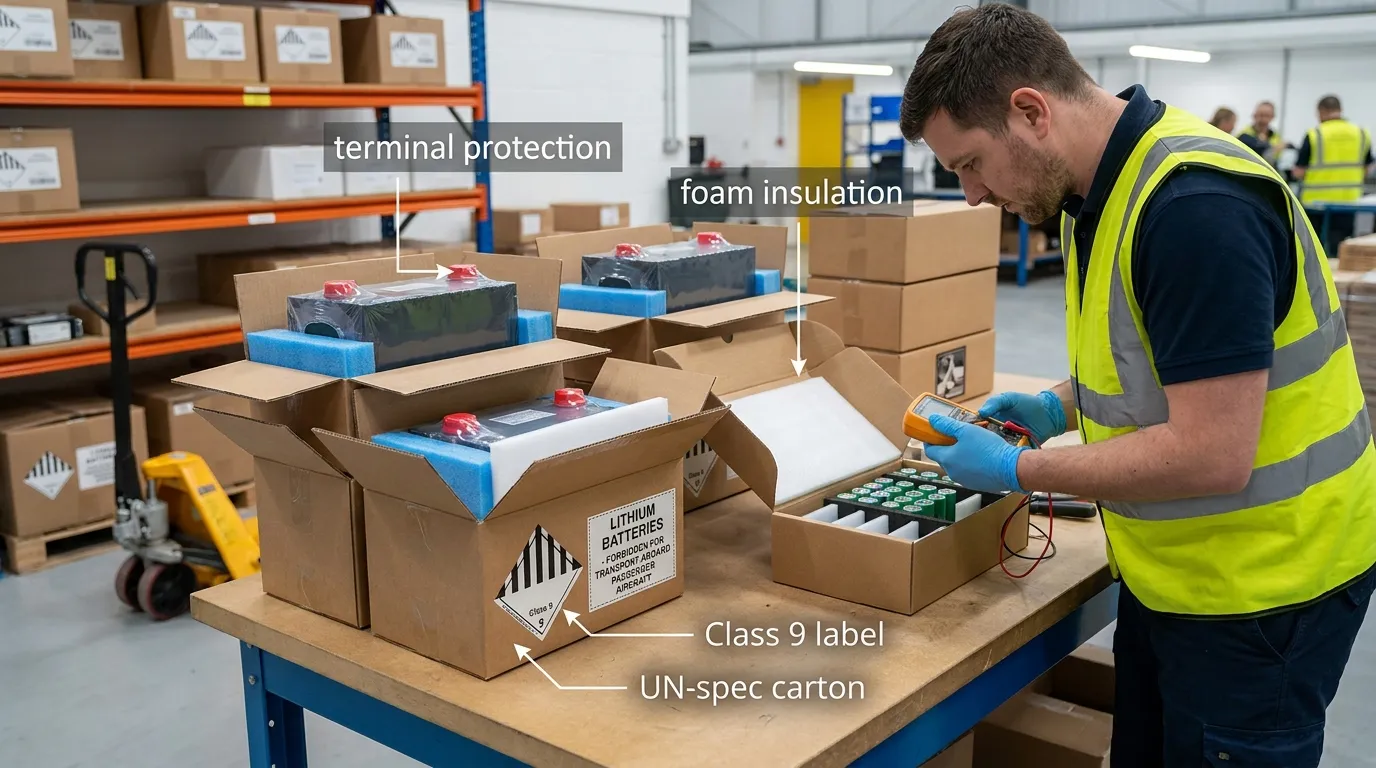
Lithium batteries must be classified before quoting, packing, or booking. The UN number decides the carrier rules, packing method, labels, documents, and whether the cargo can move by air, sea, rail, or road.
| UN number | Cargo type | Common examples | Key handling point |
|---|---|---|---|
| UN3480 | Lithium-ion batteries | Standalone Li-ion battery packs, power bank cells | Strict DG control; air cargo has state-of-charge limits |
| UN3481 | Lithium-ion batteries packed with or contained in equipment | Electronics, tools, devices with Li-ion batteries | Must confirm whether packed with equipment or installed |
| UN3090 | Lithium metal batteries | Standalone lithium metal cells/batteries | Different limits from Li-ion; documentation must match chemistry |
| UN3091 | Lithium metal batteries packed with or contained in equipment | Devices using lithium metal batteries | Packaging and declaration depend on configuration |
| UN3171 | Battery-powered vehicle/equipment | E-bikes, scooters, mobility products where applicable | Product form and transport mode must be checked carefully |
| UN3536 | Lithium batteries installed in cargo transport units | Certain large battery energy storage cargo | Used only when the shipment truly fits this classification |
For air freight, standalone lithium-ion batteries are typically subject to cargo-aircraft-only restrictions and state-of-charge controls. Many shipments require the battery to be prepared at no more than 30% state of charge, depending on the packing instruction and shipment type.
For all modes, the cargo must be protected against short circuit, movement, crushing, accidental activation, and heat exposure. Correct inner packaging, insulation, outer cartons, palletization, lithium battery marks, Class 9 labels, cargo aircraft only labels where required, and dangerous goods declarations reduce rejection risk.
Our team works under UN38.3, IATA, and IMDG compliant procedures and checks the shipment before booking so problems are found before the cargo reaches the carrier.
Shipping Modes and Transit Options From China to Germany
The best mode depends on battery type, UN number, weight, volume, urgency, customs setup, and final delivery address. Exact transit time is confirmed at the quote stage because DG acceptance, route availability, customs inspection, and final-mile delivery can change by shipment.
| Mode | Best for | Typical use | DG battery suitability | Transit note |
|---|---|---|---|---|
| Air freight | Urgent, higher-value cargo | Samples, small batches, time-sensitive orders | Strong compliance control; stricter airline acceptance | Fastest option when documents and carrier approval are ready |
| Sea freight | Bulk batteries, pallets, lower urgency | Larger commercial shipments, B2B inventory | Often suitable for DG cargo with proper IMDG handling | Cost-effective for volume, slower than air |
| Rail freight | China-Europe pallet cargo | Mid-speed shipments to EU inland points | Depends on product type, route, and operator acceptance | Useful balance between speed and cost |
| Truck route | Regional or multimodal EU delivery | Final delivery after EU entry or selected China-Europe routes | ADR rules matter for inland movement | Often used as part of door-to-door delivery |
| DDP line | Sellers wanting managed delivery | Amazon, 3PL, warehouse, eCommerce stock | Must be checked by UN number and product type | Simplifies customs and delivery responsibility for the buyer |
Our 5-Step Shipping Process
1. Pickup From Supplier or Factory
We collect cargo from Shenzhen, Dongguan, Guangzhou, Shanghai, Ningbo, Yiwu, Xiamen, or other China origins. Before pickup, we review battery type, cargo photos, carton marks, gross weight, dimensions, invoice value, destination address, and required Incoterm.
2. DG Packing and Labeling Check
The cargo is checked for battery classification, short-circuit protection, inner packaging, carton strength, pallet condition, lithium battery mark, Class 9 label, orientation marks if needed, and cargo-aircraft-only label when required. If the shipment is not ready for DG acceptance, we advise what must be corrected before handoff.
3. Export and Import Customs Preparation
We review invoice, packing list, HS code, battery description, UN number, consignee details, and Germany/EU import requirements. For DDP and DDU shipments, the customs plan must match the buyer’s importer setup, VAT arrangement, and final delivery address.
4. Freight Booking and Movement
The shipment is matched with a suitable air, sea, rail, truck, or multimodal route. DG battery cargo is not booked like general cargo; carrier acceptance must match the UN number, packaging level, documents, and declared product.
5. Germany Delivery and EU Distribution
After arrival and clearance, the cargo moves to the final German address or onward EU delivery point. This may include warehouse delivery, Amazon FBA delivery, distributor delivery, factory delivery, or door-to-door shipment under DDP/DDU terms.
Documents Required for Germany Battery Shipments
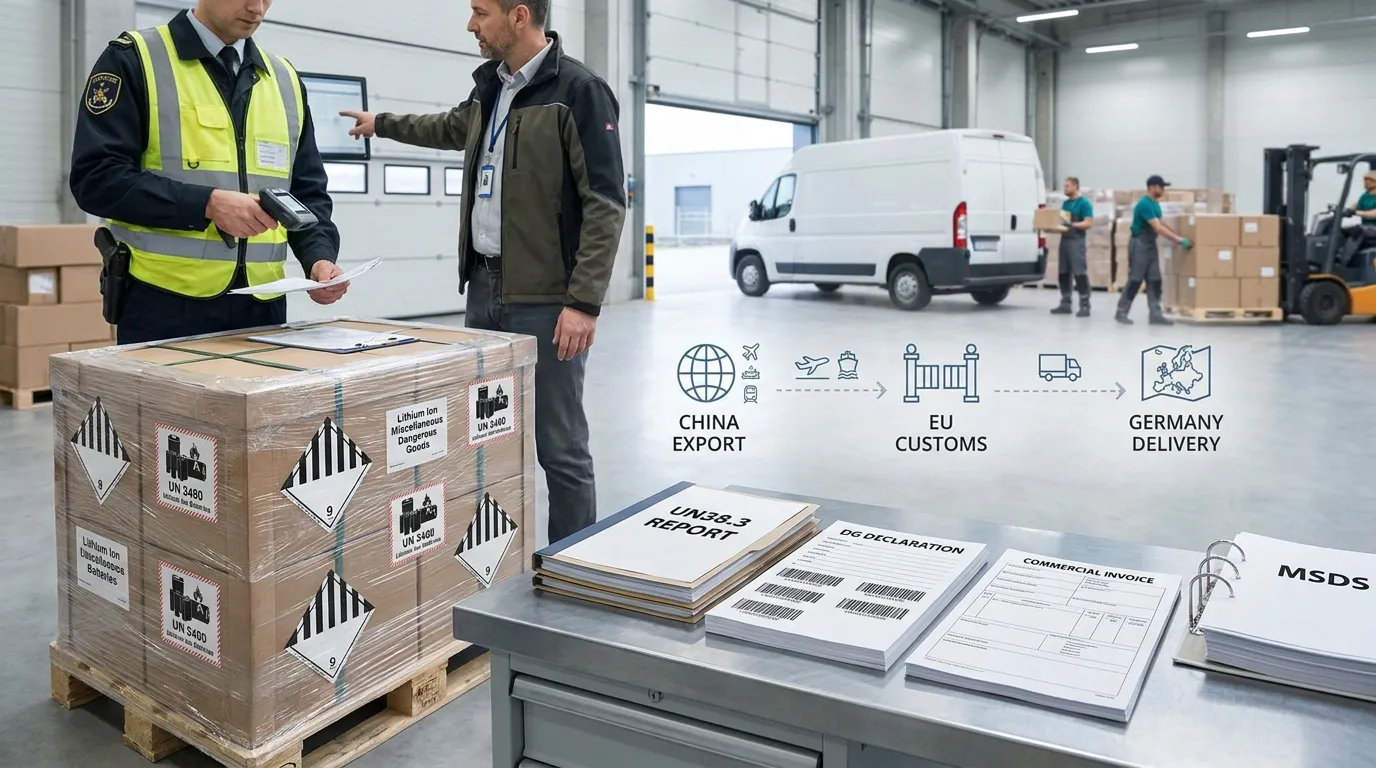
Correct documents reduce customs questions, carrier rejection, and inspection delays. The required set depends on product type and mode, but most shipments need:
| Document | Why it matters |
|---|---|
| UN38.3 test summary/report | Shows the battery has passed required transport safety tests |
| MSDS/SDS | Provides battery chemistry, hazard, handling, and emergency details |
| Dangerous Goods Declaration | Required for many regulated DG shipments |
| Commercial invoice | Used for customs value, buyer/seller details, and product description |
| Packing list | Shows carton count, weight, dimensions, and packing method |
| Battery specification sheet | Confirms Wh rating, voltage, capacity, chemistry, and model |
| Product photos and label photos | Helps check marks, labels, packaging, and cargo condition |
| HS/TARIC code details | Supports German/EU customs classification |
| EORI, VAT, or IOSS information | Needed depending on importer type and shipment model |
A common mistake is describing the product as “electronic accessories” while the cargo includes standalone battery packs. That mismatch can trigger carrier rejection or customs delay. The declared product name, UN number, documents, labels, and packaging must all match.
DDP, DDU, FOB and CIF Options
Different buyers need different shipping terms.
| Term | Best for | Buyer responsibility |
|---|---|---|
| DDP | Amazon sellers, eCommerce brands, buyers without a German customs setup | Lowest operational burden; customs/tax handling is arranged within the service scope |
| DDU | Buyers with their own importer, broker, or VAT setup in Germany | Buyer handles import duties/taxes and local clearance responsibility |
| FOB | Buyers who want their forwarder to take over after China port/airport handoff | Supplier handles local export-side delivery to agreed point |
| CIF | Buyers who want cost, insurance, and freight to port/airport | Buyer still needs destination clearance and delivery planning |
For Germany, DDP is often preferred by sellers who want one managed route from China supplier to German warehouse, Amazon FBA, or 3PL. DDU is better when the buyer already has a German company, EORI, VAT setup, and customs broker.
Why Choose Fexbuy for China-to-Germany Battery Freight?
Fexbuy is a Shenzhen-based dangerous-goods freight forwarder with 21 years of logistics experience, 98% on-time performance, low inspection rate, and battery transport procedures aligned with UN38.3, IATA, and IMDG requirements.
Buyers choose us because we understand both sides of the lane: China export handling and Germany/EU import clearance. We help check the battery type, UN number, documents, labels, packing, mode choice, Incoterm, and final delivery plan before the shipment moves.
You also get one team for DG review, freight planning, customs coordination, and door-to-door delivery instead of separating the job between a factory, general forwarder, customs broker, and last-mile provider.
For other destination lanes, we also support lithium battery shipping from China to Canada and lithium battery shipping from China to Australia.
FAQ
Can lithium batteries be shipped from China to Germany?
Yes, lithium batteries can be shipped when the cargo is correctly classified, packed, labeled, documented, and accepted by the selected carrier. The route depends on the UN number, battery type, shipment size, mode, and Germany/EU customs requirements.
What documents are required for lithium battery shipping from China to Germany?
Most shipments need UN38.3, MSDS/SDS, commercial invoice, packing list, battery specification sheet, product photos, label photos, and the correct DG declaration when required. DDP/DDU shipments may also need importer, VAT, EORI, or IOSS-related information depending on the shipment model.
Can standalone UN3480 lithium-ion batteries move by air?
They may move by air only when accepted under the correct IATA rules, cargo-aircraft-only conditions, state-of-charge requirements, packing instruction, and airline approval. Many general express channels reject standalone batteries, so DG freight review is required before booking.
Is DDP available for battery shipments to Germany?
Yes, DDP may be available depending on the cargo type, UN number, shipment size, customs profile, and final delivery address. It is commonly used by sellers who want a managed China-to-Germany service that includes freight, customs coordination, and final delivery.
What causes customs delays or carrier rejection?
Common causes include missing UN38.3, incorrect MSDS, wrong UN number, vague invoice description, undeclared batteries, poor carton labels, damaged packaging, incorrect Wh rating, battery terminals not protected, or mismatch between documents and actual cargo.
Which mode should I choose: air, sea, rail, or truck?
Choose air for urgent and higher-value shipments, sea for larger bulk cargo, rail for a speed-cost balance, and truck or multimodal delivery for specific EU routing needs. The safest choice depends on battery classification, weight, volume, deadline, and carrier acceptance.
Get a Free Quote for Germany Battery Shipping
Send your shipment details and our DG team will check the route, documents, packaging requirements, customs approach, and available service options.
For a faster quote, prepare:
- Origin city in China
- Destination city and postcode in Germany
- Product name and battery type
- UN number if known
- Battery Wh rating, voltage, and capacity
- Quantity, carton count, gross weight, and dimensions
- MSDS/SDS and UN38.3 files
- Commercial invoice value
- Preferred term: DDP, DDU, FOB, or CIF
- Delivery address type: Amazon FBA, warehouse, factory, 3PL, or business address
Get a free quote from Fexbuy or send your specs and Germany destination by WhatsApp for a DG shipping review.


