


IOSS vs DDP Shipping: Which VAT and Delivery Model Works for EU Ecommerce Orders?
IOSS vs DDP shipping comes down to scope. IOSS is usually better for EU B2C ecommerce orders under €150 because VAT is collected at checkout and reported through one scheme. DDP is better when the seller wants to cover VAT, duties, customs clearance, and delivery charges for a full landed-cost customer experience.
EU buyers don’t want surprise tax messages after checkout. Sellers don’t want parcels held because the wrong tax model or customs data was used. The hard part is that IOSS and DDP sound similar, but they solve different problems. One is mainly a VAT reporting route. The other is a delivery term where the seller takes more cost and customs responsibility.
IOSS vs DDP shipping: what is the real difference?
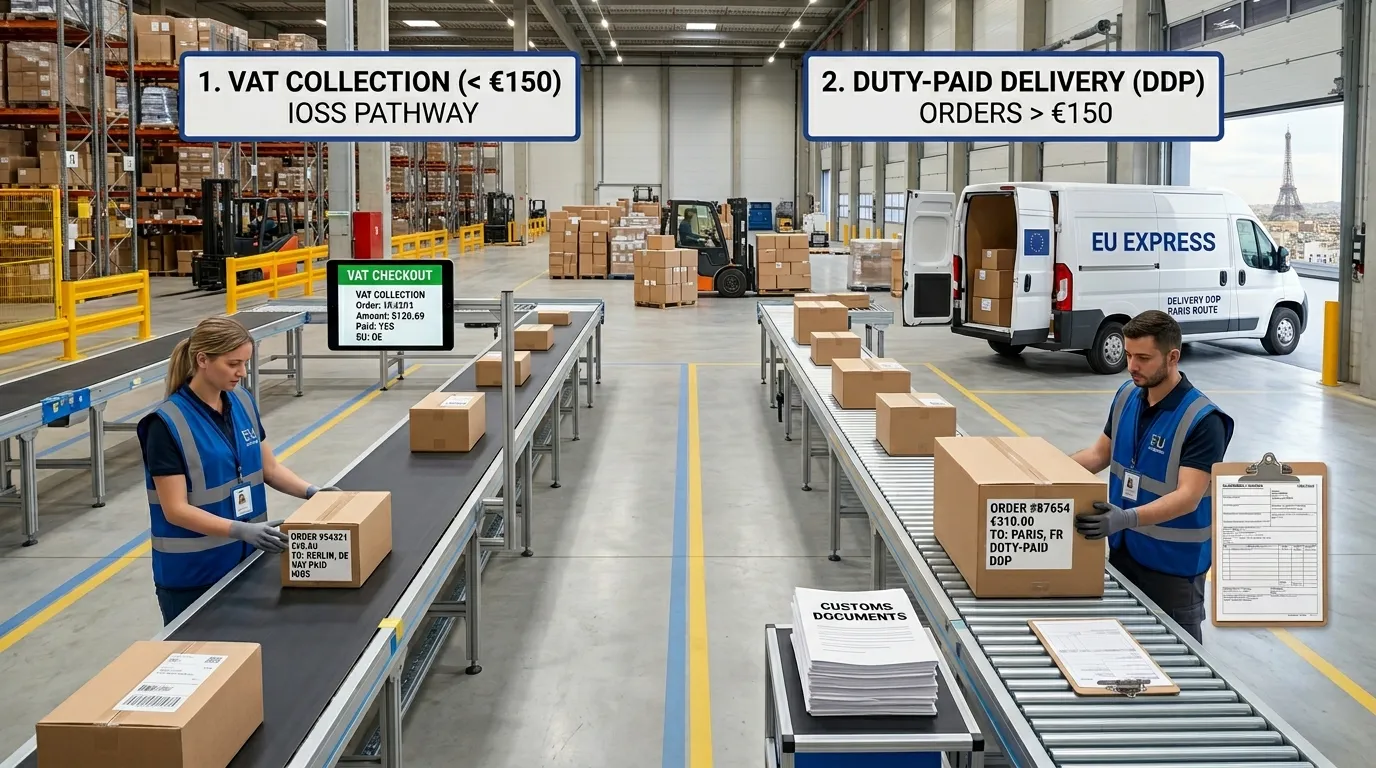
IOSS is best for eligible EU B2C orders up to €150 because VAT is collected at checkout and reported through IOSS. DDP is broader because the seller takes responsibility for duties, taxes, customs clearance, and delivery charges.
The European Commission’s IOSS guidance explains IOSS as a way to simplify VAT declaration and payment for low-value goods imported into the EU. It is mainly about import VAT. It does not turn every parcel into a fully prepaid landed-cost shipment.
DDP, or Delivered Duty Paid, is different. Under Incoterms, delivery terms define who handles payment, shipping, insurance, customs clearance, documentation, and other shipment responsibilities. Trade.gov lists DDP as Delivered Duty Paid, which means the seller takes a much wider delivery responsibility.
| Area | IOSS | DDP |
|---|---|---|
| Main purpose | Import VAT collection for eligible EU B2C orders | Full seller-managed landed delivery |
| Value limit | Up to €150 intrinsic value | No IOSS-style €150 limit |
| Buyer pays VAT at delivery? | Usually no, if data is correct | No, if DDP is set up correctly |
| Duties covered? | No, not as a full landed-cost model | Yes, if included in the DDP setup |
| Best fit | Low-value B2C ecommerce parcels | Premium, high-value, B2B, or full-cost delivery |
A simple way to remember it: IOSS is a VAT tool, not a cheaper version of DDP. DDP is a wider shipping promise. It works well when the seller can calculate tax, duty, customs, and delivery cost correctly before the order ships.
When should an ecommerce seller use IOSS?
Use IOSS when you sell B2C goods from outside the EU to EU consumers and the consignment value is not over €150. It helps VAT get paid at checkout instead of being collected from the customer at delivery.
IOSS fits low-value ecommerce orders where the buyer is an EU consumer and the goods are outside the EU when sold. Ireland Revenue explains that IOSS applies to consignments not exceeding €150 and does not apply to excise goods.
For example, a Shopify seller ships a €42 skincare accessory from China to France. If it is a B2C sale, the item is not excise goods, and the parcel value stays under €150, IOSS can work. The seller charges VAT at checkout and sends the IOSS number in the customs data.
IOSS eligibility checklist
Before choosing IOSS, check these points:
- The goods are outside the EU when sold.
- The buyer is an EU consumer.
- The consignment intrinsic value is not over €150.
- The goods are not excise goods.
- VAT is charged at checkout.
- The IOSS number can be transmitted correctly to the carrier.
If one of these checks fails, don’t force IOSS. A wrong IOSS setup can create the same problem it was meant to avoid: the customer may be asked to pay VAT again before delivery.
When is DDP the better option?
DDP is better when the seller wants full control of the landed delivery experience or when the order does not qualify for IOSS. It is safer for premium orders, B2B shipments, and above-threshold ecommerce shipments.
DDP works best when the seller wants to protect the buyer from delivery-stage charges. It is also useful when the shipment sits outside IOSS scope, such as high-value orders, B2B shipments, or products that need a more controlled customs process.
A €280 electronics order from China to Germany is a good example. IOSS cannot apply because the order is above €150. If the seller wants the customer to receive the parcel without paying import charges at delivery, DDP is the better route.
| Seller situation | Better model | Why |
|---|---|---|
| €42 B2C order to France | IOSS | Low-value consumer order under €150 |
| €280 gadget to Germany | DDP | IOSS does not apply above €150 |
| B2B parts order | DDP or another customs route | IOSS is for B2C sales |
| Premium DTC brand | DDP | Cleaner customer experience |
| Low-cost parcel with clear VAT setup | IOSS | Lower operational burden than full DDP |
DDP is not always the premium answer. It works when the seller has accurate duty calculation, importer support, and a carrier or broker process. Without that, DDP can create customs holds instead of preventing them.
Does IOSS cover duties, or only VAT?
IOSS covers import VAT, not the full landed cost of a shipment. DDP can cover VAT, customs duty, clearance, and carrier charges, which is why sellers should not treat IOSS as a complete replacement for DDP.
This is where many sellers make the wrong call. IOSS helps with import VAT collection and reporting, but it does not mean customs duties, broker charges, and all delivery fees are automatically solved. DDP can include those costs when the seller sets it up correctly.
| Cost or responsibility | IOSS | DDP |
|---|---|---|
| Import VAT | Yes, for eligible orders | Can be seller-paid |
| Customs duty | No | Can be seller-paid |
| Carrier handling fee | Not automatically | Can be included |
| Customs clearance responsibility | Needs correct data | Seller-led setup |
| Buyer delivery charge risk | Lower if done right | Lower if done right |
For EU ecommerce sellers, this means the checkout message must be clear. If you use IOSS, say VAT is handled, but don’t promise full duty-paid delivery unless your shipping route supports it. If customs data is wrong, even an IOSS shipment can be delayed.
2026 EU small-parcel duty update
The 2026 duty change makes this decision more important. The Council of the EU agreed to apply a fixed €3 customs duty on small parcels under €150 entering the EU from July 1, 2026, for IOSS-registered non-EU sellers.
A seller shipping 10,000 low-value EU parcels each month should model that cost before the change starts. If the duty exposure is €3 per parcel, that creates a possible €30,000 monthly cost line before considering product mix and tariff handling. This is where customs data rules matter more.
What happens if the EU order is over €150?
If an EU order is over €150, IOSS does not apply. The seller should either use DDP for a prepaid delivery experience or clearly tell the customer that import VAT, duty, and handling charges may be collected at delivery.
The €150 limit is based on the consignment’s intrinsic value. If a customer buys three products in one parcel and the total intrinsic value reaches €155, the shipment falls outside IOSS, even if each item is individually below €150.
For above-threshold shipments, the seller has two realistic choices. Use DDP and include the landed cost in the checkout or shipping price. Or use a customer-paid model such as DAP/DDU and make the delivery-stage charges clear before payment.
| Scenario | IOSS allowed? | Better action |
|---|---|---|
| One €35 product to Spain | Yes, if eligible | Use IOSS or marketplace IOSS |
| Three products, total €155 | No | Use DDP or clear DAP/DDU messaging |
| €280 electronics order | No | Use DDP for prepaid delivery |
| B2B wholesale sample | No | Use a proper B2B customs route |
This is also where mixed carts cause trouble. A store may have IOSS logic for low-value orders, but one extra item can push the parcel out of scope. Your checkout and shipping rules need to catch that before the label is created.
Which model reduces customs delays better?
Neither IOSS nor DDP automatically prevents customs delays. IOSS helps when VAT data and the IOSS number are transmitted correctly, while DDP helps when the seller has proper importer, duty, invoice, and broker arrangements.
Customs delays usually come from bad data, missing documents, or unclear payment responsibility. The model matters, but the shipment file matters just as much. A missing IOSS number can make customs treat the parcel as unpaid, even if the buyer already paid VAT at checkout.
DDP has its own failure points. If the seller promises duty-paid delivery but the carrier, broker, importer data, or invoice is not ready, the parcel can still get held. That is why shipment data accuracy should be part of the shipping setup, not an afterthought.
Common reasons IOSS or DDP shipments get held
Use this checklist before scaling EU parcel shipping:
- IOSS number is missing or sent in the wrong data field.
- The parcel value exceeds €150, but the shipment was routed as IOSS.
- HS code or product description is too vague.
- Commercial invoice does not match checkout value.
- DDP is selected, but importer or broker setup is incomplete.
- Customer-facing tax wording does not match the shipping model.
- Marketplace IOSS number is used on the wrong type of order.
A marketplace order shows the risk clearly. If a seller ships a €35 item to Spain and the marketplace is the deemed supplier, the marketplace may provide an IOSS number. That number must be used correctly in the shipment data, or the buyer may still face VAT collection at delivery.
How should Shopify, marketplace, and China-to-EU sellers choose?
The right model depends on who sells the product, who owns the tax setup, and what delivery promise the buyer sees at checkout. A Shopify seller, a marketplace seller, and a China-to-EU direct seller may all need different routing rules.
A direct-to-consumer Shopify seller usually needs its own IOSS setup or an intermediary when using IOSS. A marketplace seller may need to use the marketplace IOSS number if the platform is responsible for VAT. A premium brand may still choose DDP because the buyer expects a fully paid delivery experience.
| Seller type | Common order | Better route | Decision point |
|---|---|---|---|
| Shopify DTC seller | €42 accessory to France | IOSS | Needs valid IOSS setup and VAT checkout |
| Marketplace seller | €35 item to Spain | Marketplace IOSS | Must use the correct marketplace IOSS number |
| China-to-EU seller | Mixed low-value parcels | Hybrid | Route by order value and product type |
| Premium electronics brand | €280 gadget to Germany | DDP | Buyer should not face delivery charges |
| Bulk replenishment seller | Pallets or cartons | Not IOSS parcel logic | Check pallet shipping rules |
The safest EU ecommerce setup is usually hybrid. Use IOSS for eligible low-value parcels, use DDP for above-threshold or premium orders, and keep DAP/DDU only when the customer clearly accepts delivery charges.
What should you check before choosing IOSS or DDP?
Check the order, buyer type, value, product data, and delivery promise before you choose the model. The best shipping route is the one your checkout, carrier, customs data, and logistics partner can actually support.
Use this process checklist before sending EU ecommerce shipments:
| Checkpoint | Why it matters |
|---|---|
| Order value | Confirms whether the €150 IOSS limit applies |
| Buyer type | IOSS is for B2C consumer sales |
| Product type | Excise goods are outside IOSS scope |
| VAT setup | Confirms whether VAT is charged at checkout |
| IOSS number | Must be transmitted in customs data |
| EORI and importer data | Helps customs identify the right party |
| HS code and invoice | Reduces customs questions and value disputes |
| Delivery terms | Confirms whether the seller or buyer pays charges |
| Label and parcel data | Keeps carrier handling aligned with the model |
If you also prepare ecommerce or Amazon inventory, keep labeling requirements separate from VAT decisions. Labels help the parcel move correctly, but they do not replace IOSS, DDP, or customs data.
Final recommendation: should you use IOSS, DDP, or both?
Most EU ecommerce sellers should use both models, not one model for every order. IOSS fits eligible low-value B2C parcels, while DDP fits higher-value, premium, B2B, or full landed-cost shipments.
IOSS vs DDP Shipping is not a winner-takes-all choice. Use IOSS where it fits: low-value EU B2C parcels with correct VAT checkout and IOSS data. Use DDP when the order needs a full landed-cost promise or falls outside IOSS scope.
Before scaling, ask your logistics partner to validate order value rules, VAT handling, HS codes, invoice data, carrier routing, and customs clearance responsibility. For the wider tax and customs setup, review your EU import compliance plan instead of trying to solve every import rule inside one shipping decision.
If you sell through Amazon or plan to move stock closer to buyers, compare parcel delivery with Amazon storage options. That may change whether direct EU parcel shipping is still the best path.
Frequently Asked Questions
Is IOSS mandatory?
No, IOSS is not mandatory. Sellers can use other import VAT and customs models, but IOSS can simplify VAT collection for eligible EU B2C orders under €150 and reduce surprise charges at delivery.
What is the €150 threshold for IOSS?
The €150 threshold means IOSS can apply only when the intrinsic value of the consignment does not exceed €150. If the order is above that value, the seller needs another customs and VAT route, such as DDP.
Does IOSS cover customs duties?
No, IOSS is mainly for import VAT collection and reporting. DDP is broader because it can include VAT, customs duties, clearance fees, and carrier handling charges in the seller’s responsibility.
Can I use IOSS for B2B sales?
No, IOSS is for B2C distance sales to consumers in the EU. B2B shipments need a different VAT and customs process, and DDP may be considered if the seller wants to control delivery charges.
What happens if I forget to provide the IOSS number?
The shipment may be treated as if VAT was not prepaid. The carrier or customs authority may then collect VAT and handling fees from the customer, causing delays, complaints, or refusal.
Is DDP better than IOSS for EU ecommerce?
DDP is better when the seller wants to cover every landed cost or when the order does not qualify for IOSS. IOSS is usually more efficient for eligible low-value B2C EU orders.
Will the 2026 EU small-parcel duty change affect IOSS?
Yes, sellers should review pricing and customs routing before July 1, 2026. The Council of the EU agreed to apply a fixed €3 duty on small parcels under €150 entering the EU for IOSS-registered non-EU sellers.


