


Lithium Battery Shipping From China to Canada
As a Shenzhen-based DG freight forwarder, we help importers reduce booking rejection, customs delay, wrong-label risk, and last-mile delivery problems before the shipment leaves China.
China to Canada Lithium Battery Freight Service
We arrange compliant battery freight from major China manufacturing and export hubs, including Shenzhen, Guangzhou, Dongguan, Shanghai, Ningbo, Xiamen, Qingdao, and Hong Kong routing where suitable. Delivery can be planned to Canadian commercial addresses, warehouses, distributors, 3PLs, project sites, or Amazon-style receiving facilities.
This service is built for importers who need a forwarder that understands battery cargo, not only general cargo. We handle standalone lithium-ion batteries, lithium batteries packed with equipment, lithium batteries contained in equipment, power banks, consumer electronics with built-in batteries, e-bike batteries, solar storage batteries, UPS batteries, and industrial battery packs.
For broader battery freight support across destinations and modes, see our main lithium battery shipping service page.
What Is Included in Our China to Canada Battery Shipping Service
A battery shipment can fail because of small details: the wrong UN number, missing UN38.3, no MSDS/SDS, incorrect carton label, battery terminals not protected, or a consignee not ready for Canadian clearance. Our service is designed to check those risks early.
Typical service scope includes:
- Supplier pickup or warehouse receiving in China
- Cargo photo and packing review before dispatch
- Battery classification and UN number confirmation
- MSDS/SDS, UN38.3 and invoice review
- DG packing, marks and label guidance
- Air, ocean, DDP, DDU, FOB or CIF route planning
- China export customs coordination
- Canadian customs clearance support
- GST/duty handling for DDP shipments where applicable
- Door-to-door delivery to Canadian business destinations
The exact route is confirmed after reviewing the cargo type, weight, carton size, battery watt-hour rating, shipment volume, destination city, and delivery requirement.
Canada-Specific Requirements: TDG, Customs, GST and DDP Delivery
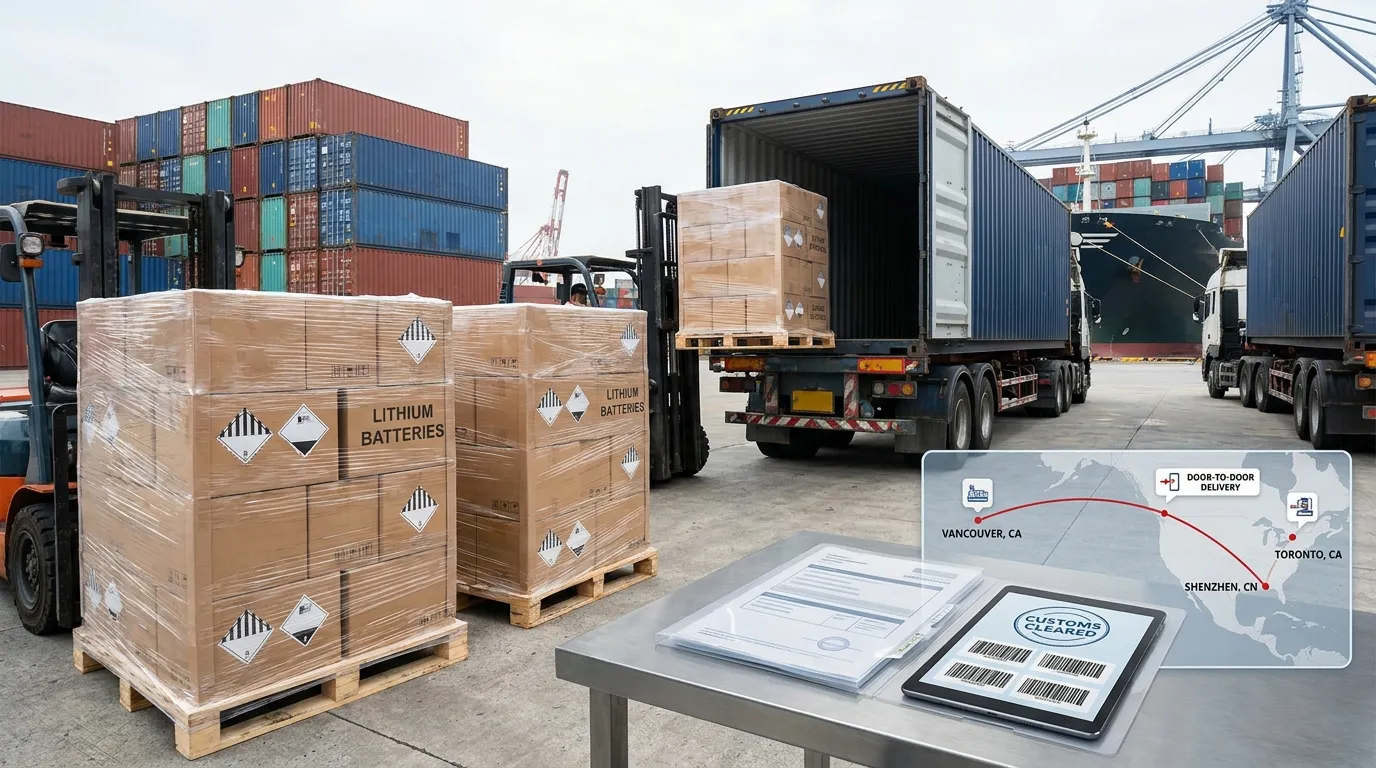
Canada is not just another destination on a battery freight list. Lithium battery cargo must be prepared for international transport and also accepted into the Canadian import environment. That means the shipment needs clear classification, correct documentation, proper packaging, and customs data that supports release.
For Canada-bound shipments, buyers should pay attention to three areas:
| Canada Import Area | What It Means for the Shipment |
|---|---|
| TDG awareness | Battery cargo must be correctly identified, marked, labelled, documented and packed as dangerous goods where required. |
| Customs clearance | Invoice, packing list, HS code, declared value, importer details and product description must match the cargo. |
| GST/duty planning | Import taxes and duties must be considered before shipping, especially for DDP delivery. |
DDP is often preferred by importers who do not want to manage customs clearance, tax handling and final delivery separately. With DDP, the shipment can be planned as a managed door-to-door service, but only if the cargo documents and Canadian delivery details are correct from the beginning. For buyers who want that structure, our battery DDP shipping from China service explains how DDP battery freight is normally arranged.
Battery Classification and DG Compliance We Check Before Booking
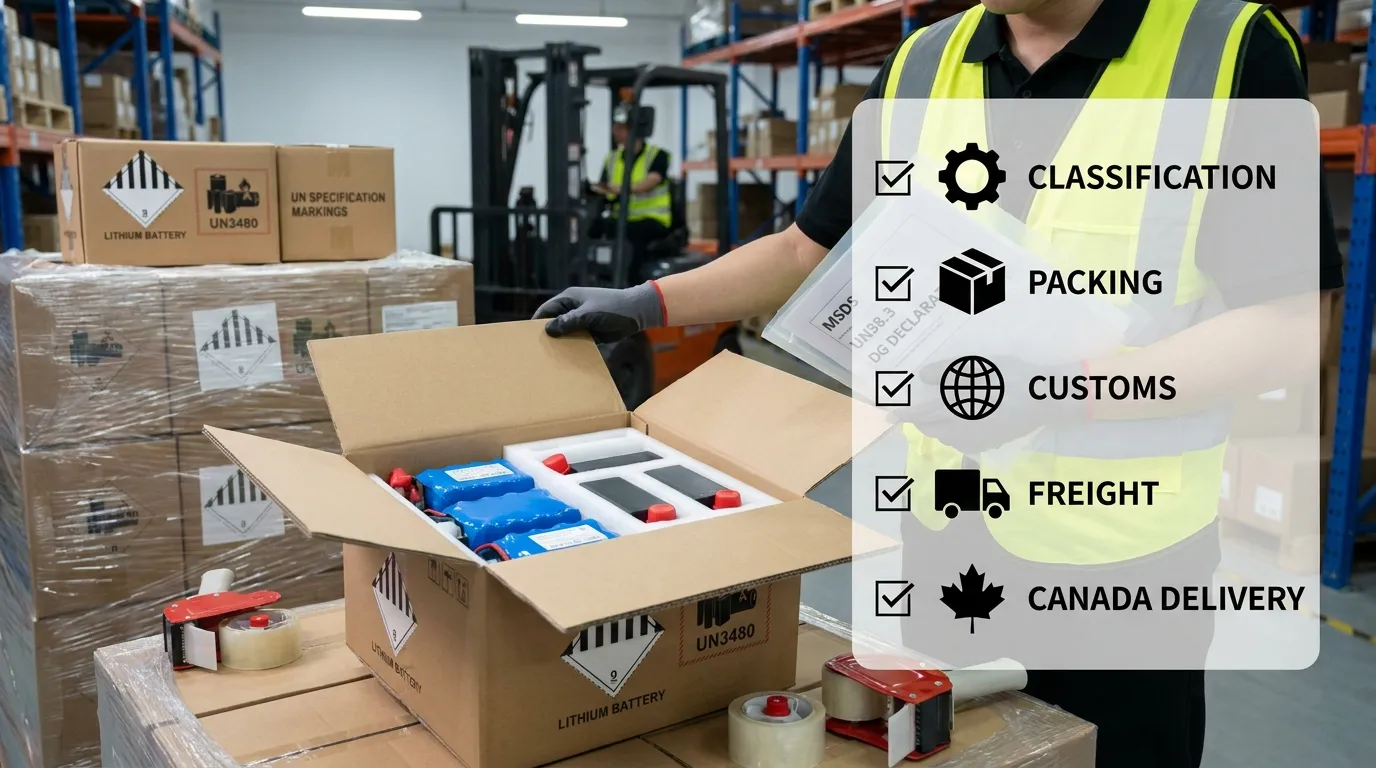
Before booking space, the battery must be classified correctly. This affects whether it can move by air, ocean or only under specific DG conditions.
| Cargo Type | Common UN Number | Typical Description |
|---|---|---|
| Lithium-ion batteries shipped alone | UN3480 | Standalone rechargeable lithium-ion cells or battery packs |
| Lithium-ion batteries packed with equipment | UN3481 | Batteries packed in the same shipment as the device |
| Lithium-ion batteries contained in equipment | UN3481 | Batteries already installed inside the product |
| Lithium metal batteries shipped alone | UN3090 | Non-rechargeable lithium metal cells or batteries |
| Lithium metal batteries packed with / contained in equipment | UN3091 | Lithium metal batteries with or inside equipment |
| Battery-powered vehicles or equipment | UN3171 | E-bikes, scooters or powered equipment where applicable |
| Lithium batteries installed in cargo transport unit | UN3536 | Specialized containerized energy storage cargo where applicable |
For air cargo, standalone lithium-ion batteries are commonly subject to stricter acceptance controls, including state-of-charge limits and Cargo Aircraft Only handling in many cases. Battery terminals must be protected against short circuit, inner packaging must prevent movement, and the outer carton must support safe handling through warehouse, airline, terminal and delivery stages.
We check the correct Class 9 lithium battery label, lithium battery mark, UN number marking, overpack labels, DG declaration needs, and whether the shipment matches IATA, IMDG and carrier acceptance rules.
Shipping Modes and Planning Transit Times to Canada
Different battery shipments need different modes. A sample shipment, an urgent replacement order, and a full container of battery-powered products should not be routed the same way.
| Mode | Best For | Typical Planning Range | Notes |
|---|---|---|---|
| Air freight | Urgent samples, small commercial batches, high-value electronics | Faster, confirmed by route | Strong DG screening; cargo acceptance depends on classification and documents |
| Ocean LCL | Medium-volume battery cargo not filling a container | Longer but cost-efficient | Good for cartons, pallets and consolidated DG cargo |
| Ocean FCL | Larger battery shipments, project cargo, factory orders | Route-specific | Better control for volume shipments when packing is ready |
| DDP door-to-door | Importers wanting managed customs, tax handling and delivery | Confirmed at quote stage | Useful for Canada delivery when buyer wants one forwarder-managed solution |
| DDU / FOB / CIF | Buyers with own broker, consignee or import process | Route-specific | Suitable when importer controls part of the destination process |
Example planning lanes include Shenzhen to Vancouver, Guangzhou to Toronto, Shanghai to Montreal, Ningbo to Calgary, and China warehouse pickup to Mississauga, Ottawa or other Canadian business addresses. Exact transit time is confirmed at the quote stage because battery class, airline/vessel availability, customs review, weather, peak season and final delivery address can all affect the schedule.
If your company also imports batteries into other markets, we can also support related lanes such as lithium battery shipping from China to Australia.
5-Step Process: From China Pickup to Canada Delivery
1. Supplier Pickup or Warehouse Receiving
We collect from your Chinese supplier or receive cargo at our warehouse for document and packing checks. If the shipment is not ready, we identify missing labels, weak cartons, unclear battery specs or mismatched paperwork before export.
2. DG Classification, Packing and Label Review
Our team checks battery type, UN number, watt-hour rating, MSDS/SDS, UN38.3 and whether the product is standalone, packed with equipment or contained in equipment. Cartons are reviewed for short-circuit protection, movement control, marks and Class 9 lithium battery labels.
3. China Export Customs and DG Booking
After documents are aligned, we arrange the export declaration and book the correct air or ocean DG channel. This reduces the risk of airline refusal, terminal hold, warehouse rejection or last-minute repacking.
4. International Freight to Canada
The shipment moves by the selected mode: air for speed, sea for larger volume, or DDP/DDU depending on the importer’s customs preference. Tracking and milestone updates are provided through the transport process.
5. Canada Customs and Final Delivery
For Canada arrival, customs information must match the commercial invoice, packing list, HS code and consignee details. For DDP shipments, GST/duty handling and delivery are coordinated as part of the managed route. For DDU or other Incoterms, the importer or broker handles the destination-side obligations.
Documents Required for Canada Battery Shipments
To prepare a compliant quote and reduce rejection risk, send the available documents before the cargo is collected.
| Document | Why It Matters |
|---|---|
| UN38.3 test summary or report | Confirms the battery has passed required transport safety tests |
| MSDS / SDS | Provides battery chemistry, hazard and handling information |
| Commercial invoice | Needed for customs value, buyer/seller details and product description |
| Packing list | Shows carton count, gross weight, net weight and dimensions |
| DG declaration | Required for regulated dangerous-goods air or sea shipments where applicable |
| Battery specification sheet | Confirms voltage, capacity, watt-hour rating and battery type |
| Product photos and carton photos | Helps verify packing, labels and cargo condition |
| HS code and importer details | Supports Canadian customs clearance and duty/tax planning |
Do not hide batteries inside a general cargo description. Undeclared or misdeclared batteries create a high risk of shipment hold, inspection, penalty, carrier refusal, or return.
Why Choose Fexbuy for China to Canada Battery Freight
Fexbuy works with battery cargo as a dangerous-goods logistics specialist, not as a general parcel reseller. With 21 years’ experience, a 98% on-time record, UN38.3 / IATA / IMDG compliant handling, DDP/DDU/FOB/CIF options, and door-to-door delivery support, our team helps importers move battery shipments with fewer avoidable problems.
Buyers choose us when they need:
- A DG forwarder based close to China battery supply chains
- Route planning for Canada-bound battery imports
- Document and packing checks before export
- Air, sea and DDP options under one team
- Support for customs, GST/duty planning and final delivery
- Quote communication by Free Quote form or WhatsApp
FAQ
Can lithium batteries be shipped from China to Canada?
Yes, if the battery type, UN number, documents, packing, marks and labels meet the required transport rules. The correct route depends on whether the cargo is UN3480, UN3481, UN3090, UN3091, UN3171 or another applicable classification.
What documents are needed for Canada battery imports?
Common documents include UN38.3, MSDS/SDS, commercial invoice, packing list, battery specification sheet, product photos, HS code, consignee information and DG declaration where required.
Can lithium batteries go by air freight to Canada?
Some battery shipments can move by air, but acceptance depends on the battery type, state of charge, packing instruction, airline policy and whether the cargo is standalone or packed with/contained in equipment.
Is DDP available for battery cargo to Canada?
Yes, DDP can be arranged for suitable shipments after checking the cargo details, documents, delivery address and tax/duty handling requirements. It is often useful for importers who want managed customs and door delivery.
How long does lithium battery shipping from China to Canada take?
Transit time depends on mode, China origin city, Canadian destination, battery classification, customs review and delivery requirements. Air is usually selected for urgent cargo, while sea is better for larger commercial shipments.
What is the difference between UN3480 and UN3481?
UN3480 is for lithium-ion batteries shipped alone. UN3481 is for lithium-ion batteries packed with equipment or contained inside equipment. This difference affects packing, labels, documents and carrier acceptance.
Get a Free Quote for Canada-Bound Battery Freight
Send your battery type, UN number if known, MSDS/SDS, UN38.3, product photos, carton size, weight, quantity, China pickup city, Canadian delivery city or postal code, and preferred Incoterm.
Fexbuy can review the shipment and recommend air, sea, DDP, DDU, FOB or CIF routing. Get a free quote or send your specs by WhatsApp to plan a compliant China-to-Canada battery shipment.


