


FBA Pallet Requirements from China: Cartons, Labels, Booking, and Delivery Mistakes to Avoid
FBA pallet requirements from China come down to four controls: Amazon pallet specs, carton and pallet labels, ISPM 15 wood packaging compliance, and delivery appointment accuracy. Use 40 x 48 inch pallets for US FBA, keep pallets stable and scannable, confirm IPPC marks on wood pallets, and verify labels before cargo leaves China.
Shipping cartons from China to Amazon FBA looks simple until one pallet blocks the whole delivery. A wrong pallet size, hidden label, missing IPPC mark, or booking mismatch can create rework, storage delay, or Amazon receiving issues. The best time to fix these details is before your supplier loads the cargo, not after your truck reaches the fulfillment center.
Do you need pallets for an FBA shipment from China?
Not every FBA shipment from China needs pallets. Use pallets when the shipment moves by LTL, FTL, FCL, or when cartons need safer forklift handling. For smaller parcel shipments, carton-level prep may be enough.
Pallets are mainly about handling and delivery method. If your goods move as small parcels, the cartons may go directly through a parcel carrier. If the shipment moves by truckload, less-than-truckload, or full container, you need to plan palletization early.
Palletizing in China is not always the cheapest choice. It works well for fragile goods and FCL shipments, but destination palletization can be safer for LCL shipments when freight volume is the main cost driver. Sellers comparing direct FBA delivery with staging can also review AWD vs FBA.
| Shipment situation | Better option | Why |
|---|---|---|
| Small parcel cartons | No pallet | Parcel carriers can handle carton-level delivery |
| 35 cartons by LCL | Palletize after customs | Lower international volume in many cases |
| 80 cartons in FCL | Palletize in China | Safer loading and less carton damage |
| Fragile ceramics or glass | Palletize in China | Reduces handling damage before export |
| Heavy bulk cartons | Palletize before delivery | Easier forklift handling and safer receiving |
What are the Amazon FBA pallet requirements for US delivery?
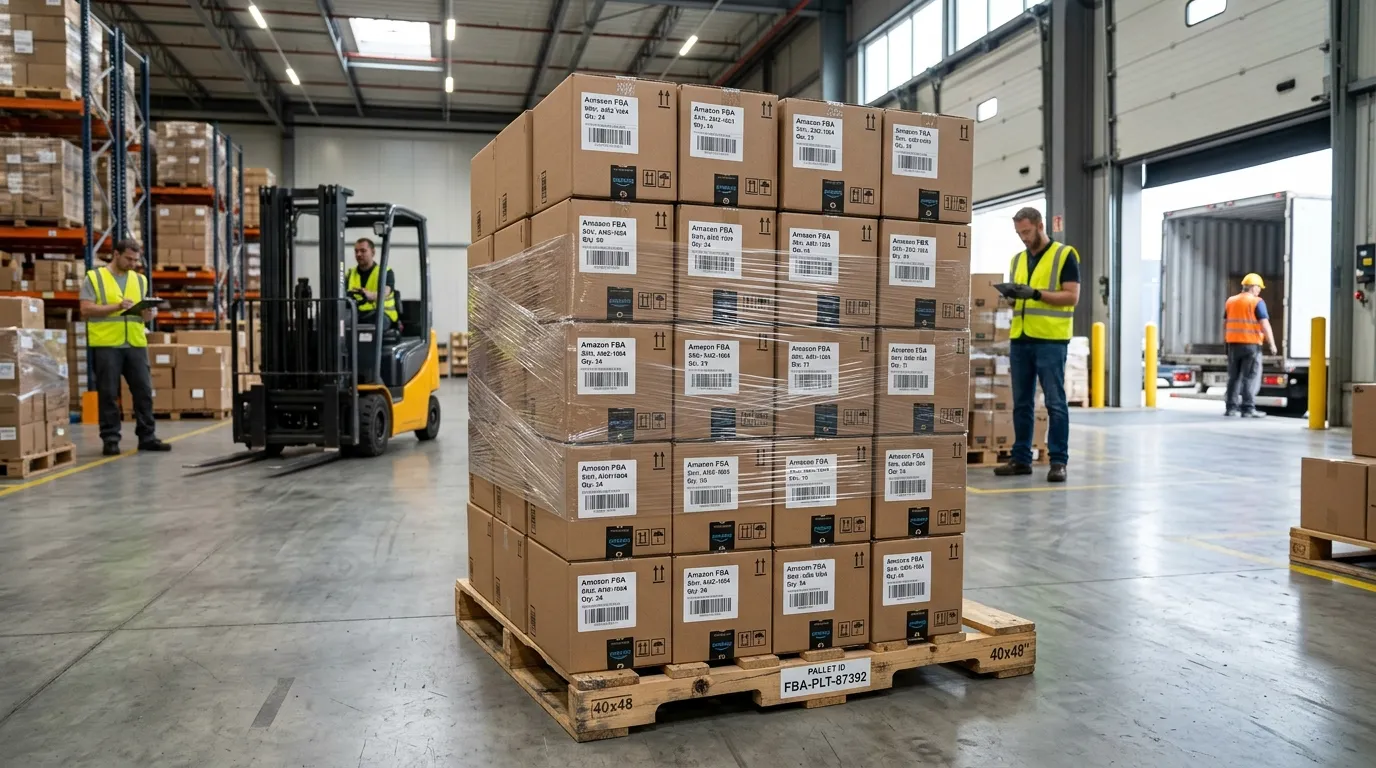
For US FBA, plan around 40 x 48 inch pallets, 72 inches maximum loaded height, and 1,500 lb maximum pallet weight. Each pallet should be stable, stretch-wrapped, scannable, and labeled on all four sides.
For US fulfillment centers, the standard pallet footprint is usually 40 x 48 inches. Amazon seller guidance also refers to a 72-inch loaded pallet height limit, with a limited exception for a single unit taller than 72 inches, and a 1,500 lb maximum pallet weight.
| Requirement | Practical rule |
|---|---|
| Pallet size | Use 40 x 48 inch pallets for US FBA |
| Loaded height | Keep the pallet at or below 72 inches |
| Weight | Keep total pallet weight at or below 1,500 lb |
| Wrapping | Use clear stretch wrap so labels stay visible |
| Labels | Apply one pallet label on each side |
| Carton position | Keep cartons inside the pallet edge |
| Stability | Stack cartons flat, tight, and safe for forklift handling |
Amazon receiving teams need to scan labels quickly. That means carton labels should face outward where possible, and pallet labels should not be hidden under thick wrap or placed where forklift contact can damage them. For deeper label prep, use the FBA prep labels guide.
A supplier saying “we know Amazon” is not enough. The forwarder or prep center should confirm pallet size, labels, ISPM 15 marks, carton orientation, and booking responsibility before cargo leaves China.
Should you palletize in China or after customs clearance?
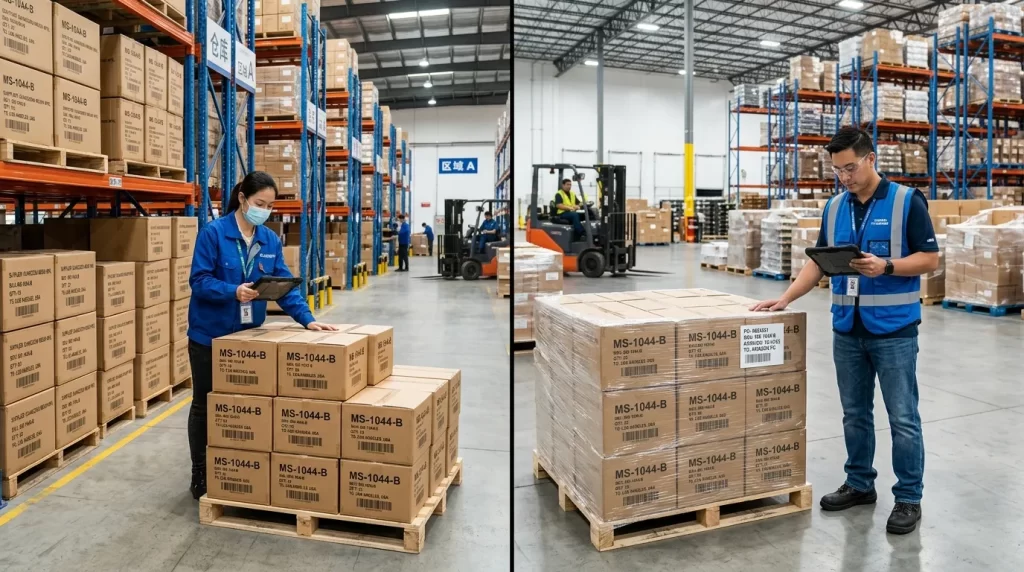
Palletize in China when goods are fragile, heavy, or moving as FCL. Palletize after customs when you want to reduce international freight volume and your destination forwarder can rebuild compliant pallets before Amazon delivery.
The right answer depends on risk and cost. Palletizing in China can protect goods before export, but it can also increase chargeable volume. Destination palletization can save space during international freight, but only if your forwarder can rebuild the pallets correctly before Amazon delivery.
For example, 80 cartons of ceramic plates in a full container should usually be palletized in China. The damage risk is higher than the space saving. But 35 cartons of plastic household goods by LCL may be cheaper to ship as cartons, then palletize after customs clearance before trucking to Amazon.
| Situation | Palletize in China | Palletize at destination | Risk to watch |
|---|---|---|---|
| Fragile glass goods | Yes | Only if packed very well | Breakage during export handling |
| FCL shipment | Usually yes | Sometimes | Poor container loading |
| LCL shipment | Sometimes | Often better | Rework quality after clearance |
| Air freight | Rarely | Usually better | Dimensional weight cost |
| Oversized cartons | Case by case | Case by case | Amazon receiving limits |
| Mixed supplier consolidation | Sometimes | Often better | Wrong SKU grouping |
Pallet choices can affect trucking, appointment planning, and routing cost. If you’re planning broader inbound fees, check your inbound placement cost before choosing the cheapest-looking option.
Which carton and pallet labels must be ready before booking?
Before booking, confirm the unit label, FBA box label, carrier label, and four pallet labels are assigned to the correct shipment. Label mismatches can delay receiving even when the pallet itself is physically compliant.
Labels need a clear handoff. The seller creates the shipment in Seller Central, the supplier or prep center applies unit and carton labels, the forwarder checks carton count, and the carrier handles delivery labels and appointment details. One mismatch can slow receiving.
Use this simple sequence before booking the Amazon delivery:
- Confirm FNSKU or manufacturer barcode requirements.
- Apply the correct FBA box label to every carton.
- Match carton labels to the right shipment ID.
- Confirm pallet count and carton count with the forwarder.
- Apply one pallet label on each side.
- Take photos before loading and after wrapping.
Label handoff sequence from Seller Central to supplier to forwarder
Seller Central labels should not be sent casually in a chat thread without checking the final shipment plan. If the seller changes the fulfillment center, carrier, carton count, or shipment split, old labels may become a problem.
A mixed-ASIN pallet needs extra care. If three SKUs share one pallet, separate them by layer or section, keep carton labels facing outward, and photograph all four sides before wrapping. For full label rules, use the carton labeling guide.
What customs issues can pallets from China create?
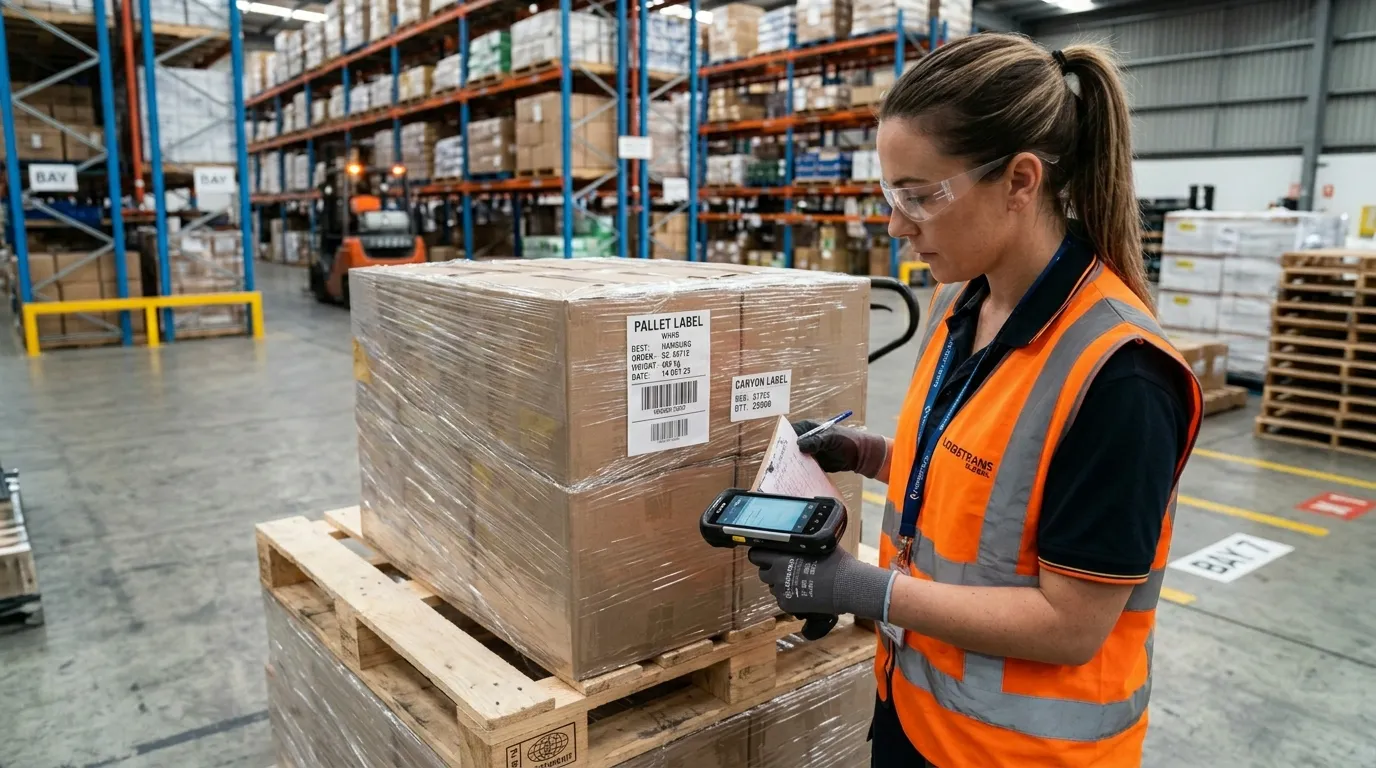
Amazon may accept the pallet format, but customs can still hold cargo if wood packaging is noncompliant. For China-origin wood pallets, confirm a clear ISPM 15 mark before loading and keep photo proof.
A pallet can be Amazon-compliant and still fail customs. Amazon checks receiving specs, labels, and delivery readiness. APHIS and CBP care about wood packaging material, pest risk, treatment marks, and import rules.
For US imports, solid wood packaging material must be treated and marked under ISPM 15 rules. APHIS says wood packaging material must be pest-free, treated or fumigated, and marked with the correct stamp. Noncompliant material may face corrective action, destruction, or re-export under APHIS wood packaging rules.
What happens if the pallet has no valid IPPC mark?
If a supplier uses solid wood pallets but cannot show clear IPPC mark photos, do not treat it as a small detail. Ask the forwarder to hold loading until the mark is confirmed, or switch to compliant pallets before export.
For ocean freight, pallet and shipment details also connect to import filing. The eCFR rules for Importer Security Filing require key data before cargo is loaded at the foreign port. If your shipments also touch Europe or the UK, hand off that topic to your EU UK compliance review instead of mixing all rules into one checklist.
How should booking and delivery appointments be handled?
The carrier, forwarder, or domestic trucking partner usually books the Amazon delivery appointment. The seller still needs to verify the shipment ID, pallet count, carton count, carrier details, and fulfillment center address before delivery.
A clean booking depends on clean data. The trucker needs the right FBA shipment information, pallet count, carton count, delivery address, and any Amazon appointment instructions. If customs clearance is delayed, the delivery plan may also need to shift.
Watch for changes after labels are printed. If the seller changes the carrier, updates the shipment plan, or gets assigned a different fulfillment center, the old booking details may no longer match. This is where shipment split planning can prevent messy handoffs.
A common failure looks like this: the seller changes carrier after labels are printed, but the forwarder still uses the old details. Before domestic delivery, recheck the FBA shipment ID, carrier label, pallet count, and appointment request.
What pallet mistakes cause Amazon rejection or receiving delays?
Most FBA pallet problems are simple but expensive: wrong size, weak stacking, missing labels, hidden barcodes, carton overhang, and noncompliant wood packaging. These should be checked before export, not after the truck reaches Amazon.
The biggest mistakes usually happen before the freight leaves China. A supplier may use the wrong pallet size, wrap labels under plastic, mix ASINs without separation, or stack cartons beyond the pallet edge. These errors look small in the factory but become costly at the destination.
Use this mistake checklist before loading:
- Pallet is taller than Amazon’s limit.
- Pallet is overweight.
- Cartons overhang the pallet edge.
- Pallet labels are missing from one or more sides.
- FBA box labels are hidden, damaged, or mismatched.
- Mixed ASINs are not separated clearly.
- Wood pallet has no valid IPPC mark.
- Pallet is unstable, moldy, broken, or poorly wrapped.
The safest habit is to request photos of the pallet before pickup. Ask for close-up photos of pallet labels, carton labels, IPPC marks, all four sides, and the full loaded pallet. For a deeper error list, use this prep mistake checklist.
What should you send your supplier or forwarder before shipment?
Send a clear checklist before production cartons leave the factory or warehouse. This reduces back-and-forth and gives the supplier, prep center, and forwarder the same working standard.
| Checklist item | What to confirm |
|---|---|
| Shipment plan | Correct FBA shipment ID and fulfillment center |
| Unit labels | FNSKU or barcode rule confirmed |
| Carton labels | Every carton has the correct FBA box label |
| Carton data | Weight, dimensions, SKU, and quantity match |
| Pallet type | 40 x 48 inch pallet for US FBA where required |
| Wood packaging | ISPM 15 and IPPC mark photo provided |
| Pallet labels | One label on each side of every pallet |
| Mixed ASINs | ASINs separated by layer or section |
| Photo proof | Four sides, top view, label close-ups, IPPC mark |
| Booking owner | Forwarder or carrier assigned to book delivery |
This checklist is also useful when comparing suppliers or forwarders. A good logistics partner should ask for shipment details early, not after customs clearance. For wider landed cost and routing decisions, use the FBA inbound cost strategy.
What to Do Next
Before you approve pickup, ask your supplier or forwarder for pallet photos, carton label photos, pallet label photos, and IPPC mark proof. Then compare those photos against your Seller Central shipment plan and delivery booking details.
FBA Pallet Requirements from China are not hard, but they are easy to miss when several parties handle the same shipment. Get the pallet decision, labels, wood packaging, and booking data right before export. That is the simplest way to avoid rework, delay, and Amazon receiving problems.
Frequently Asked Questions
What is the standard FBA pallet size for US fulfillment centers?
The standard US FBA pallet size is usually 40 x 48 inches. The loaded pallet should stay within Amazon’s height and weight limits, and cartons should not overhang the pallet edge.
Do wood pallets from China need ISPM 15 certification?
Yes, solid wood pallets used for China-to-US shipments should be ISPM 15 compliant and clearly marked. APHIS says noncompliant wood packaging material will not be allowed to enter the United States.
How many labels does each Amazon FBA pallet need?
Each pallet should have four Amazon pallet labels, one on each side. The labels must be visible, scannable, and not hidden under stretch wrap or placed where forklift handling can damage them.
Can I mix different ASINs on the same pallet?
Yes, mixed ASIN pallets can work when cartons are clearly separated and easy to identify. The safest approach is to separate ASINs by layer or section and keep every carton label facing outward.
Should I palletize goods in China or after arrival?
Palletize in China for fragile, heavy, or FCL cargo. For LCL or cost-sensitive shipments, destination palletization may reduce freight volume if your forwarder can rebuild Amazon-compliant pallets before delivery.
What happens if the pallet has no IPPC mark?
A solid wood pallet without a valid IPPC mark can trigger inspection, corrective action, fumigation, destruction, or re-export. The safest step is to request clear pallet-mark photos before cargo leaves China.
Who books the Amazon FBA delivery appointment?
Usually the carrier, forwarder, or domestic trucking partner books the Amazon delivery appointment. The seller must still confirm shipment ID, pallet count, carton count, carrier details, and delivery address are correct.


