


Free Up Cash Flow with 20% Import VAT Shipping to UK: How PVA Works
For VAT-registered importers, Free Up Cash Flow with 20% Import VAT Shipping to UK is mainly about changing when import VAT affects working capital—not eliminating the tax.

When eligible businesses use Postponed VAT Accounting (PVA), import VAT can be accounted for on the UK VAT Return instead of being paid immediately when the goods enter the country. HMRC confirms that VAT-registered importers may use PVA where the relevant conditions are met.
Why 20% Import VAT Can Tie Up Working Capital
Goods imported into the UK are normally subject to the VAT rate that would apply if the same goods were supplied domestically. Therefore, 20% is common for standard-rated goods, but not every imported product is necessarily taxed at 20%.
Consider a simplified example:
•Import VAT Value]Illustrative VAT at 20%
•£10,000]£2,000
•£25,000]£5,000
•£50,000]£10,000
•£100,000]£20,000
For a £50,000 VAT value, £10,000 of import VAT could represent a significant temporary cash requirement.
The actual import VAT value is more complex than simply using the supplier invoice. It generally starts from the customs value and may include Customs Duty, transport, insurance, packing and other incidental expenses up to the relevant UK destination.
How PVA Changes the Import VAT Cash-Flow Cycle
The central principle behind Free Up Cash Flow with 20% Import VAT Shipping to UK is the difference between paying VAT and accounting for VAT.
Without PVA, an importer may pay import VAT at entry and later recover eligible input VAT using the appropriate evidence.
With PVA, the process becomes:
Import → Customs Declaration with PVA → Monthly PVA Statement → VAT Return → Eligible Input VAT Recovery
PVA therefore changes the timing of import VAT accounting. It is not a VAT exemption.
HMRC states that PVA enables a VAT-registered importer to account for relevant import VAT on its VAT Return rather than paying it immediately or through a duty deferment account.
Who Can Use Postponed VAT Accounting?
PVA is designed for qualifying UK VAT-registered importers.
The importer should verify:
•Correct EORI number
•Ownership/right to dispose of the imported goods
•Business use of the goods
•Correct VAT registration number on the customs declaration
•Clear instructions to the customs intermediary
Importers that are not VAT registered, or that cannot treat the import VAT as input tax because they are not the owner of the imported goods, are not permitted to use PVA under HMRC guidance.
Special rules may also apply to certain low-value consignments and other specific import arrangements.
What Should Be Verified Before Making A Customs Declaration?
A Free Up Cash Flow with 20% Import VAT Shipping to UK strategy is highly dependent on the correct declaration of data.
Before shipment clearance, check:
•Legal importer name
•VAT registration number
•GB EORI
•Commodity code
•Commercial invoice
•Customs value
•Packing list
•Incoterm
•PVA instruction
•UK delivery destination
HMRC states that once an import declaration has been submitted, the chosen method for accounting for import VAT cannot simply be changed on that declaration. This makes pre-declaration verification important.
The decision to use PVA also belongs to the importer, not the freight forwarder or customs intermediary. HMRC recommends clear agreement between the importer and intermediary about how import VAT will be accounted for.
How PVA Appears on the VAT Return
The accounting stage is what turns the customs process into a cash-flow mechanism.
For imports accounted for under PVA:
•Box 1: import VAT due under PVA
•Box 4: eligible import VAT reclaimed as input tax
•Box 7: total net value of imports
•Normal input-tax recovery rules still apply.
Where the VAT in Box 1 can also be reclaimed in Box 4 under normal rules, the importer can avoid the separate cycle of paying the tax at customs and waiting to recover it later.
Why the Monthly PVA Statement Matters
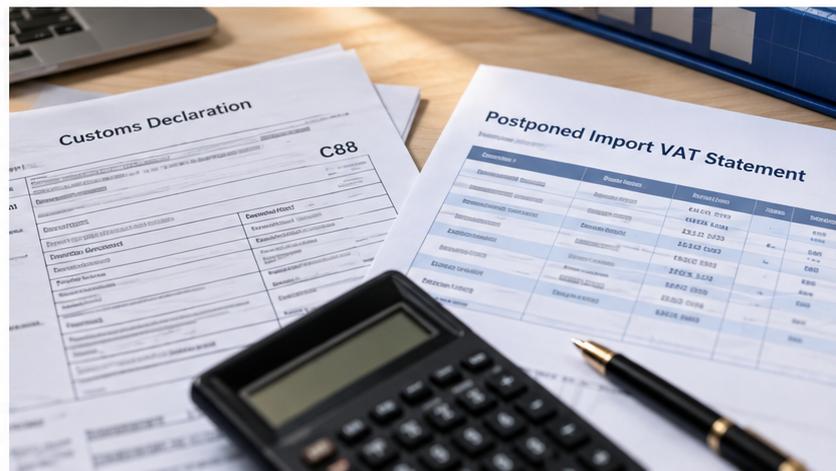
The Monthly Postponed Import VAT Statement, or MPIVS, connects customs declarations with VAT accounting.
It records postponed import VAT against the importer’s EORI and provides information needed for VAT Return reconciliation. HMRC also requires businesses to retain appropriate records and recommends downloading the statements.
A practical control process is:
Customs Entry → EORI → VAT Number → MPIVS → Accounting Records → VAT Return
If these records do not reconcile, the importer should investigate the discrepancy rather than automatically relying on the freight invoice.
PVA vs Paying Import VAT Upfront
| Factor | VAT Paid at Import | PVA |
| Upfront VAT cash payment | Usually required | Generally avoided |
| VAT liability disappears | No | No |
| VAT Return accounting | Recovery later | VAT due and eligible recovery recorded |
| Main evidence | C79 where applicable | MPIVS |
| Working-capital impact | Higher | Usually lower |
| Correct declaration required | Yes | Yes |
PVA should also not be confused with a Duty Deferment Account. PVA concerns import VAT accounting; it does not automatically remove Customs Duty, freight charges, port costs, warehousing or other import expenses.
Common Errors That Can Break the Process
Businesses considering Free Up Cash Flow with 20% Import VAT Shipping to UK should avoid several common mistakes:
•Treating PVA as “VAT-free shipping”
•Assuming every import uses a 20% VAT rate
•Using an incorrect VAT number or EORI
•Identifying the wrong importer
•Failing to instruct the customs intermediary before declaration
•Ignoring differences between customs records and the MPIVS
Assuming PVA also postpones Customs Duty
The objective is not simply to select a shipping service. It is to align importer status, customs data, VAT accounting and supporting evidence.
A Practical PVA Shipping Checklist
Before using PVA, confirm:
VAT registration → EORI → importer ownership → commodity code → customs value → applicable VAT rate → PVA instruction → MPIVS access → VAT Return reconciliation
This sequence explains why Free Up Cash Flow with 20% Import VAT Shipping to UK is fundamentally a customs-and-accounting decision rather than a way to avoid UK taxation.
For businesses shipping goods from China to the UK, correct information should be prepared before customs entry so that freight arrangements and VAT accounting follow the same plan. Companies evaluating PVA-related shipping can discuss their shipment requirements with Fexbuy Logistics and coordinate the logistics process around the importer’s chosen UK customs and VAT treatment.
FAQs
Q1. Can Fexbuy support PVA-related shipping to the UK?
Yes. Fexbuy can coordinate shipping and customs information where the importer intends to use Postponed VAT Accounting.
Q2. Does Fexbuy eliminate the 20% UK import VAT?
No. PVA changes how eligible import VAT is accounted for; it does not remove the VAT liability.
Q3. What information does Fexbuy need for UK PVA shipments?
Typically, the importer should provide the VAT number, GB EORI, commercial invoice, packing list, commodity code, Incoterm and PVA instructions.
Q4. Does Fexbuy decide whether PVA should be used?
No. The importer should decide its VAT treatment and clearly instruct the freight forwarder or customs intermediary.
Q5. Can Fexbuy help reduce upfront VAT cash pressure?
Fexbuy can coordinate a shipment around the importer’s chosen PVA arrangement, which may reduce the need to pay eligible import VAT upfront.
Share:


