


Import Duties for Online Sellers: How to Plan Product Pricing Before You Ship
Import duties for online sellers are one of the most overlooked inputs in product pricing. Before you set a retail price or place a purchase order, you need to know your full duty stack: base HTS rate, country-of-origin surcharges (up to 52%+ for China-origin goods in 2026), CIF valuation basis, and Incoterm liability. This guide gives ecommerce sellers a practical framework, including a pre-shipment checklist and margin scenarios, to model duty costs before inventory leaves the supplier.
Most sellers treat import duties as a customs problem. They’re not. They’re a pricing problem, and the damage is done before your order ships. If you set your retail price without knowing your full duty stack, you’re building a margin model on incomplete numbers. This article gives you what you need to fix that before your next purchase order.
What Import Duties Actually Are (and Why They’re a Pricing Problem, Not Just a Customs Problem)
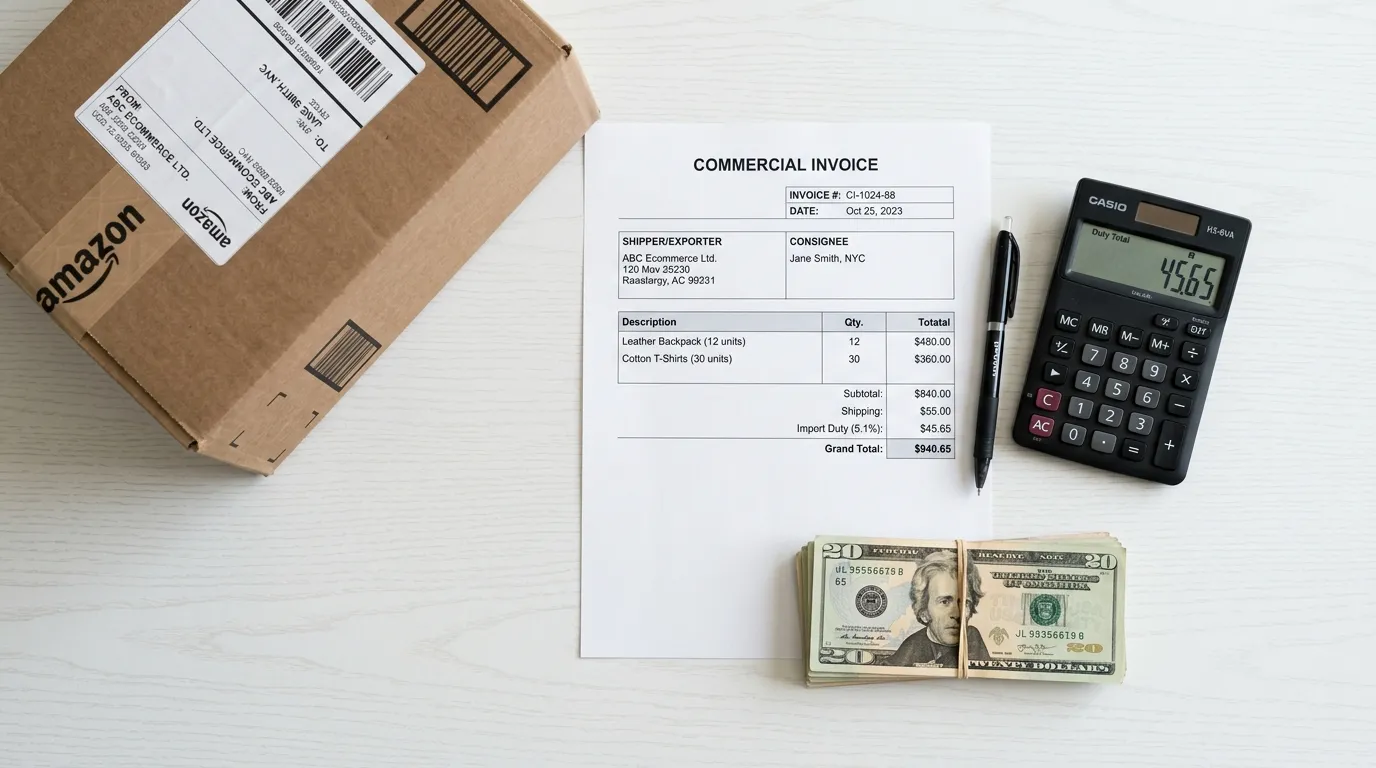
Import duties for online sellers are taxes collected by the destination country’s customs authority when your inventory crosses the border. They are calculated on the customs value of your shipment, typically cost plus insurance plus freight (CIF), and applied before your goods reach a warehouse or customer. Failing to model duty costs before setting your retail price is one of the most common margin errors in cross-border ecommerce.
Most sellers find out what they owe at the border, after they’ve already set their price and committed to inventory. By that point, you have three bad options: absorb the cost, raise your price and lose sales, or ship at a loss. None of those options feel good when you’re staring at a customs bill you didn’t plan for.
The fix is simple: treat your duty cost as a line item on your pricing spreadsheet before you place the purchase order. To do that, you need to understand how the number is calculated, what variables drive it, and how your shipping and Incoterm choices affect the final figure. Start by pulling your full landed cost calculation to see how duty fits into the broader cost picture.
How Your Duty Rate Is Calculated Before a Single Box Leaves China
To calculate import duties before shipping, multiply your CIF value (product cost plus freight plus insurance) by the combined duty rate. For Chinese goods in 2026, that typically includes a base HTS rate, a Section 301 tariff, and a 15% Section 122 surcharge. Add the Merchandise Processing Fee (0.3464%) and customs broker fees. Run this calculation before issuing your purchase order, not after your goods are on a vessel.
Here’s the full step-by-step process:
- Identify your 10-digit HTS code. This determines your base duty rate. You need the full 10-digit US HTS code, not just the 6-digit international HS code. Find your product’s HTS code before doing any other math.
- Confirm country of origin. Origin is where the product was manufactured, not where your supplier is located or where the shipment departs from.
- Get a real CIF quote. Ask your freight forwarder for a full CIF figure: supplier invoice value plus international freight plus insurance to the destination port.
- Stack all applicable duty rates. For Chinese goods, this is: base HTS rate + Section 301 tariff (7.5–25%) + Section 122 surcharge (15%, active until at least July 24, 2026).
- Add the Merchandise Processing Fee (MPF). This is 0.3464% of CIF value, with a minimum of $27.23 and a maximum of $528.33 for US imports.
- Add the Harbor Maintenance Fee (HMF) if shipping by ocean. This is 0.125% of CIF value.
- Add customs broker fees. Expect $100–$200 per informal entry, more for formal entries.
Worked example: You’re importing textiles from China. Supplier invoice: $300. International freight: $35. Insurance: $5. CIF total: $340.
- Base HTS (textiles): 12% = $40.80
- Section 301: 25% = $85.00
- Section 122 surcharge (15%): $51.00
- MPF: minimum applies, so $27.23
- HMF: $0.43
- Broker fee: $150 (spread across units)
Total duty and fees come to approximately $354.46 in costs on a $300 product. That’s before your domestic freight, platform fees, or returns. Run this calculation before you commit.
Why Product Category Is the Single Biggest Duty Variable
Product category determines both the base HTS duty rate and whether Section 301 tariffs apply. Apparel from China can carry an effective rate exceeding 52% when all layers stack. Electronics may look cheap at a 0–2% base rate but jump sharply once Section 301 is added. Always check your category’s full stacked rate before calculating your minimum viable retail price.
Here’s how common ecommerce categories stack up for US imports from China in 2026:
| Product Category | Base HTS Rate | Section 301 Add-On | Section 122 (2026) | Effective Rate (China) |
|---|---|---|---|---|
| Apparel / Textiles | 12–32% | 25% | 15% | 52–72% |
| Electronics / Gadgets | 0–2.6% | 7.5–25% | 15% | 22.5–42.6% |
| Plastic Goods / Toys | 0–6.8% | 25% | 15% | 40–46.8% |
| Furniture / Home Goods | 0–9.9% | 25% | 15% | 40–49.9% |
| Health / Beauty Tools | 0–6.5% | 7.5–25% | 15% | 22.5–46.5% |
The point isn’t the exact rates — always verify against the USITC Harmonized Tariff Schedule for your specific product. The point is that the category, not the product price, often decides whether a sourcing decision is viable. A $10 apparel item from China that sounds cheap may carry a higher effective landed cost than a $13 item from Vietnam with no Section 301 exposure. Check your product classification and duty rates before you source, not after.
Country of Origin: Why Where It’s Made Changes What You Pay
Two sellers can import the same product at the same price. If one sources from China and the other from Vietnam, their effective duty rates can differ by 40 percentage points. Country of origin is where the product was manufactured, not where your supplier is headquartered, not where the shipment departs.
Here’s how major sourcing origins compare for US imports in 2026:
| Origin Country | Standard MFN Rate | Section 301 | Section 122 | Notes |
|---|---|---|---|---|
| China | Varies by category | 7.5–25% | 15% | Highest stacked rate in 2026 |
| Vietnam | Varies by category | None (generally) | 15% | Section 301 doesn’t apply |
| Bangladesh | Varies by category | None | 15% | Strong for apparel; GSP-qualified categories |
| India | Varies by category | None | 15% | MFN applies; no China-specific stacking |
| Mexico / Canada | Varies | None | Exempt (USMCA-qualifying) | USMCA rules of origin must be met |
Re-routing inventory through a third country does not change its origin. CBP uses the substantial transformation rule: origin is the country where the product last underwent a meaningful manufacturing process. Attempting to change origin paperwork through a transit country is a customs violation, not a workaround.
Make sure your country of origin is accurately declared on your origin documentation on your commercial invoice. Errors here can trigger holds, reassessments, and penalties.
Declared Value and CIF: The Number Customs Actually Uses
Customs calculates import duties on your CIF value: the price you paid your supplier plus international freight and insurance. For US imports, CBP uses transaction value, meaning your actual supplier invoice. Intentionally under-declaring value to reduce duty exposes your shipment to seizure, reassessment, and fines that far exceed any duty savings. Use the real invoice figure and model your pricing around the true cost.
CIF stands for Cost, Insurance, and Freight. The CIF value is almost always higher than your FOB (Free On Board) supplier price because it includes your freight cost to the destination port. That matters because your duty is calculated on the higher CIF figure, not the lower FOB figure.
Here’s where sellers make a costly mistake. CBP has algorithmic flags for price anomalies by HTS category. If electronics routinely clear at $18–45 per unit and your invoice shows $4, that shipment gets flagged. The time and broker cost of clearing a held shipment typically exceeds the duty that would have been owed on the honest value. Under-declaring value is not a grey area. It is customs fraud, and beyond the legal exposure, it is commercially counterproductive.
Use your real supplier invoice as the declared value. Account for your freight quote when modeling your duty cost. Get an accurate commercial invoice in place before your shipment departs.
Incoterms and Pricing: Who Pays the Duty Shapes What You Charge
Under DDP (Delivered Duty Paid), you as the seller pay all import duties and must build that cost into your retail price before listing. Under DDU, your customer pays duty on delivery, which causes checkout friction and abandoned orders. For ecommerce sellers shipping directly to consumers, DDP pricing is usually the right model, but only if you have calculated the full duty stack before setting your selling price.
| Incoterm | Who Pays Duty | Pricing Implication | Risk for Ecommerce |
|---|---|---|---|
| DDP | Seller | Duty fully embedded in retail price; buyer sees no surprise charges | Under-priced if you didn’t calculate duty first |
| DDU / DAP | Buyer | Lower apparent cost for seller; buyer notified at delivery | Cart abandonment, returns, negative reviews |
| FOB | Buyer (from port) | Common for B2B; buyer models their own landed cost | Buyer needs to trust your pricing is competitive net of their duty |
DDU is not cheaper for sellers. It’s cheaper on paper and expensive in reality. When a buyer receives an unexpected customs bill at the door, they reject the parcel, file a chargeback, or leave a negative review. The duty you didn’t pay upfront costs you the sale, the return shipping, and often your platform standing. DDP pricing with a properly calculated duty stack is the right model for DTC ecommerce. The only question is whether you’ve done the math before setting your price.
Per Incoterms 2020 rules from the International Chamber of Commerce, the liability split under each term is fixed. Your freight forwarder should confirm which Incoterm applies to your shipment before goods leave origin, and that choice should be reflected in your pricing model from day one.
You’ll also want to understand when your shipment requires formal customs entry based on value and product type, since that affects your broker costs under any Incoterm.
How Your Shipping Method Changes Your Duty Bill
Air freight is not just a cost upgrade. It inflates your CIF value, which increases your duty base. For high-duty-rate products from China, the extra cost of air freight can generate significant additional duty on top of the freight premium itself.
Here’s the same $300 product shipped two ways:
| Shipping Method | Product Cost | Freight | Insurance | CIF Total | Duty at 40% Effective Rate | Total Duty Cost |
|---|---|---|---|---|---|---|
| Sea freight | $300 | $35 | $5 | $340 | $136 | $136 |
| Air freight | $300 | $120 | $5 | $425 | $170 | $170 |
That’s $34 more in duty per shipment, purely from the shipping method. Scale to 100 units per month and you’re paying $3,400 per month in avoidable duty, not counting the freight premium itself.
For small, fast-moving SKUs with tight margins, sea freight combined with earlier ordering is commercially superior to air freight plus reactive replenishment. The speed advantage of air can vanish quickly when you account for the duty base it creates. Model both scenarios in your pricing spreadsheet before committing to a shipping method.
Duty Rules by Destination: US, UK, EU, and Canada at a Glance
In 2026, the US has eliminated practical de minimis protection for most ecommerce shipments and applies a stacked duty rate including base HTS, Section 301, and a 15% Section 122 surcharge. The UK and EU maintain lower flat-rate import duties on Chinese goods but require VAT compliance from the first sale. Canada’s de minimis threshold is only CAD $20. Price for the destination market, because the same product can have a 30–40% duty difference between markets.
| Market | De Minimis (2026) | VAT / GST | Typical Duty Range | Key 2026 Change |
|---|---|---|---|---|
| United States | Effectively $0 (eliminated for commercial ecommerce) | None at federal level | 15–52%+ (China-origin) | Section 122 surcharge + de minimis gone |
| United Kingdom | £135 for VAT; duty applies from £0 for most goods | 20% VAT | 0–12% typical | No China-specific stacking |
| European Union | €150 for duty; VAT from €0 (IOSS applies) | 20–25% VAT | 0–17% typical | IOSS VAT registration required for DTC |
| Canada | CAD $20 for duties | 5% GST + provincial | 0–20% typical | USMCA advantages apply to US-origin only |
The UK and EU do not have Section 301 or Section 122 equivalents on Chinese goods, so sourcing strategy differs significantly by destination market. A product priced correctly for the US market may be under-priced for a Canadian customer if you haven’t accounted for Canada’s near-zero de minimis threshold. For a full model of how these costs stack into a complete landed cost, see how duties fit into your total landed cost by destination.
The end of de minimis in the US is the most disruptive change for ecommerce sellers in 2026. For the full picture of what that means for your China-US logistics model, see China to US shipping after de minimis.
Margin Table: What Import Duties Actually Do to Your Numbers
This is where the theory becomes real. The three scenarios below use the same $10 FOB product price. Only the origin country and product category change.
| Scenario A: Vietnam, Apparel (MFN only) | Scenario B: China, Electronics (stacked) | Scenario C: China, Apparel (stacked) | |
|---|---|---|---|
| Supplier cost (FOB) | $10.00 | $10.00 | $10.00 |
| International freight | $2.00 | $2.00 | $2.00 |
| Insurance | $0.20 | $0.20 | $0.20 |
| CIF total | $12.20 | $12.20 | $12.20 |
| Base HTS duty | 12% = $1.46 | 2.6% = $0.32 | 12% = $1.46 |
| Section 301 | None | 25% = $3.05 | 25% = $3.05 |
| Section 122 (2026) | 15% = $1.83 | 15% = $1.83 | 15% = $1.83 |
| MPF + HMF | $0.20 | $0.20 | $0.20 |
| Broker fee (per unit) | $0.20 | $0.20 | $0.20 |
| Total landed cost | $13.89 | $17.80 | $18.94 |
| Effective duty rate | ~30% | ~45.4% | ~55.2% |
| Gross margin at $29.99 retail | 53.7% | 40.6% | 36.9% |
| Retail price needed for 40% margin | $23.15 | $29.67 | $31.57 |
Scenario C is where most sellers get hurt. They source a $10 apparel item from China, apply a rough 67% markup to reach $29.99, and believe they have healthy margin. The real gross margin, once the full 2026 duty stack is applied, is under 37%. After a 15% Amazon FBA fee and $4 in customer acquisition cost, that product is effectively unprofitable.
The fix is not to stop importing from China. The fix is to run this table before you set your price or issue a PO. For the broader per-unit landed cost breakdown including fulfillment and last-mile costs, use that as your full pricing model.
As Emplicit’s analysis of duty impacts on ecommerce pricing shows, a 40% tariff on a $15 product adds $6 to landed cost, cutting gross margin from 56% to 42%. At scale, that margin compression becomes an existential issue.
Pre-Shipment Pricing Checklist for Online Sellers
Work through each step before you place your purchase order. This checklist assumes you are importing goods for resale in the United States.
- Confirm your 10-digit HTS code. The 6-digit HS code is not enough for US duty rate purposes. Verify your full HTS code using the USITC lookup tool and confirm it with your customs broker.
- Verify country of origin. Country of origin is where the product was manufactured, not where it ships from. Confirm this with your supplier in writing.
- Request a CIF freight quote. Get a real freight quote from your forwarder and calculate: supplier invoice + freight + insurance = your CIF value.
- Stack all applicable duty rates. For Chinese-origin goods: base HTS rate + Section 301 rate + 15% Section 122 surcharge. Apply all three to your CIF value.
- Add the Merchandise Processing Fee. MPF is 0.3464% of CIF value. For US imports, the minimum is $27.23 per entry.
- Add the Harbor Maintenance Fee for ocean freight. HMF is 0.125% of CIF value if you are shipping by sea.
- Add your customs broker fee. Informal entry (shipments under $2,500): typically $100–$200. Formal entry (over $2,500 or regulated goods): higher. Confirm with your broker.
- Check whether formal customs entry is required. With de minimis eliminated in the US in 2026, most shipments now require either an informal or formal entry. Know which type of entry applies to your shipment before it departs.
- Decide your Incoterm (DDP or DDU). Confirm in writing who is responsible for duty payment at each stage of the shipment. For DTC ecommerce, DDP is usually the right choice.
- Calculate your minimum viable retail price. Formula: Landed cost ÷ (1 – target gross margin %). If your target margin is 40% and landed cost is $17.80, you need a minimum retail price of $29.67 before platform fees and returns.
- Check competitive pricing at your required retail. If the market won’t bear your minimum viable price, revisit your origin country, product category, or MOQ before placing the order.
- Document all assumptions in a pricing sheet. Record the freight quote, duty rates, and HTS code you used. When your next shipment arrives, verify nothing has changed.
How Fexbuy Helps You Plan Costs Before Inventory Leaves China
Most freight forwarders give you a quote after you’ve already placed your order. Fexbuy works differently. With 21 years in international logistics, Fexbuy provides DDP and DDU cost estimates before you commit to inventory, so you can build a real CIF value and full duty stack into your pricing before your purchase order is issued.
Fexbuy covers sea, air, rail, and truck transportation with routes from China to the US, EU, UK, Canada, and beyond. That route selection directly affects your CIF value and therefore your duty base. Choosing the right shipping method is not just a speed decision, and Fexbuy helps you model both scenarios before you commit.
For sellers shipping into Amazon FBA, Fexbuy handles full DDP routing from China to US FBA inbound, managing customs clearance and duty payment so you receive a single, predictable landed-cost figure. For the full breakdown of FBA inbound cost structure, see Amazon FBA inbound cost planning from China.
If you want a pre-shipment cost estimate before your next purchase order, contact Fexbuy for a quote. Get the numbers right before your inventory leaves China, not after it arrives at the border.
Frequently Asked Questions
It depends on the Incoterm agreed at checkout or in the supplier contract. Under DDP (Delivered Duty Paid), the seller pays all import duties and includes that cost in the product price. Under DDU (Delivered Duty Unpaid), the buyer pays duties when the parcel arrives at the border. Most ecommerce sellers shipping directly to consumers use DDP to prevent surprise charges that cause complaints, returns, and chargebacks.
For US imports in 2026, goods from China carry a base HTS duty rate plus a Section 301 tariff (7.5–25% depending on product category) and a 15% Section 122 global surcharge active until at least July 24, 2026. A typical consumer product category can reach an effective stacked rate of 40–55%+. The exact rate depends on your 10-digit HTS code. Check the USITC Harmonized Tariff Schedule for your specific product.
Customs generally uses the CIF value: the cost of goods plus insurance plus freight to the destination port. For US imports, CBP primarily uses transaction value, meaning the actual price you paid your supplier as shown on the commercial invoice. Inflating shipping fees or under-declaring product value to reduce duty is flagged by CBP algorithmically and can trigger seizure, reassessment, and fines.
Yes, indirectly. Air freight rates are higher than sea rates, which increases your CIF value, which is the base on which duties are calculated. Shipping the same $300 product by air (adding $120 in freight) instead of sea (adding $35) creates an $85 difference in the duty base. At a 40% effective duty rate, that means $34 more in duty per shipment solely from the shipping method choice.
The US de minimis exemption ($800 duty-free threshold) has effectively been eliminated for commercial ecommerce shipments as of 2026. The suspension was reaffirmed by executive order in February 2026. Formal or informal customs entry is now required for shipments that previously qualified for automatic clearance, adding broker fees and full duty liability. Sellers who relied on de minimis to offer low-cost products from China must recalculate their entire pricing model.
The HS code is a 6-digit international product classification used by customs authorities globally. The HTS code is the US-specific extension, 10 digits, that determines the exact duty rate applied by US Customs and Border Protection. When calculating import duties for US shipments, you need the full 10-digit HTS code. Other markets such as the UK, EU, and Canada use their own extended classifications built on the same 6-digit HS foundation.
Yes, significantly. Country of origin is one of the most powerful duty variables. Sourcing the same product from Vietnam instead of China can reduce your effective US duty rate by 25–40 percentage points by removing Section 301 exposure. The Section 122 surcharge of 15% applies to most countries in 2026, but without the China-specific Section 301 stack, the total effective rate is substantially lower. Model the sourcing cost difference against the duty savings before switching suppliers.


