


Formal Entry vs Informal Entry: Which Customs Process Fits Your Shipment?
Formal entry vs informal entry comes down to three factors: shipment value, product type, and your import frequency. In the US, shipments under $2,500 typically qualify for informal entry — no customs bond, minimal paperwork, faster clearance. Shipments above $2,500, or any regulated goods (FDA, USDA, EPA), require formal entry with a customs bond, CBP Form 7501, and usually a licensed broker. Choosing wrong costs you delays, fines, or rejected cargo.
You’ve been importing small parcels. The shipments are growing. Now someone — your supplier, your freight forwarder, or a customs notice — has mentioned “formal entry,” and you’re not sure what that means for your next booking.
This article gives you a clear answer. No theory, no filler. Just the information you need to pick the right clearance path before goods leave the factory.
The Verdict at a Glance
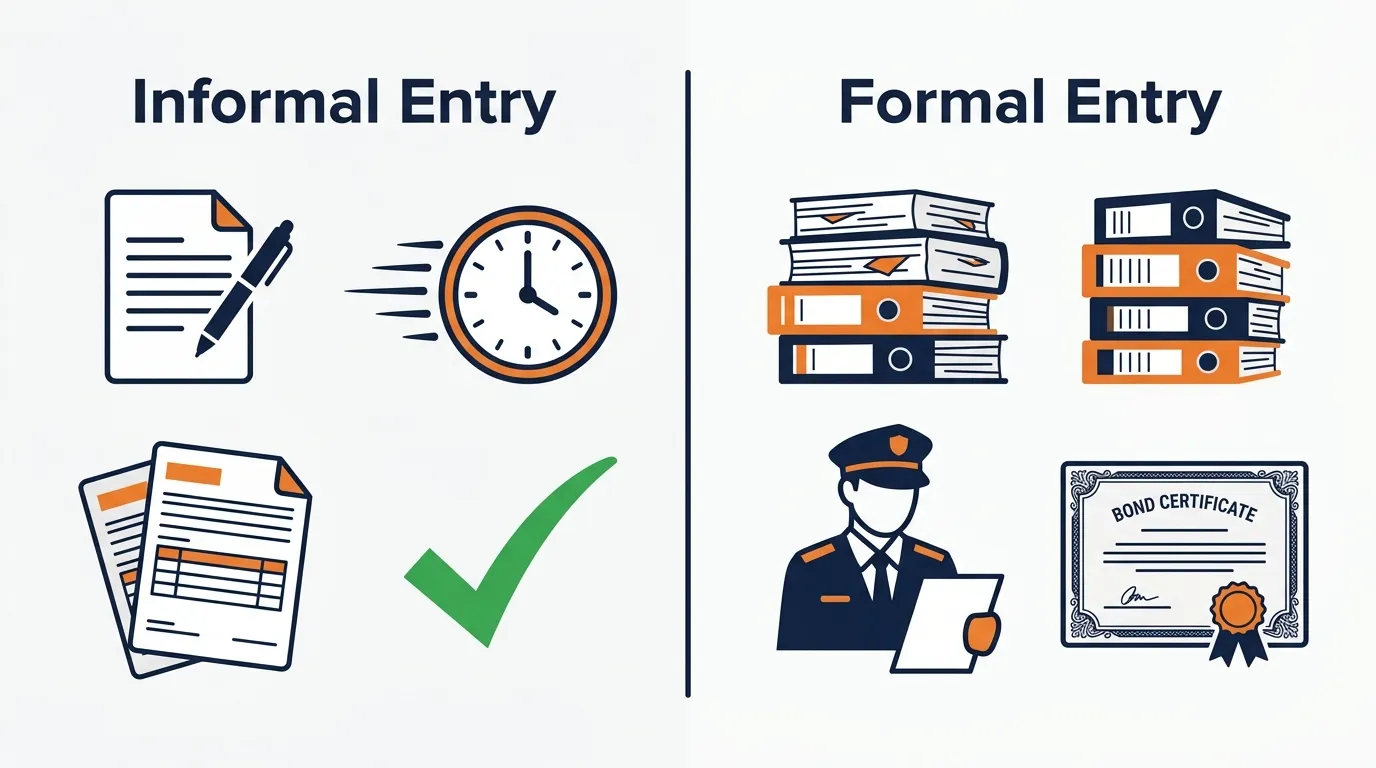
Informal entry (CBP Type 11) applies to US shipments valued at $2,500 or less with simplified documentation and no customs bond. Formal entry (CBP Type 01) is required above $2,500 or for regulated goods at any value. Formal entry requires CBP Form 7501, a customs bond, and typically a licensed customs broker.
| Factor | Informal Entry | Formal Entry |
|---|---|---|
| Value threshold | $2,500 or under | Above $2,500 |
| Value override | N/A | Regulated goods require formal entry at any value |
| Key documents | Commercial invoice, airway bill | CBP Form 7501, Form 3461, commercial invoice, packing list, bill of lading |
| Customs bond | Not required | Required (single-entry or continuous annual) |
| Broker required? | No (self-file is possible) | Strongly advised; legally required for foreign entities |
| Clearance time | Hours | 1 to 5 business days |
| Typical cost | $0 to $50 | $150 to $400+ in broker fees plus bond and MPF |
| Liquidation review | No | Yes — CBP can adjust duties for up to one year |
Source: CBP Help Center on informal entries and FDA common entry types
What Is Informal Entry — and Who It Is Actually For?
Informal entry (CBP Type 11) is a streamlined US customs clearance process for commercial shipments valued under $2,500. It requires a commercial invoice and airway bill but no customs bond. Regulated goods — including FDA-controlled products — may still require formal entry below this threshold.
Informal entry is the right path for low-value commercial shipments that are non-regulated and straightforward. Think product samples, test orders, or initial small consignments to validate a supplier before scaling. The process is faster because CBP doesn’t require a full entry summary or financial guarantee from the importer.
What informal entry is not: it is not the same as de minimis. The Section 321 exemption allowed goods valued at $800 or less to enter duty-free without any customs filing. That program was suspended for Chinese-origin goods in May 2025. Informal entry still requires a filing and still incurs duties — it’s just a simpler filing than formal entry.
Make sure your valid commercial invoice format is correct before you file. A missing or incomplete invoice is one of the top reasons informal entries get flagged for review.
What Is Formal Entry — and What Does CBP Actually Require?
Formal entry (CBP Type 01) is required for US shipments valued above $2,500 or for regulated, quota-restricted, or anti-dumping-subject goods at any value. It requires CBP Form 7501, a customs bond, a commercial invoice, packing list, and bill of lading, and is typically filed by a licensed customs broker.
The CBP Form 7501 Entry Summary is the core document. It tells CBP exactly what you’re importing, where it came from, and what duties are owed. Your broker also files CBP Form 3461 (Entry/Immediate Delivery) to request cargo release while the full entry summary is being processed.
One thing sellers often miss: formal entries go through liquidation. CBP can revise the duties you paid for up to one year after entry. That’s not a problem if your documentation is clean — but it’s a financial exposure you need to know about.
You’ll also need to meet the commercial invoice requirements for formal entry, which are stricter than informal. Seller name, buyer name, country of origin, full description of goods, unit price, and total value are all mandatory.
Single-Entry Bond vs. Continuous Bond: Which Makes Sense for Your Volume?
A customs bond is a financial guarantee to CBP that your duties and obligations will be paid. Every formal entry requires one.
A single-entry bond covers one shipment. It typically costs $50 to $100. If you’re importing once or twice a year, this is the practical choice.
A continuous bond covers all your entries for 12 months. It usually runs $300 to $600 per year, depending on your import volume. If you’re booking more than three or four formal entries annually, the math favors a continuous bond quickly. Your broker can advise based on your expected shipment schedule.
When Informal Entry Is Not Enough (Even Under $2,500)
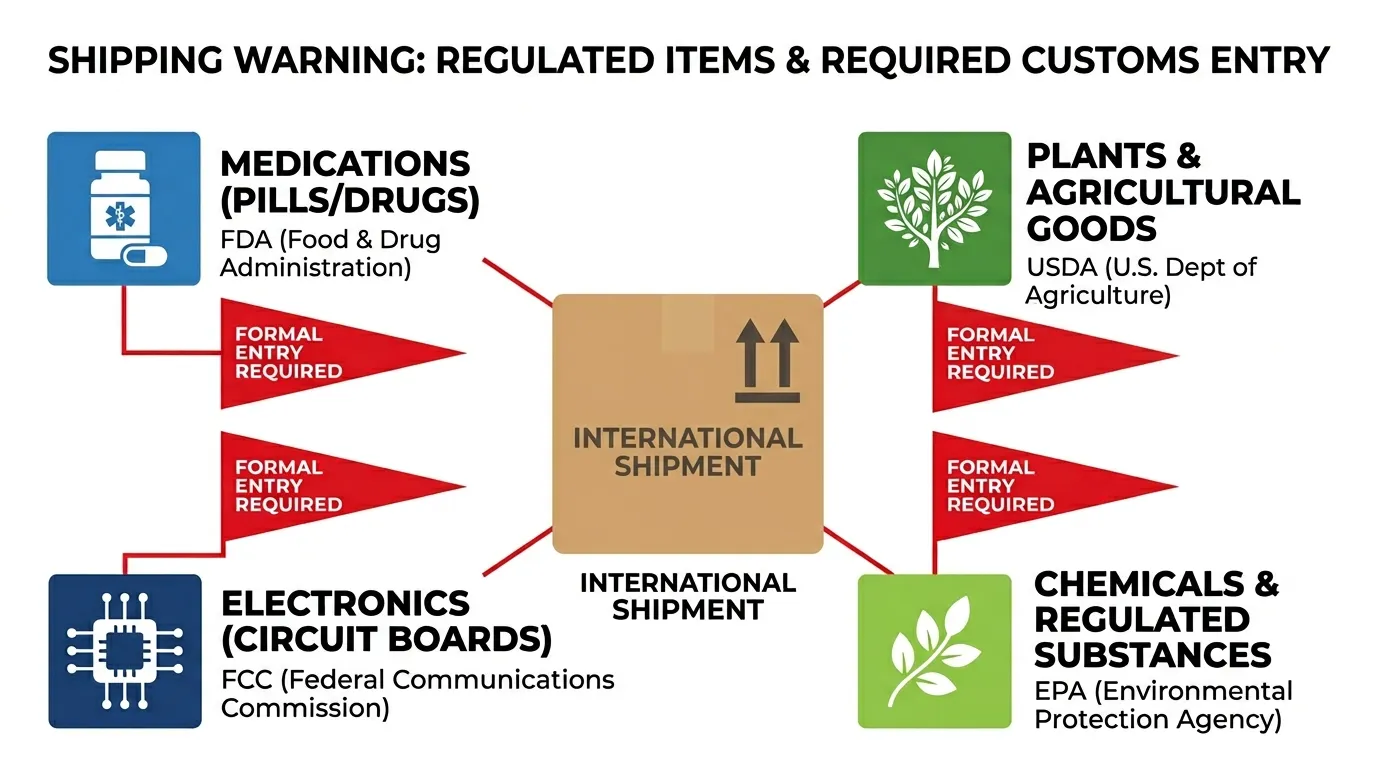
Even below $2,500, informal entry is not available for goods regulated by the FDA, USDA, EPA, or FCC. Splitting a single large shipment into multiple sub-$2,500 parcels to avoid formal entry can trigger CBP undervaluation scrutiny and does not guarantee informal processing.
This is the assumption that costs sellers the most. The $2,500 threshold is a starting point, not a guaranteed pass. CBP and partner agencies can require formal entry for any shipment based on what’s inside it.
Goods that require formal entry regardless of value include:
- FDA-regulated products: Food, dietary supplements, cosmetics, medical devices, drugs, and most personal care items
- USDA-controlled goods: Agricultural products, plants, seeds, and animal-origin materials
- EPA-regulated items: Engines, vehicles, and certain chemical products
- FCC-regulated electronics: Any device that emits radio frequency signals (this includes most consumer electronics and wireless accessories)
- Textiles subject to quota: Apparel and fabric categories with active quota restrictions
- Anti-dumping and countervailing duty goods: Steel, aluminum, solar panels, and hundreds of product categories from specific countries
- Tobacco and alcohol: Formal entry required regardless of value
Getting your correct HTS classification right before you book determines whether you fall into any of these categories. Most misclassification problems that force unexpected formal entries trace back to an incorrect HTS code chosen at the product listing stage.
Important: Some sellers try to divide a $6,000 order into three $1,999 shipments from the same factory, to the same consignee, in the same week — hoping to use informal entry three times and skip broker fees. CBP recognizes this pattern. Related-party entries with the same origin, same destination, and near-identical timing are a documented audit trigger. The cost of a CBP hold, amended entry filing, and potential penalty far exceeds the $200 to $400 in broker fees you were trying to avoid. Don’t build your import strategy around this.
Formal vs Informal Entry — Real Cost Breakdown for Ecommerce Sellers
The cost difference between informal and formal entry is real. But sellers often underestimate formal entry’s true value by ignoring the cost of getting informal entry wrong.
Here are three concrete scenarios:
| Scenario A | Scenario B | Scenario C | |
|---|---|---|---|
| Shipment | 50 Bluetooth speakers | 200 branded hoodies | Private-label protein powder |
| Declared value | $1,800 | $3,200 | $950 |
| Entry type | Informal (Type 11) | Formal (Type 01) | Formal (Type 01) — forced |
| Reason for entry type | Under $2,500, non-regulated | Over $2,500 threshold | FDA-regulated supplement |
| Broker fee | $0 (self-filed) | $250 | $250 |
| Bond cost | None | $75 (single-entry) | $75 (single-entry) |
| MPF | $32 minimum | $32 minimum | $32 minimum |
| HMF (ocean) | N/A | $4 | N/A |
| Est. clearance | 4 hours | 3 business days | 3 to 4 business days |
| Total customs cost | ~$32 | ~$357 + duties | ~$357 + duties |
| Catch | Fine if product is non-FCC. Radio components would force formal entry. | Broker caught an HTS code error that would have caused a hold. | Seller assumed informal entry was fine. CBP hold on arrival, unexpected fees. |
The MPF (Merchandise Processing Fee) is 0.3464% of cargo value, with a minimum of $32 and a maximum of $634. The HMF (Harbor Maintenance Fee) is 0.125% and applies to ocean shipments only.
Scenario C shows the real cost of assuming value equals clearance path. The seller saved nothing. They paid formal entry costs anyway — plus a hold delay that pushed their FBA restock date back two weeks.
Factor clearance type into your total landed cost estimate before you commit to a supplier price or a shipment schedule.
How the De Minimis Elimination Changed Informal Entry in 2025–2026
Since May 2, 2025, Chinese-origin goods no longer qualify for the $800 de minimis duty-free exemption. Informal entry (Type 11) is now the primary path for small-value China-sourced commercial shipments into the US, making correct entry-type selection more critical than ever.
Before May 2025, many ecommerce sellers shipping small China-origin orders relied on Section 321 — the $800 de minimis threshold — to move goods duty-free with no formal customs documentation. That pathway closed. Goods that would have entered duty-free now require at minimum an informal entry with duties applied, and goods above $2,500 require full formal entry.
There’s one positive update for sellers still working with sub-$2,500 shipments: CBP proposed reducing the informal entry limit for Chapter 99 goods (goods subject to Section 301 tariffs on China) but extended the existing $2,500 informal entry limit rather than lowering it. That means informal entry is still available for China-origin shipments under $2,500 — just not duty-free.
If your business model was built around de minimis pricing from Chinese suppliers, the strategic adjustments go well beyond entry type. The full picture of how to restructure your post-de minimis China import strategy covers sourcing alternatives, pricing recalculation, and shipment structuring options.
The Formal Entry vs Informal Entry Decision Framework
Before you book your next shipment, work through these five decision points in order. Each “yes” answer routes you to formal entry — and tells you exactly why.
Step 1: Is the shipment’s declared value above $2,500?
Yes: Formal entry required. Arrange a licensed broker and customs bond before goods leave origin.
No: Continue to Step 2.
Step 2: Is your product regulated by FDA, USDA, EPA, or FCC?
Yes: Formal entry required regardless of value. Identify which agency documentation you need (FDA Prior Notice, EPA certificate, etc.) before booking.
No: Continue to Step 3.
Step 3: Is your product subject to anti-dumping duties, countervailing duties, Section 301 tariffs, or quota restrictions?
Yes: Formal entry required. Your broker will need to file the correct ADD/CVD case number on the entry summary.
No: Continue to Step 4.
Step 4: Are you importing more than three times per year from this supplier?
Yes: Consider setting up a continuous bond and an ongoing broker relationship now. It’s cheaper than paying single-entry bond fees repeatedly, and it puts compliance infrastructure in place before your volume grows further.
No: A single-entry bond per shipment is fine for now.
Step 5: Is this shipment going to Amazon FBA?
Yes: Formal entry is almost always required for FBA inbound shipments from international origins. Amazon’s ISF filing requirements and inbound documentation standards are strict. An informal entry for a regulated or over-threshold FBA shipment creates two risks: CBP hold and Amazon rejection at the fulfillment center. Build this into your Amazon FBA inbound customs strategy from the start.
No: If all previous steps cleared, informal entry may apply to this shipment.
If any step produces a “yes,” the decision is made. The risk of choosing informal entry when formal entry is required is not just a delayed shipment. It’s an amended entry fee, a potential penalty, and a disrupted inventory timeline.
Fexbuy reviews entry type requirements as part of shipment booking, not as an afterthought at the port. If your shipment triggers any of these five conditions, we flag it before cargo moves — so you have time to arrange the right documentation, not scramble to fix it on arrival.
Factor customs cost into landed cost as soon as entry type is confirmed. The clearance path affects your margin, your restocking lead time, and your pricing to end customers.
Getting the formal entry vs informal entry decision right is not a customs formality. It’s a margin, timeline, and compliance decision that affects every shipment you scale into. Work through the five-step framework above, confirm your entry type with your freight partner before booking, and build clearance costs into your landed cost model from day one.
Frequently Asked Questions
What is the difference between informal entry and de minimis?
De minimis (Section 321) allowed shipments valued at $800 or less to enter the US duty-free with no formal customs declaration. Informal entry applies to commercial shipments valued under $2,500 and still requires documentation and duty payment — it’s simply less complex than formal entry. As of May 2025, de minimis no longer applies to Chinese-origin goods, making informal entry the key path for small China-sourced commercial parcels.
Do I need a customs broker for informal entry?
For informal entry, a licensed customs broker is not required in most cases. You can self-file if the shipment is straightforward, non-regulated, and under $2,500. If you’re unfamiliar with HTS classification or your product sits near a regulatory boundary, using a broker reduces the risk of misclassification holds — even on informal entries. The fee for broker-assisted informal entry is typically $50 to $100, which is cheap insurance on a first import.
What documents are required for formal entry into the US?
Formal entry requires CBP Form 3461 (Entry/Immediate Delivery), CBP Form 7501 (Entry Summary), a commercial invoice, a packing list, a bill of lading or airway bill, and a valid customs bond. Regulated goods require additional agency-specific documentation such as FDA Prior Notice, EPA certificates, or USDA permits, depending on the commodity. Your broker will confirm the full document set once your HTS code and country of origin are confirmed.
What is a customs bond and when is it required?
A customs bond is a financial guarantee filed with CBP that ensures import duties and regulatory obligations will be paid. It’s mandatory for all formal entry shipments. Two types exist: a single-entry bond, which covers one shipment (typically $50 to $100), and a continuous bond, which covers all entries for 12 months (typically $300 to $600 per year). If you’re importing more than three or four times per year, the continuous bond usually pays for itself within two or three shipments.
Can a shipment under $2,500 still be required to go through formal entry?
Yes. CBP can require formal entry for any shipment regardless of value if the goods are regulated by a partner government agency (FDA, USDA, EPA, FCC), are subject to anti-dumping or countervailing duties, require a quota visa, or if the port director deems formal processing necessary. Value is the primary trigger, but product classification and admissibility always take precedence. Check your HTS code before assuming the $2,500 threshold protects you.
What is liquidation in the customs formal entry process?
Liquidation is CBP’s final calculation of the duties and fees owed on a formal entry shipment. Even after CBP releases your cargo, the duties paid at entry are treated as preliminary estimates. CBP typically completes liquidation within one year. If the final amount differs from what was paid at entry, CBP issues either a bill or a refund. Informal entries don’t go through liquidation — duties are assessed and collected at the time of release.
How does formal entry affect Amazon FBA shipments?
Most Amazon FBA inbound shipments from international origins require formal entry because they involve commercial merchandise, often exceed the $2,500 threshold, and must comply with Amazon’s strict documentation and ISF filing requirements. Using informal entry for FBA shipments above the threshold, or for regulated product categories, can result in CBP holds, Amazon rejection at the fulfillment center, or both. Confirm entry type before booking, not after the shipment is in transit.


