


China to USA Ecommerce Shipping After De Minimis: What Sellers Should Change First
China to USA ecommerce shipping after de minimis now requires every seller to rethink their route, compliance documents, and pricing. The $800 duty-free exemption ended for China-origin goods on May 2, 2025. Direct parcel shipping is now the most expensive option for low-value goods. The fastest path to compliance is a five-step sequence: audit HS codes, fix customs documents, choose the right shipping route, set up U.S. fulfillment if your volume justifies it, and reset your delivery promise to customers. This guide walks through each step.
If you’re still shipping direct parcels from China to U.S. customers the way you did before May 2025, your landed cost math is broken. Every shipment now triggers formal customs entry and applicable tariffs. The sellers who move fastest on the five changes below will protect their margins. The ones who wait will keep absorbing costs that compound every order.
What Actually Changed for China-to-USA Ecommerce Sellers
As of May 2, 2025, the U.S. eliminated the de minimis exemption for all goods from China and Hong Kong. Every parcel now requires formal customs entry and faces applicable tariffs — typically 54% ad valorem on low-value postal shipments, or existing Section 301 rates of 7.5–25% on commercial entries, depending on HS code and transport mode.
Before this change, goods valued under $800 entered the U.S. duty-free under Section 321 of the Tariff Act. Over 1.36 billion de minimis packages were processed annually, with more than 60% originating from China. That flow is now fully taxable.
The two current rate structures work like this. Postal and low-value parcel shipments from China face a 54% ad valorem tariff (reduced from the original 120% after the May 2025 U.S.-China trade framework). Commercial freight entries pay the HS-code-specific duty rate plus any applicable Section 301 surcharge, which ranges from 7.5% to 25% depending on your product category. Check the applicable tariff rates by product category before making any route decision.
Your 5-Step Checklist: What to Change First
Start with your product data: verify HS codes, fix commercial invoice values, then select a shipping route that matches your volume and margin. Resetting your customer delivery promise is the last step but the one most sellers forget — formal customs entry adds 5–14 days that must be disclosed.
Work through these steps in order. Skipping to route selection before fixing your customs data creates compliance risk that costs more than the shipping change itself.
Step 1 — Audit Your Product Values and HS Codes
Under the old de minimis model, your HS code had no financial stakes. No duty meant no penalty for imprecision. That’s over. Your HS code now determines your actual duty rate, and an incorrect code creates two problems: you either overpay duties or you face a CBP customs violation when audited.
Run every active SKU through a classification review. If you don’t have in-house expertise, a licensed customs broker can verify codes in a few days. Get correct HS codes for your products before you touch your shipping setup.
Step 2 — Update Every Customs Document
Your commercial invoice must now reflect the true transaction value of every shipment. Under 19 U.S.C. § 1592, undervaluation is a customs violation. The risk has always existed, but CBP scrutiny on China-origin commercial entries has increased sharply since de minimis ended.
For ocean shipments, ISF (Importer Security Filing) — sometimes called the “10+2 filing” — is required at least 24 hours before the vessel departs China. The filing covers 10 data elements including shipper name, consignee, HS codes, and country of origin. Late or missing ISF filings carry a $5,000 penalty per vessel call. One shipment handled incorrectly can cost 8 times the value of the goods.
Review the complete commercial invoice requirements and confirm your ISF process is in place before your next ocean booking.
Step 3 — Choose a New Shipping Route
This is the decision most sellers focus on first, but it belongs at Step 3 for a reason. Your route choice depends on accurate duty rates (Step 1) and a compliant documents process (Step 2). The full comparison is in the next section.
Step 4 — Decide on Your U.S. Fulfillment Structure
Two paths exist after de minimis. You stay direct-from-China using DDP air or DDP sea, or you move to a U.S. inventory buffer using a third-party logistics provider (3PL) or Amazon FBA. The right choice depends on your SKU velocity, your average order value (AOV), and whether your operation can handle customs documentation reliably.
High-velocity SKUs with predictable demand generally favor U.S. warehouse replenishment. Low-volume, wide-catalog operations often fit better with DDP freight. The comparison table below helps you match your situation to the right model.
Step 5 — Reset Your Customer Delivery Promise
This is the step most sellers skip, and it generates the most avoidable customer service costs. Formal customs entry adds 5–14 days to U.S. delivery timelines depending on port congestion, entry type, and shipping mode. If your product pages or checkout still show pre-de minimis delivery windows, you’re creating inaccurate buyer expectations on every order.
Update your store’s estimated delivery range, your order confirmation email, and any shipping policy page before your next campaign goes live. A few hours of site updates prevents weeks of dispute management.
The Five Routes: Which China-to-USA Shipping Method Fits Your Business Now
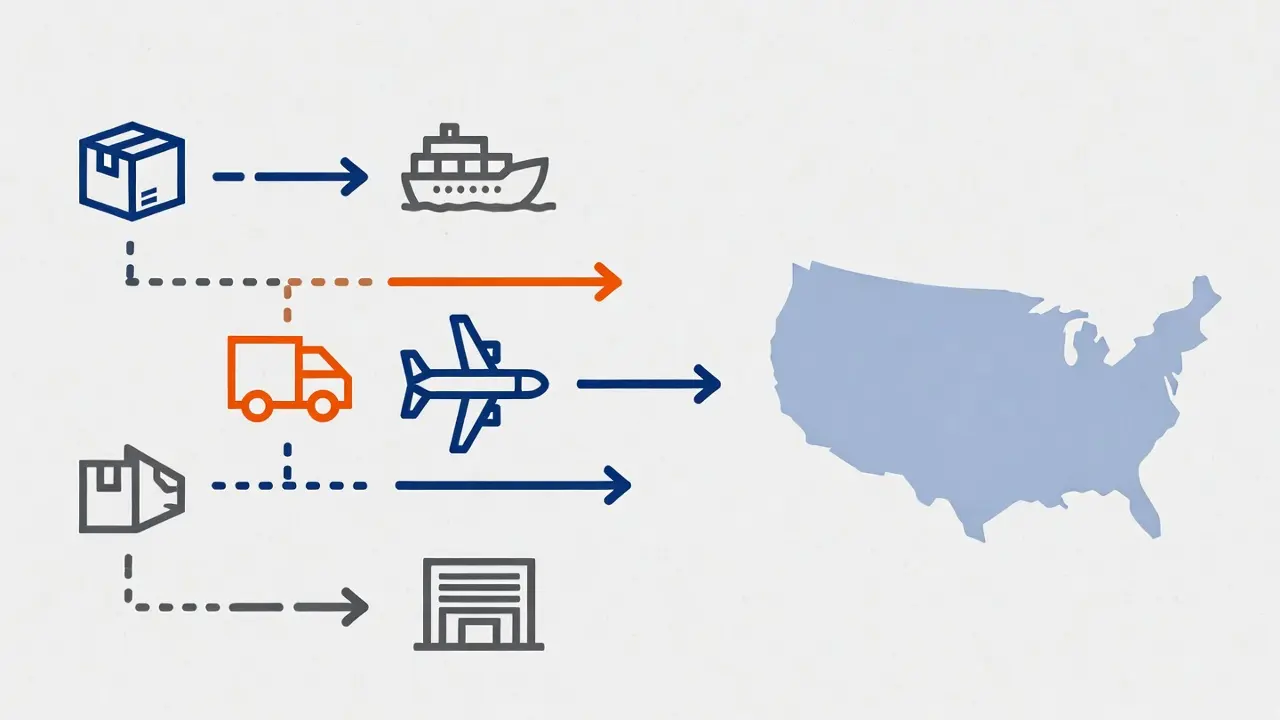
DDP freight and U.S. warehouse replenishment are the two routes that offer China sellers the best combination of compliance coverage and margin control after de minimis. Direct parcel is now the most expensive route for low-value goods from China and should be the first model you move away from.
Here is a head-to-head breakdown of all five options:
| Route | Who Handles Customs | Typical Transit (2026) | Compliance Burden | Best Fit |
|---|---|---|---|---|
| Direct parcel (postal/ePacket) | Carrier + seller | 15–30 days | High (54% postal tariff, formal entry required) | Being phased out for China origin; not recommended |
| Express courier (FedEx/DHL/UPS) | Courier acts as broker | 5–10 days | Medium (Section 301 rates + broker fee) | Urgent or high-value single orders only |
| Consolidated import (LCL sea) | Freight forwarder + customs broker | 25–40 days | Medium | Mid-volume sellers with predictable monthly demand |
| DDP freight (air or sea) | Forwarder pays duties, fully inclusive | 8–25 days (mode-dependent) | Low for seller | Sellers wanting one all-in invoice, AOV $40+ |
| U.S. warehouse replenishment (bulk to 3PL or FBA) | Handled at bulk commercial entry | 3–7 days domestic after stocking | Low per-unit, one-time per shipment | High-velocity SKUs, Amazon FBA sellers |
For ocean shipments across all routes, review the formal entry requirements for ocean shipments before booking. The entry type determines your documentation checklist and clearance timeline.
For the broader picture of how this route decision fits into your China-to-USA supply chain strategy, see the China-to-USA logistics strategy overview on the Fexbuy pillar guide.
When DDP Is Not the Right Answer
Every logistics provider defaults to recommending DDP. It’s clean, predictable, and easy to explain. But DDP is a logistics solution, not a margin solution — and that distinction matters a great deal on low-AOV products.
DDP pricing bundles your freight, duties, and the forwarder’s margin on those duties into a single per-unit cost. For products with a factory price under $15, that bundle often exceeds or severely compresses your U.S. retail margin. In those cases, the problem is not your shipping method. The problem is your product economics, and no route change solves it.
Use this table to match your situation to the right model:
| Your Situation | Recommended Route |
|---|---|
| AOV over $40, monthly volume under 500 units | DDP air or DDP sea |
| AOV under $20, monthly volume over 500 units | U.S. warehouse replenishment via LCL sea |
| AOV over $40, monthly volume over 2,000 units | U.S. warehouse replenishment via FCL |
| Urgent or seasonal restock needed | DDP express courier |
| Selling primarily on Amazon FBA | FBA replenishment via sea + Amazon inbound |
If your product price at factory is $12 and your U.S. retail price is $22, shipping direct parcel now looks like this: $12 factory cost + $3.50 shipping + $8.37 duty (54% applied to $15.50 dutiable value) = $23.87 landed. That is $1.87 more than your retail price before you’ve paid platform fees or marketing. DDP doesn’t fix this. It makes it slightly more predictable while still losing money.
The same $12 product via bulk sea replenishment to a U.S. 3PL looks like: $12 + $0.90 per-unit freight allocation + $2.70 duty (22.5% commercial rate on a properly classified SKU) = $15.60 landed. That’s a viable margin structure.
How U.S. Warehouse Replenishment Works for China Sellers
U.S. warehouse replenishment means shipping inventory in bulk to a U.S. 3PL or Amazon FBA center, paying import duties once at commercial freight rates, then fulfilling orders domestically. For high-velocity SKUs, this cuts per-unit duty cost significantly compared to parcel-by-parcel entry under the old de minimis model.
The mechanics are straightforward. You consolidate inventory at a warehouse in China, ship via LCL or FCL sea freight to a U.S. port, clear customs under a single commercial entry, and deliver to your 3PL or FBA center. From there, U.S. orders ship domestically in 2–5 days.
The part most sellers get wrong is the inventory buffer calculation. Sea transit from China averages 30 days. Customs clearance at a major U.S. port adds 5–10 days. Inland delivery to your 3PL adds another 3–5 days. That’s a 38–45 day replenishment lead time. If you sell 200 units per month, your minimum safety stock is 300 units (45 days of demand), and your first shipment needs to be at least 500 units: 300 buffer plus the 200-unit current cycle.
Sellers who size their first replenishment shipment at one month of demand consistently run out of stock during their second cycle. Size it at two to three months to cover the first full replenishment loop. For Amazon FBA-specific inbound cost planning, see Amazon FBA inbound cost planning before you book your first container.
Recalculating Landed Cost: What Sellers Get Wrong
Most China sellers calculate landed cost as factory price plus freight. That was close enough under de minimis. It is not close enough now.
The correct formula is: landed cost = factory/transaction value + international freight + import duty + customs broker fee + inland delivery to your warehouse or fulfillment center. All five components. Every time.
Here’s the same $12 product across two scenarios after de minimis, side by side:
Scenario A: Direct parcel, postal carrier
- Factory: $12.00
- Shipping: $3.50
- Duty (54% on $15.50 dutiable value): $8.37
- Handling fee: $2.00
- Landed cost: $23.87
- U.S. retail price: $22.00. Negative margin before platform fees.
Scenario B: Bulk LCL sea to U.S. 3PL
- Factory: $12.00
- Per-unit freight allocation: $0.90
- Duty (22.5% Section 301 commercial rate on $12.90 dutiable value): $2.90
- Per-unit broker fee allocation: $0.30
- Inland delivery allocation: $0.15
- Landed cost: $16.25
- U.S. retail price: $22.00. Viable margin.
The applicable Section 301 tariff rate on your commercial entry depends on your HS code. Verify your classification before building your new pricing model. For the complete landed cost methodology across different import structures, see the full landed cost framework for ecommerce imports.
How Fexbuy Helps China Sellers Rebuild U.S. Routes
Fexbuy is a China-origin logistics provider with 21 years of experience in cross-border ecommerce shipping. That origin matters. Most U.S.-facing logistics platforms manage the U.S.-side of the equation well but have limited visibility into what happens before the cargo leaves China. Fexbuy operates from the China side, which is where most post-de minimis problems actually start.
Fexbuy’s services for China-to-USA ecommerce sellers include:
- DDP air and DDP sea freight to U.S. residential addresses, commercial addresses, and Amazon FBA centers
- LCL sea consolidation from China for sellers not yet ready for full container loads
- ISF filing support and customs documentation preparation
- Specialized handling for DG (dangerous goods) and battery-containing products, which face additional restrictions most forwarders decline
- Transparent, all-in DDP pricing with no hidden fees on duties or brokerage
If you’re rebuilding your China to USA ecommerce shipping route after de minimis and need a forwarder who handles the China side completely, contact Fexbuy for a route assessment and quote.
Frequently Asked Questions
What happens to my China shipments now that de minimis is gone?
Every parcel from China and Hong Kong now requires formal customs entry and is subject to applicable tariffs, regardless of declared value. For shipments via postal carriers, the current rate is 54% ad valorem. For commercial courier and freight shipments, standard Section 301 tariffs apply, typically 7.5–25% depending on your HS code, stacked on top of any applicable base duty rate. There is no minimum value threshold for exemption from Chinese-origin goods.
Is DDP shipping from China worth it for small sellers after de minimis?
DDP works well for sellers with an average order value above approximately $40. Below that threshold, the duty costs and forwarder margin built into DDP pricing can exceed or severely compress your product margin. Small sellers with low-AOV products are often better served by transitioning to U.S. warehouse replenishment using bulk sea freight, where per-unit duty cost is substantially lower. Run the landed cost math for your specific product before choosing a route.
How do I calculate import duties on China shipments now?
Import duty is calculated as follows: take your transaction value plus international freight cost, then multiply by your applicable duty rate. Your duty rate depends on your product’s HS code plus any applicable Section 301 surcharge ranging from 7.5% to 25%. For postal de minimis shipments, a flat 54% ad valorem rate currently applies. For formal commercial entries, the HS-code-specific rate applies. Always calculate landed cost before setting your retail pricing.
Should I move my inventory to a U.S. warehouse to avoid tariffs?
Moving to a U.S. warehouse does not avoid tariffs. It changes when and how you pay them. You pay import duties once at commercial freight rates when the bulk shipment enters the U.S., which is typically a lower per-unit cost than per-parcel duties on direct shipments. The main benefits are faster domestic fulfillment and more predictable per-unit duty costs. Sellers expecting to eliminate their tax liability by using a U.S. 3PL will be disappointed.
What is an ISF filing and do I need one for China shipments?
An Importer Security Filing (ISF), also called the “10+2 filing,” is a mandatory CBP requirement due at least 24 hours before a vessel departs China for the U.S. It covers 10 data elements including shipper name, consignee, HS codes, and country of origin. Failure to file or filing late carries a $5,000 penalty per vessel call. ISF applies to ocean shipments only. Air freight and express courier shipments follow separate entry documentation requirements.
Which shipping method is cheapest from China to USA after de minimis?
On a per-unit basis, bulk sea freight to a U.S. 3PL or FBA center is the lowest landed-cost option for high-volume sellers. For sellers who cannot hold U.S. inventory, consolidated LCL sea freight on DDP terms offers the best balance of cost and compliance. Express courier is now the most expensive option per unit for low-value goods and should only be used for urgent or high-value shipments where speed justifies the cost.
How long does China-to-USA shipping take after de minimis?
Delivery times depend on the shipping mode. Express courier runs 5–10 days. DDP air freight takes 8–14 days including customs clearance. DDP sea freight runs 20–30 days. LCL consolidated sea takes 25–40 days. U.S. warehouse replenishment requires 38–45 days to restock, but once inventory is in the U.S., domestic orders deliver in 2–5 days. Factor in 5–14 days for formal customs entry on any commercial shipment.


