


Amazon FBA Inbound Placement Fee: How Sellers Can Reduce Extra Cost Before Shipping
Amazon FBA inbound placement fee is a per unit charge that covers Amazon redistributing your inventory across its network. If you ignore it, the fee quietly eats your margin. You can cut this cost by planning shipment splits, standardizing cartons and labels, and aligning China to FBA routing with Amazon’s inbound rules and fee tiers.sellerapp+2
Amazon has turned inbound placement into a real line item, not a small rounding difference. Many sellers first see it inside a settlement report after their margins already slip. This guide focuses on what you control: inventory planning, shipment splits, carton configuration, and consolidation strategy from China to FBA. You will see how each decision changes the fee and what a partner like Fexbuy can handle for you before your next shipment.sellerassistant+4
What is the Amazon FBA inbound placement fee and why did it appear on my statement?
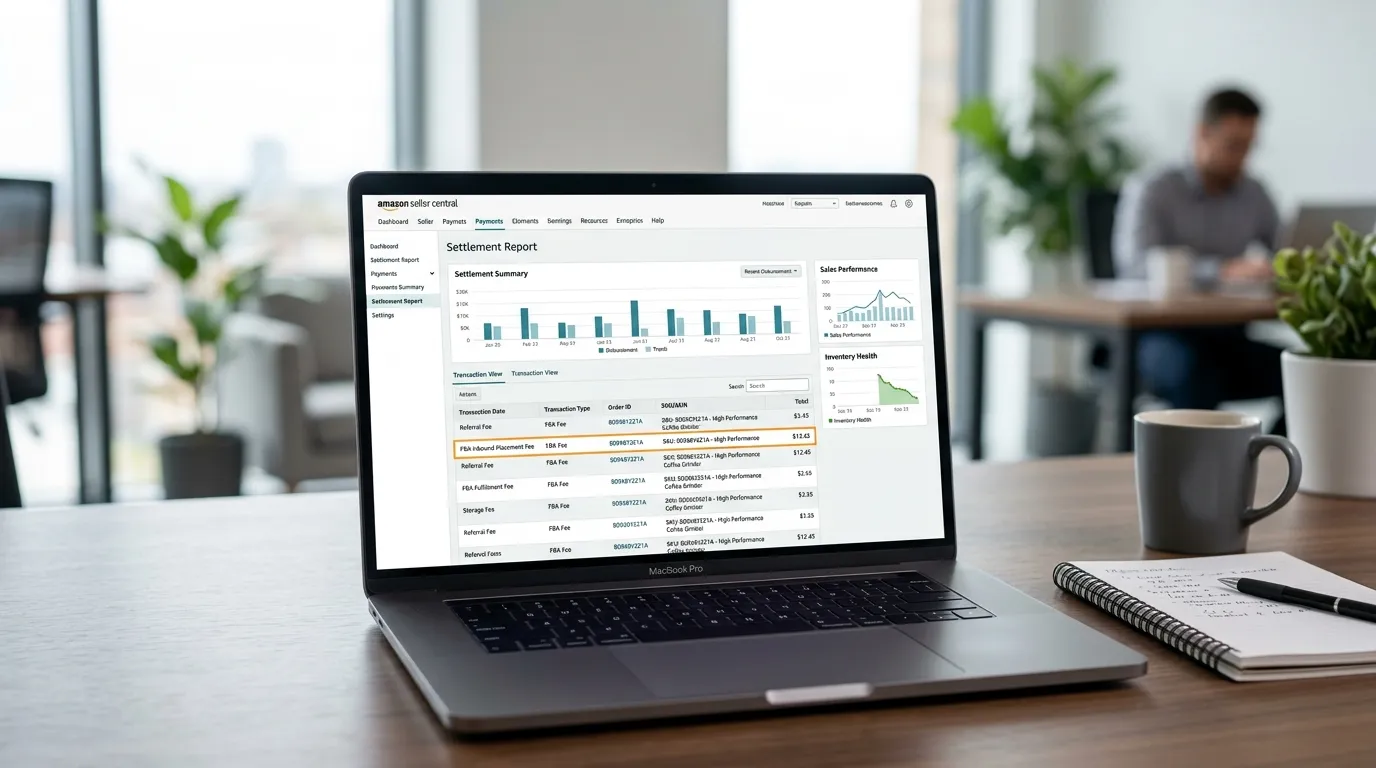
The Amazon FBA inbound placement fee is a per unit charge for Amazon to redistribute your FBA inventory across its network. It applies mainly to standard and large bulky items and is billed about 45 days after the shipment is received, based on location and quantity.ecomengine+3
In simple terms, this fee covers Amazon’s cost to move your inventory from the first fulfillment center that receives it to other locations where it expects demand. Instead of absorbing that internal transfer cost, Amazon now passes it through as a separate inbound placement line, tied to each unit in the shipment.sellercentral.amazon+2
The fee currently applies to standard size and large bulky FBA items. Extra large SKUs and certain special programs, such as some Supply Chain by Amazon flows, can follow different rules, and some new selection units may receive limited credits. The key detail is that you will not see the fee at shipment creation, you see it later in your statements and in the inbound placement report.myfbaprep+3
Amazon usually posts the fee around 45 days after receiving the shipment at its network, based on the actual units and destinations rather than the draft plan. That delay is why many sellers feel surprised: by the time the charge appears, the boxes are long gone and the shipment choices feel hard to adjust. This article connects that fee back to the choices you make before your cartons leave the factory.sellerapp+2
When you want to look at inbound placement alongside other inbound costs like prep, storage, or low inventory fees, use an overall inbound FBA cost strategy that treats every fee as part of your landed unit cost.adverio+2
How does Amazon calculate the FBA inbound placement fee for your SKUs?
Amazon calculates inbound placement fees per unit based on your product’s size tier, weight, number of fulfillment centers, and inbound region. Minimal splits to one FC cost the most, partial splits cost less, and Amazon optimized multi FC shipments can reduce the fee to zero for eligible SKUs.forceget+4
There is no single flat rate. Amazon looks at your SKU’s size tier and weight, then looks at how many fulfillment centers you choose to ship to and where those centers sit in its network. Minimal splits, which send everything to one building, carry higher per unit fees. Partial splits send to a small group of locations for a lower rate. Amazon optimized splits send to more FCs, sometimes for no placement charge.sellerassistant+3
Size tier and weight are the first big inputs. Standard size products sit in fee bands that often range from roughly 0.21 to 0.68 dollars per unit in high cost minimal split scenarios, while large bulky products can reach 2.16 to 6 dollars per unit if you insist on single destination shipments. Fulfillment centers in certain western regions usually sit in higher cost zones than central regions.shipsage+3
Amazon also considers whether you accept its recommended optimized paths. If you agree to ship enough identical cartons of an eligible SKU into four or more FCs that Amazon selects, the inbound placement fee can be reduced to zero. EcomEngine notes that you generally need at least five identical cartons for a SKU to qualify for zero fee optimized placement. That is where carton planning becomes important.ecomengine
You will then see the final charges in your settlement reports and in Amazon’s dedicated inbound placement service fee report. The report breaks fees down by shipment and SKU, which is critical for calculating per unit impact and deciding which products need a different plan.sellercentral.amazon+1
Realistic fee ranges by tier
You do not need to memorize every cell of Amazon’s fee table, but it helps to know the bands you are playing in:
- Standard size items often fall in a range of about 0.21 to 0.68 dollars per unit for minimal splits, with lower numbers when you accept more locations.forceget+2
- Large bulky products can see fees around 2 to 6 dollars per unit in 2024 minimal split scenarios, especially when shipping to expensive regions.shipsage+3
These are the numbers you will test against your margins when you decide whether to pay the fee or redesign the shipment.
What changed in 2025 and 2026 that affects inbound placement cost and risk?
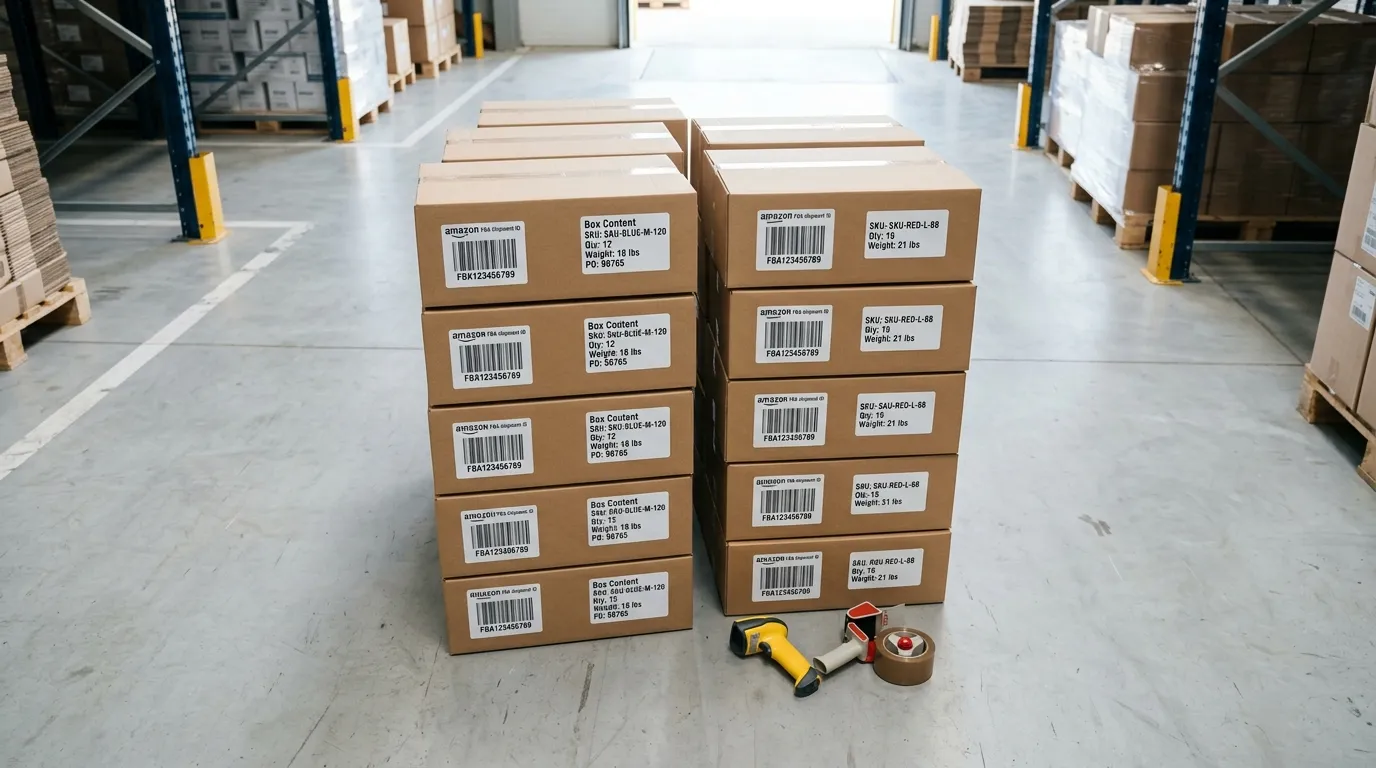
From January 2025, large bulky minimal split fees fall by roughly 0.58 dollars per unit, while standard items stay in the 0.21 to 0.44 dollar range. In 2026, inbound defect penalties jump to roughly 0.32 to 5.72 dollars per unit, which makes non compliant shipments far more expensive.sellerlabs+2
Amazon did not freeze the inbound placement schedule after 2024. In 2025, it reduced certain minimal split fees for large bulky items by around 0.58 dollars per unit, which gives some breathing room to bulky sellers who ship heavy or oversized products. Standard size items, however, continue to sit in similar bands, often between 0.21 and 0.44 dollars per unit for many scenarios.ecomengine+1
At the same time, more sellers learned how to use partial and optimized splits, which shaped Amazon’s expectations. Several guides for 2025 highlight new examples where optimized splits produce zero placement fees but require more units and more identical cartons, which is easier for established SKUs than for small test runs.adverio+2
The bigger shock arrives in 2026 through inbound defect fees. SellerLabs reports that inbound defect penalties for misrouted, late, or non compliant shipments climb from a few cents to roughly 0.32 to 5.72 dollars per unit, depending on size and issue type. Those numbers are in the same order of magnitude as high inbound placement fees, so one flawed shipment can double your inbound hit.sellerlabs
That means inbound placement decisions cannot be separated from compliance and prep decisions anymore. If you chase the cheapest placement configuration but your cartons, labels, or routing create defects, the inbound defect penalty will wipe out the savings. This is where an overall inbound FBA cost strategy becomes essential, since you now balance placement, defects, storage, and other FBA charges together.myfbaprep+1
If you also import into the EU or UK, broader duty and tax impacts belong in total landed cost modeling, not in this fee specific guide.
What really drives high inbound placement costs?
Your inbound placement cost is mostly driven by product size tier and weight, how many fulfillment centers you ship to, where those FCs are, and how cleanly your cartons and box data match Amazon’s requirements. Standardizing cartons and shipping to more FCs can sharply cut per unit fees.sellerapp+4
At a high level, the same physical traits that affect your outbound FBA fees also affect inbound placement. Bigger and heavier items cost more for Amazon to distribute, especially when you insist on single destination shipments to high cost regions. On top of that, Amazon now looks closely at how predictable and consistent your cartons are, and how accurate your box level content information is in Seller Central.sellerassistant+1
To make this practical, it helps to map each driver to specific actions.
Inbound placement fee drivers and mitigation options
| Fee driver | How it raises cost | Mitigation lever | Where to act |
|---|---|---|---|
| Size tier and dimensional weight | Larger dimensional size moves SKUs into higher placement bands for both minimal and partial splits | Redesign packaging to reduce dimensions or reclassify borderline SKUs into lower tiers | Product and packaging design |
| Actual and chargeable weight | Heavy units are expensive for Amazon to redistribute, especially if shipped to one distant FC | Use realistic weight bands when planning, and test if small design changes reduce weight class | Product and packaging design |
| Number of FCs in the plan | Sending everything to one FC triggers the highest minimal split rates | Use partial or Amazon optimized splits for most SKUs to spread inventory and lower per unit fees | Shipment plan configuration |
| Inbound region mix | Shipping only to high cost western FCs increases placement charges | Accept a broader regional spread where Amazon’s recommended FC mix includes lower cost locations | Shipment plan configuration |
| Carton homogeneity | Mixed cartons with many SKUs reduce Amazon’s ability to move inventory efficiently | Build more homogeneous cartons per SKU, and hit minimum identical carton counts for optimized placement | Carton configuration and factory packing |
| Box level content data accuracy | Incorrect or missing box content info increases handling time and misrouting risk | Capture accurate box content details and sync them into Seller Central before shipping | Data capture at supplier and logistics partner |
| Shipment timing vs Amazon windows | Tight timelines leave little room for Amazon to route inventory optimally | Plan inbound schedules with some buffer so Amazon can execute cheapest internal transfers | Inventory planning and freight booking |
| Compliance quality and prep | Poor labels, barcodes, or prep cause inbound defects that stack on top of placement fees | Implement strict prep checks or use a prep partner so shipments meet Amazon standards consistently | Prep workflow and partner selection |
Most guides talk about size, weight, and FC count, but few treat carton homogeneity and box content as primary levers. This is where a more thoughtful plan provides an edge. Once you understand all these levers, the next step is to integrate them into a full FBA inbound cost breakdown so your SKU margins reflect reality.myfbaprep+1
How can you use shipment splits and inventory planning to reduce or eliminate the fee?
To cut inbound placement fees, avoid minimal splits for most SKUs. Plan shipments that qualify for Amazon optimized or partial splits by shipping more units in standardized cartons to the FC mix Amazon recommends, then use inventory planning to keep 30 to 60 days of stock across regions.forceget+4
You do not have to accept minimal splits as the default. Minimal splits send everything to one FC, which is convenient for freight quoting but usually carries the highest per unit placement fee. Partial and Amazon optimized splits send inventory to more FCs, and that can reduce or completely remove the fee if you plan properly.sellerapp+3
A practical sequence looks like this:
- Decide which SKUs should use partial splits and which can target Amazon optimized. High volume, stable products are usually better candidates for optimized placement than small tests.adverio+2
- Work backward from those choices to carton counts. For Amazon optimized placement, aim to ship at least five identical cartons for a SKU so you meet Amazon’s minimum for zero fee placement.ecomengine
- For each SKU, plan 30 to 60 days of cover in each region that Amazon serves and ship that quantity in one cohesive wave instead of many tiny shipments.myfbaprep+1
Example: 2 lb standard size SKU, 2,000 unit shipment
Consider a 2 lb standard size product where you plan to send 2,000 units from China to FBA. A minimal split that sends everything to a single central FC might carry a placement fee around 0.49 dollars per unit, which is roughly 980 dollars for the shipment. If your margin per unit is only 4 dollars, this eats about 12 to 13 percent of your profit.adverio
If you instead accept a partial split across several FCs, the same guides show fees around 0.34 dollars per unit, or 680 dollars on 2,000 units. For eligible SKUs that qualify for Amazon optimized placement with enough identical cartons, the fee can drop to zero, shifting the focus back to freight cost and internal distribution that Amazon handles.adverio
The trade off is that you must be able to forecast demand by region and keep stock balanced. Inventory planning becomes the foundation. Once you have that in place, you can even align this with cross border fulfillment and returns so your broader network supports the inbound plan.
How do carton configuration, labels, and data quality affect placement fees and inbound defect penalties?
Standardized cartons and accurate box level data help you qualify for cheaper or zero inbound placement fees and avoid 2026 inbound defect penalties. Mixed cartons, misrouted shipments, or missing labels can trigger both higher placement charges and defect fees of up to several dollars per unit.sellerlabs+3
Amazon’s internal movement model rewards predictability. When your cartons are clean and consistent, Amazon can move them in bulk across its network with less manual work. When cartons are mixed or mislabeled, or when box content data is missing, every move becomes more expensive and more risky. That cost shows up first as placement fees and then as defect penalties.sellerassistant+2
A few specific patterns cause trouble. Sending mixed cartons crammed with many ASINs makes it harder for Amazon to route only the SKUs that sell well in a region. Incorrect or missing box content details in Seller Central create mismatches between what your shipment claims to include and what Amazon scans at receiving. Poor or missing labels force manual intervention at the dock and increase the chance of misrouted boxes.sellerlabs+2
EcomEngine points out that Amazon optimized placement expects at least five identical cartons for a SKU to qualify for zero fee optimized routing. That is not only about carton count. Those cartons must be consistent in content and labeling. If you treat cartons as random containers of product, you will not meet the threshold and your fees will remain high.ecomengine
If then impact of carton and data quality
| Carton or data situation | What Amazon does | Impact on fees |
|---|---|---|
| Identical cartons per SKU with correct labels and box content | Routes units efficiently across the network, often qualifies for Amazon optimized placement | Lower or zero inbound placement fee, minimal defect risk |
| Mixed cartons with many SKUs and partial labels | Requires more handling to separate units, increases misrouting risk | Higher effective placement cost, increased chance of defect penalties |
| Missing or wrong box level content data | Delays receiving and increases checks to confirm contents | Risk of inbound defects alongside normal placement charges |
| Inconsistent carton sizes for same SKU | Limits Amazon’s ability to batch move units | Less chance of optimized placement, higher per unit cost over time |
How do customs delays and China to USA routing interact with inbound placement and defect timing rules?
Customs delays do not change the inbound placement fee rate, but they increase the risk of inbound defect penalties and stockouts. Amazon expects international FBA shipments to arrive within about 75 days, so tight timelines and split shipments from China need buffer and coordinated routing to stay compliant.amzprep+3
From Amazon’s perspective, inbound placement fees depend on product attributes and FC destinations, not on how smooth your customs experience is. However, customs delays and routing choices affect when shipments arrive and how Amazon measures compliance against its timing expectations, especially for international shipments from China.sellercentral.amazon+2
EcomEngine describes Amazon’s expectation that domestic FBA shipments reach FCs within about 45 days, while international shipments are expected within roughly 75 days. It also notes that additional split shipments for a plan should arrive within about 30 days of the first delivery. If customs or routing issues push you outside those windows, you are more likely to see inbound defects and receive inventory too late to meet demand.ecomengine
The broader 2026 fee schedule means those defects are no longer minor. SellerLabs reports inbound defect penalties in the 0.32 to 5.72 dollar per unit range, depending on issue and size, which quickly escalates the cost of any shipment that runs into trouble. Combine that with placement fees and you can see several dollars of inbound cost per unit for a flawed shipment.sellerlabs
Scenario: delayed China sea shipment vs air freight plus consolidation
Imagine a sea freight shipment that leaves Shenzhen with a tight timeline and minimal buffer. It consists of mixed cartons for several SKUs, headed to a single west coast FC under a minimal split plan. Customs selects the container for inspection, delaying it by three weeks. The shipment arrives later than the rough 75 day expectation, some cartons are misrouted, and receiving reports inbound defects on labeling and box content.amzprep+1
You now face full minimal split placement fees, inbound defect fees per unit, and stockouts that hurt Buy Box performance. Contrast this with a plan that routes pallets to a China based consolidator like Fexbuy, standardizes cartons, and uses a mix of air and sea so critical stock arrives within a safe time buffer. The second plan is more likely to meet Amazon’s timing rules and avoid defects, even if freight cost is slightly higher.
For sellers who also need to evaluate duties and de minimis impacts on these routes, China to USA logistics after de minimis is the right place for a deeper dive.
When should you accept inbound placement fees and when should you re engineer your supply chain?
You should accept inbound placement fees only on high margin, time sensitive, or fragile SKUs where multi FC shipments or packaging changes are impractical. For most products, it is safer to redesign cartons, split shipments, or use FBM or a 3PL to protect per unit profit.forceget+2
Minimal splits are tempting because they keep freight simple, but they are rarely the smart default. For many standard size SKUs, treating minimal splits as the default is a convenience tax that takes a permanent bite out of profit. If Amazon offers you an optimized or partial split and your operations can support it, you should seriously consider that path.myfbaprep+2
There are exceptions. High margin products, extremely fragile items, or special bundles that are hard to repack may justify minimal splits. The extra internal handling that Amazon avoids can translate into lower damage rates and better customer reviews. In those cases, you accept the fee with clear eyes and keep it on the P&L.
When the math does not work, you have two main alternatives. First, redesign cartons, packaging, or shipment patterns so you can qualify for lower placement fees. Second, consider Fulfilled by Merchant or a hybrid 3PL plus FBA setup for specific SKUs where inbound placement and other FBA costs combine to make the unit unprofitable. If you go the hybrid route across borders, your cross border fulfillment and returns strategy becomes a key part of the decision.myfbaprep+1
If then table: pay placement, redesign, or switch model
| SKU situation | Recommended approach | Why it works | Risk if ignored |
|---|---|---|---|
| Light, high margin standard size SKU with stable demand | Accept partial or optimized splits, keep in FBA | Preserves Prime benefits while holding placement fees at a reasonable level | Margin shrinks if you overuse minimal splits |
| Medium margin bulky SKU with high placement fee | Test carton redesign and partial splits, or shift part of volume to FBM | Reduces per unit inbound cost without losing all FBA benefits | Bulky fees plus storage can make SKU unprofitable |
| Slow moving oversized product | Route through FBM or regional 3PL instead of FBA | Avoids high placement and long term storage charges | Fees accumulate faster than sales |
| High velocity hero SKU with thin margin | Use Amazon optimized splits and tight carton planning | Maintains Buy Box performance while keeping inbound cost per unit low | A small fee increase can erase profit at scale |
| Bundle items sharing cartons | Repack so each bundle SKU has dedicated cartons where possible | Improves eligibility for optimized placement and reduces confusion at receiving | Mixed bundles cause defects and high internal handling cost |
How can a China to FBA partner like Fexbuy help you control inbound placement cost?
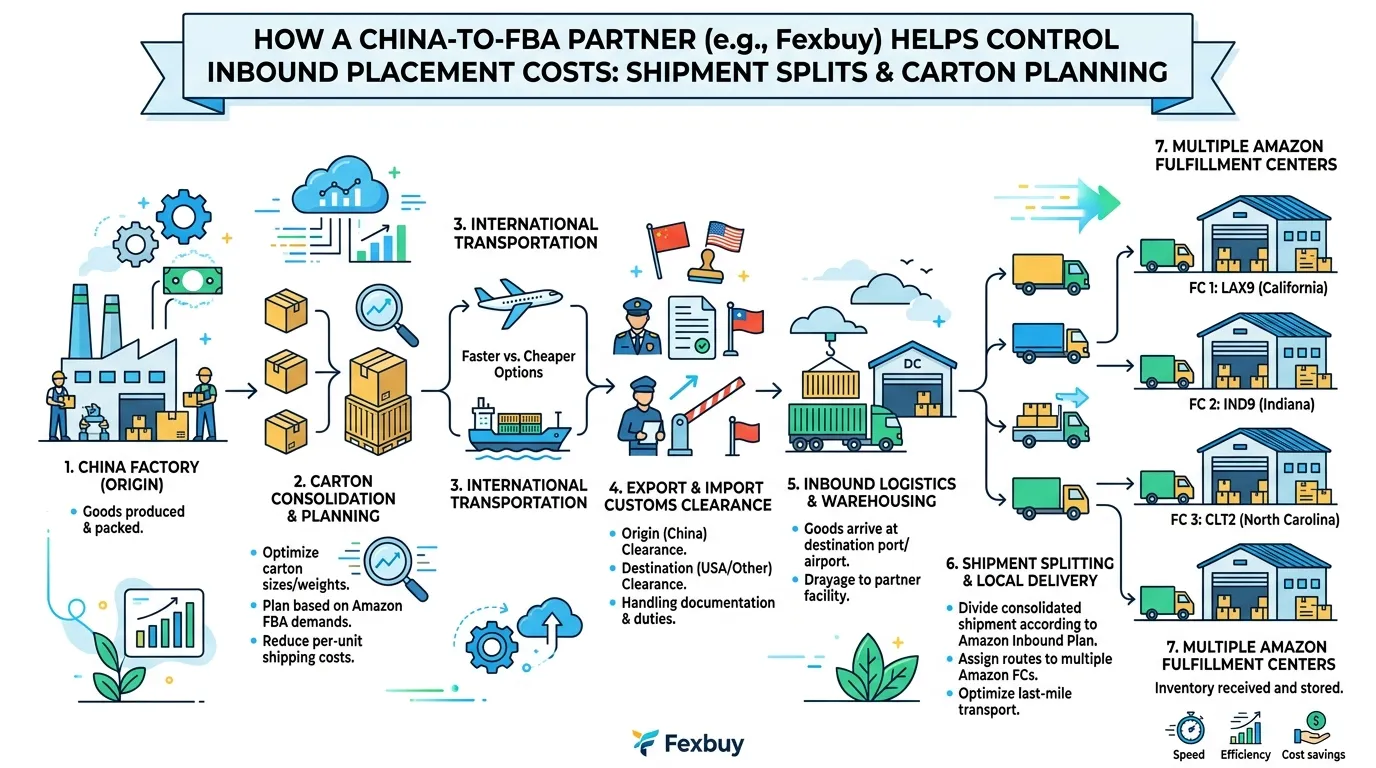
Fexbuy’s role sits upstream of Amazon’s systems. Instead of reacting to the inbound placement fee after Amazon posts it, you can design your shipments at the factory and consolidation level so that they qualify for better placements. That begins with how your supplier loads cartons and how your logistics partner groups and routes those cartons on the way to FBA.
A China based partner can pick up from multiple suppliers, consolidate at origin, and build carton plans that are tailored for your most important SKUs. That means agreed carton dimensions, consistent unit counts, and clear box labels that respect Amazon’s expectations. It also includes capturing accurate carton data at the warehouse and sharing it in a format your team can upload as box level content.sellerassistant+1
From there, the same partner can coordinate the freight mode and routing for each shipment so the plan lines up with your chosen split type. If you want Amazon optimized placement, they help you build the volume and identical cartons needed. If you prefer partial splits for some SKUs, they can structure pallets and containers by destination, which simplifies customs and trucking while still keeping per unit costs in check.forceget+2
Fexbuy already works in this way for global ecommerce shippers. Its China to FBA logistics services are built around predictable transit, clean documentation, and routes that match your inbound settings, not just the cheapest spot quote of the day. That is the difference between treating inbound placement as a surprise fee and using it as a lever you control.
What should you do before creating your next inbound shipment?
Before your next inbound shipment, review inbound placement and defect fees per SKU, choose minimal or Amazon optimized splits intentionally, standardize cartons and labels, and align your China to FBA logistics partner with those settings so cartons, routing, and timelines support your cost strategy.sellerassistant+4
Your next shipment is the first chance to apply these ideas. Start by pulling the inbound placement service fee report and settlement statements, then calculate the per unit placement cost for your top SKUs. Flag products where placement and defect fees have grown faster than sales, since those are the first candidates for change.sellercentral.amazon+2
Pre shipment checklist
- Confirm your target split type for each key SKU, for example partial or Amazon optimized instead of minimal by default.sellerapp+2
- Work with suppliers and Fexbuy to standardize carton sizes and unit counts, and to create at least five identical cartons where optimized placement makes sense.adverio+1
- Clean up box level content and label data before cartons leave China, then match your freight mode and routing so shipments arrive within Amazon’s timing windows.sellercentral.amazon+2
By turning this checklist into a recurring step, inbound placement stops being a surprise line and becomes just another planned cost inside your broader comprehensive Amazon inbound cost framework.myfbaprep+1
What to Do Next
You do not need to fix every SKU at once. Start with the products where the Amazon FBA inbound placement fee and 2026 defect penalties hurt you the most. For those SKUs, rework carton plans, accept smarter splits, and adjust routes from China. When you are ready to roll this out across your catalog, sit down with Fexbuy and map your factory pickups, carton data, and inbound plans into a clear monthly playbook that keeps fees where they belong.forceget+3
Frequently Asked Questions
When is the Amazon FBA inbound placement fee actually charged?
Amazon usually charges the inbound placement fee about 45 days after your shipment is received at its fulfillment centers. The amount is based on where units actually went and appears on settlement statements and in the FBA inbound placement service fee report.sellercentral.amazon+3
Do inbound placement fees apply to every ASIN I send to FBA?
No. The inbound placement fee applies mainly to standard and large bulky FBA items. Extra large items and some inventory handled through Supply Chain by Amazon or similar programs can follow different rules, and new selection ASINs may receive limited fee waivers for initial units.sellerassistant+2
Can I completely avoid Amazon FBA inbound placement fees?
You can often reduce the inbound placement fee to zero by using Amazon optimized splits and shipping standardized cartons of eligible SKUs to the FC mix Amazon recommends. In other cases you may only be able to minimize the fee, so upstream carton and shipment strategy still matters.forceget+4
How do inbound defect fees relate to inbound placement fees in 2026?
Inbound defect fees for misrouted, late, or non compliant shipments increase sharply in 2026, with penalties reported in the 0.32 to 5.72 dollar per unit range. These charges stack on top of any inbound placement fees, so poor prep or routing can turn a single shipment into a major cost hit.sellerlabs+1
Should I switch some SKUs from FBA to FBM because of inbound placement fees?
FBM or a hybrid model can make sense for bulky, slow moving, or low margin SKUs where inbound placement fees and storage charges combine to erase profit. For high velocity SKUs with strong Prime conversion, it often pays to keep them in FBA and optimize splits, cartons, and routing instead.forceget+2
Where can I see the exact inbound placement fees Amazon charged for each shipment?
You can see inbound placement fees in your settlement reports and in the FBA inbound placement service fee report inside Seller Central. That report breaks totals down by shipment and SKU and highlights whether your plans were compliant or triggered inbound defects.sellercentral.amazon+1


