


US Warehouse vs Direct Shipping from China: Which Model Protects Margin After Customs Changes?
Choosing between US warehouse and direct shipping from China is now a margin decision, not just a logistics one. Direct shipping from China protects cash flow with no upfront inventory investment. US warehousing protects margin predictability and delivery speed, which matters now that the de minimis exemption for Chinese goods has ended and every direct shipment faces full duty assessment. For most sellers above 500 orders per month, US warehousing produces a lower all-in cost per unit. Below that threshold, direct shipping still wins on capital efficiency.
The customs landscape shifted permanently in 2025. The rules your fulfillment decision was built on no longer apply. This article walks through the real per-unit cost of each model, the volume at which US warehousing crosses to cheaper, and the scenarios where each one wins.
The One-Sentence Verdict
Direct shipping from China protects cash flow by avoiding upfront inventory investment, but US warehousing now protects margin more reliably. The end of the de minimis exemption means every direct shipment faces duties that compress per-unit profit. The right model depends on your order volume, product value, and tolerance for customs variability.
These are not trade-offs you can manage with better carrier relationships. They are structural cost differences built into the two models. The rest of this article gives you the numbers to make the decision cleanly.
What Changed in 2025 — Why This Decision Is Different Now
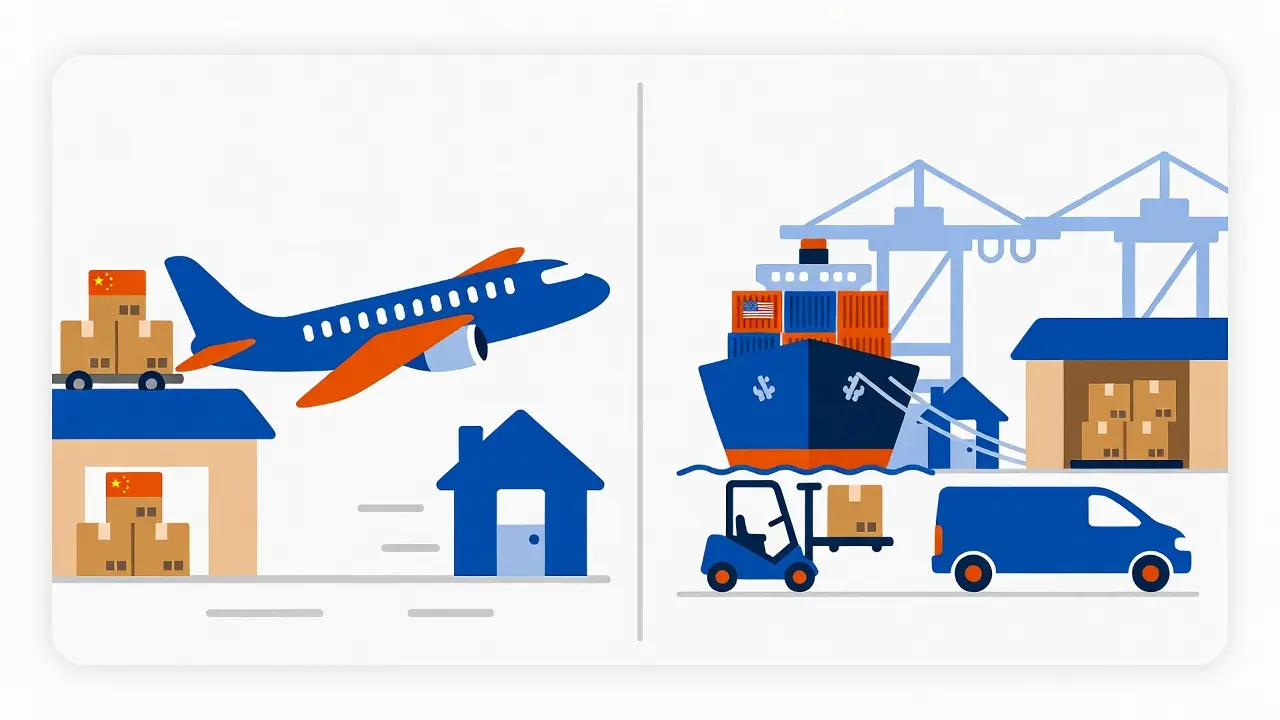
The US eliminated the de minimis exemption for goods of Chinese origin in 2025, meaning direct shipments that once entered duty-free now face full tariff assessment. Combined with elevated Section 301 tariffs, the landed cost of every direct-from-China unit has increased materially, which shifts the break-even point in favor of US warehousing for higher-volume sellers.
Before 2025, a direct shipment valued under $800 entered the US without duties. That exemption covered the majority of ecommerce orders. It is gone now for China-origin goods, confirmed by CBP as a permanent policy change, not a temporary measure.
Four things changed at once:
- The de minimis threshold dropped to zero for Chinese-origin goods
- Section 301 tariffs on most consumer product categories remained elevated, with rates published by USTR
- A reciprocal tariff framework introduced in 2025 added further cost pressure on Chinese imports
- CBP enforcement intensity on low-value shipments increased alongside the rule change
For direct shippers, this means every order now gets assessed for duties that did not exist two years ago. For US warehouse operators, the bulk inbound shipment absorbs the same tariffs but amortizes them across hundreds or thousands of units, which changes the per-unit math significantly.
For a full breakdown of how these customs changes affect your end of de minimis for Chinese shipments, the detailed compliance picture lives in that guide.
How Each Model Actually Works — Operational Mechanics
Direct shipping means product moves from a Chinese warehouse directly to your customer. Each order travels as an individual international parcel: air or express freight from China, customs clearance at the US port of entry, then last-mile delivery to the buyer’s door. Duties are assessed per shipment, per order.
US warehousing means you import product in bulk, typically by ocean freight in a container or LCL (less than container load) consolidation. That bulk shipment clears customs once at the port, duties are paid on the full batch, and the goods move into a US third-party logistics facility (3PL) or directly into Amazon FBA. Domestic orders then ship from that US location in one to three days.
The key operational difference: under direct shipping, you hold no US inventory and pay duties order by order. Under US warehousing, you hold inventory in the US and pay duties as a lump sum on inbound freight.
If you want to understand the mechanics of direct injection freight from China in more depth, that model is covered separately.
Total Cost Breakdown — What Each Model Actually Costs Per Unit
For a $25 product at 500 units per month, direct shipping from China typically runs $8 to $14 per unit in total fulfillment cost including current duties. US warehousing runs $6 to $10 per unit at the same volume once bulk freight and storage are amortized, but requires $12,000 to $20,000 in upfront working capital to maintain 60 days of stock.
Here is what goes into each model’s per-unit cost.
Direct Shipping from China — All-In Per Unit
| Cost Component | Typical Range |
|---|---|
| International express freight (per unit) | $3.50 to $6.00/kg |
| Duties and tariffs (now unavoidable) | 7.5% to 25% of product cost |
| Customs brokerage and fees | $0.50 to $1.50/unit |
| Last-mile delivery to customer | $0 to $1.50 (often bundled) |
| Return handling (at ~5% return rate) | $0.50 to $1.00/unit average |
| Total estimate (0.5 kg, $25 product) | $8 to $14/unit |
US Warehousing — All-In Per Unit
| Cost Component | Typical Range |
|---|---|
| Bulk ocean inbound freight (per unit) | $0.80 to $2.50/unit |
| Import duties on bulk shipment | 7.5% to 25% of product cost (same rate, paid once) |
| 3PL receiving fee | $0.15 to $0.30/unit |
| Monthly storage fee | $0.25 to $1.50/unit/month |
| Pick-and-pack | $2.00 to $4.00/order |
| Domestic last-mile | $5.00 to $8.00 |
| Return processing | $1.00 to $2.00/return |
| Total estimate (at 500 units/month) | $6 to $10/unit |
The surface read is that US warehousing wins on per-unit cost. That is often true at 500 or more orders per month. But it requires capital tied up in inventory. A seller holding 1,000 units of a $25 product has $25,000 in product cost sitting in a warehouse before a single sale is made.
Here is the honest position most articles skip: direct shipping is not actually cheaper than US warehousing at meaningful volume. It is lower in capital commitment but higher in cost variability. The duties you pay on each direct shipment are the same percentage as the duties on a bulk import. The difference is that bulk imports spread fixed freight and handling costs across far more units, while direct shipping pays retail-rate logistics on every single order.
For a complete methodology on calculating your full landed cost, the pillar article covers the full formula including HS code classification and insurance.
The Break-Even Table — At What Volume Does US Warehousing Win?
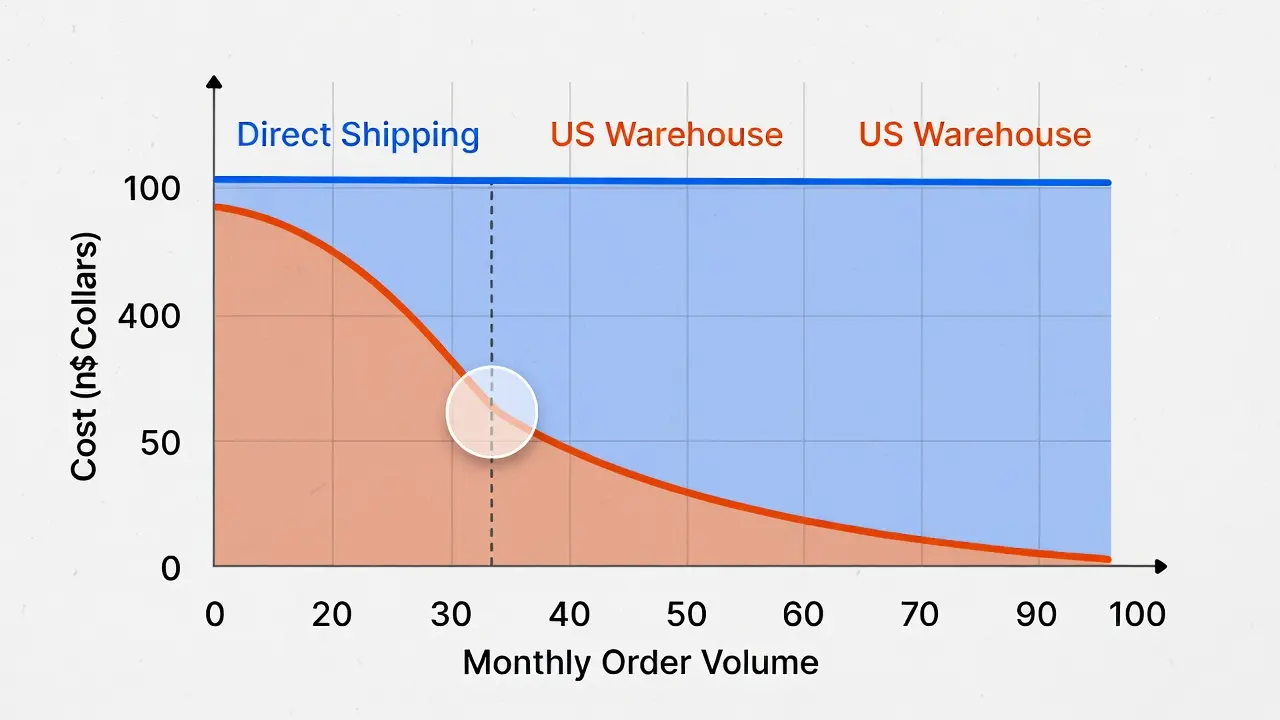
The numbers below use a baseline product: $25 retail price, 0.5 kg, standard ecommerce packaging, 15% effective duty rate. Working capital is calculated at 60 days of stock. Adjust for your product’s actual weight, value, and duty rate.
| Monthly Orders | Direct Ship Cost/Unit | US Warehouse Cost/Unit | Working Capital Required (60-day stock) | Monthly Margin Difference (per 100 units) | Recommended Model |
|---|---|---|---|---|---|
| 100 | $10.50 | $12.00 | $2,500 | Direct saves $150 | Direct shipping |
| 250 | $10.50 | $9.80 | $6,250 | Warehouse saves $175 | Borderline |
| 500 | $10.50 | $8.50 | $12,500 | Warehouse saves $500 | US warehouse |
| 1,000 | $10.50 | $7.50 | $25,000 | Warehouse saves $1,500 | US warehouse |
| 2,000 | $10.50 | $6.80 | $50,000 | Warehouse saves $2,800 | US warehouse |
| 5,000 | $10.50 | $6.20 | $125,000 | Warehouse saves $10,500 | US warehouse |
Below 300 orders per month, direct shipping wins because the working capital freed up outweighs the per-unit savings from US warehousing. Between 300 and 500 orders, it depends on your product’s storage velocity and how much capital you have available. Above 500 orders per month, US warehousing produces a lower all-in cost per unit in most product categories.
Two variables move these numbers the most. First, product weight: heavier products shift the crossover point lower because bulk ocean freight savings become larger. Second, product value: higher-value products face higher absolute duty amounts per direct shipment, which makes bulk importing more attractive at lower volumes.
To check the duty rate for your specific product category, duty rates by product category can help you run your own version of this table. The official HTS rate schedule on USITC.gov is the authoritative source for confirmed duty rates.
Inventory Risk — Who Takes the Hit When Demand Drops or Spikes
Direct shipping from China carries zero US inventory risk but high stockout risk. If demand spikes, you have no stock to ship and a three to four week replenishment window. US warehousing carries overstock and capital risk but near-zero stockout risk. For products with unpredictable demand, direct shipping is safer. For products with steady velocity, US warehousing protects revenue.
The two risks are asymmetric in a way most analyses ignore. Direct shipping’s risk is revenue loss: you cannot service fast demand, and customers buy from a competitor while your replenishment is in transit. US warehousing’s risk is capital loss: slow-moving stock accumulates storage fees and ties up working capital that could fund other SKUs.
Which risk costs more depends on your product’s margin and sales velocity. A product with 60% gross margin loses far more from a stockout than from a month of excess storage. A low-margin product on thin velocity suffers more from carrying costs than from an occasional missed sale.
Scenario C: Demand Spike. A seller moves 300 units per month on direct shipping. November hits and demand spikes to 1,200 units. The seller cannot fulfill 900 orders. At a $25 selling price and 50% margin, that is $11,250 in lost gross profit in a single month. A seller with 45 days of US stock would have had 450 units ready to ship and partially captured the spike. The replenishment order would cover the rest.
Delivery Time and Customer Experience — The Gap That Affects Refund Rates
Direct shipping from China typically delivers in 7 to 20 days to US customers. US warehouse fulfillment delivers in 1 to 3 days. The gap matters because US shoppers expect fast delivery, and slow shipping correlates with higher refund rates, negative reviews, and marketplace ranking penalties that affect future revenue, not just current orders.
This is a margin variable, not just a customer experience metric. A seller using direct shipping from China should expect a measurably higher refund rate than a seller shipping from a US warehouse, because delivery windows of 15 or more days generate buyer anxiety, disputes, and chargebacks at a rate that 2-day domestic shipping does not.
On marketplace channels, the impact compounds. Amazon and Walmart both use fulfillment speed as a ranking signal. Slower average delivery time suppresses product visibility, which reduces organic traffic, which increases reliance on paid ads to maintain sales volume. That is an additional cost that never shows up in a direct per-unit comparison but hits the P&L consistently.
If improving direct shipping speed before switching models is an option worth exploring, faster small parcel options from China covers the carrier-level alternatives.
Returns — Which Model Makes Reverse Logistics Less Painful
Returns under direct shipping from China work against you structurally. Without a US return address, customers either ship back to China (expensive, slow, and almost never worth it for low-to-mid price products) or you eat the refund and write off the unit. Most direct shippers resolve this by either absorbing returns as a fixed cost of the model or using a US-based returns aggregator who collects, inspects, and batches returns for periodic international shipment back.
US warehousing handles returns cleanly. The 3PL receives returned units, inspects them, and restocks or disposes based on condition. The cost is real, typically $1.50 to $2.50 per return processed, but it is predictable and built into the fulfillment agreement.
Scenario D: High Return Rate SKU. A seller moves 500 units per month of an apparel accessory with a 9% return rate. That is 45 returns per month. Under direct shipping, 45 write-offs at $25 per unit equals $1,125 in monthly product loss, with no recovery value. Under US warehousing at the same return rate, 45 returns are processed at $2.00 each ($90 total), and an estimated 60% are restocked and resold, recovering $675 in product value. The net difference is over $1,700 per month, just from returns handling.
Products with return rates above 5% should build US warehouse returns costs into their model comparison. For most of those products, US warehousing wins on this dimension alone.
The Hybrid Model — Buffer Stock Plus Ongoing Direct Replenishment
The hybrid model — US buffer stock for core SKUs, direct shipping for slow movers — is the structurally correct default for most sellers above 300 orders per month, not a compromise. Keep 30 to 45 days of your top five sellers in a US warehouse. Ship everything else direct from China until volume justifies local stock. This limits working capital exposure while protecting delivery speed on revenue-driving products.
Most articles present the hybrid approach as a hedge for sellers who cannot decide. That framing undersells it. For a seller with ten active SKUs, two or three of those likely drive 70% of revenue. Those high-velocity, validated products belong in US warehouse stock. The remaining SKUs with uneven demand or early-stage volume are exactly what direct shipping is designed for.
The setup looks like this:
- Identify SKUs with 300 or more consistent monthly orders and a return rate below 7%
- Move those SKUs to US warehouse stock with a 45-day safety stock buffer
- Set a reorder trigger at 20 days of remaining stock to initiate bulk replenishment from China
- Keep all other SKUs on direct shipping from China until volume crosses the threshold
- Run a bulk replenishment shipment every four to six weeks to refill US stock
This model captures domestic speed on best-sellers without over-investing across the full catalog. For Amazon sellers specifically, FBA inbound replenishment planning covers the cost structure for using FBA as the US warehousing layer.
Scenario B: New Product Launch. A seller launching a new SKU has no US demand history. Committing 1,000 units to a US warehouse at $25 per unit is $25,000 in inventory risk on an unvalidated product. Direct shipping the first 200 to 300 orders costs more per unit but validates demand with near-zero capital exposure. Once the product consistently moves 400 or more units per month, the economics justify switching to US warehouse stock.
Scenario A: The 500-Orders-Per-Month Seller. A seller moving 500 units of a $28 product at 0.4 kg uses direct shipping and pays roughly $10.80 per unit all-in including duties. Switching to US warehousing at that volume brings the per-unit cost to approximately $8.20, a saving of $2.60 per unit, or $1,300 per month. Working capital required to hold 60 days of stock is approximately $16,800. The payback period on that capital commitment is just over 13 months, without accounting for the delivery speed improvement’s effect on refund rates and marketplace ranking.
How Fexbuy Supports Both Models — One Freight Partner, Full Flexibility
Fexbuy handles both sides of this decision from a single freight relationship.
For direct shipping operations, Fexbuy manages China export freight on individual consumer shipments, including customs documentation and compliance support under the post-de minimis rules.
For US warehouse operations, Fexbuy handles bulk inbound ocean freight from China to your US 3PL or FBA, including the customs clearance and documentation required for the bulk import.
For hybrid operations, Fexbuy manages both the ongoing direct shipments and the scheduled bulk replenishment cycles, so you are not coordinating two separate freight relationships as your model evolves.
That matters practically: most sellers who start on direct shipping and grow into US warehousing have to rebuild their freight relationships from scratch. Working with a partner who covers both models means your logistics infrastructure scales with your business rather than behind it.
For a deeper look at post-de-minimis China export logistics and how Fexbuy structures compliance on outbound China freight, the full guide covers the operational detail.
Decision Flowchart — Which Model Fits Your Business
Use this five-node flowchart to find your model. Start at Node 1.
Node 1: Monthly order volume on this SKU?
- Less than 300 per month: Direct shipping wins
- 300 to 500 per month: Go to Node 2
- More than 500 per month: Go to Node 3
Node 2: Do you have $10,000 to $15,000 available as working capital for US stock?
- No: Direct shipping (reassess at 500 per month)
- Yes: Go to Node 3
Node 3: Is the product’s return rate above 5%?
- Yes: US warehouse wins (returns economics favor it)
- No: Go to Node 4
Node 4: Does your sales channel penalize slow delivery? (Amazon, Walmart, etc.)
- Yes: US warehouse wins
- No: Go to Node 5
Node 5: Is demand predictable month to month?
- Yes: US warehouse (steady velocity justifies carrying cost)
- No: Hybrid model (US stock for confirmed velocity, direct for the rest)
If you land on hybrid, start with your top three SKUs in US stock and run everything else direct from China for 60 days. Let the data tell you which SKUs earn a permanent US inventory slot.
Work With Fexbuy on Your Fulfillment Strategy
If you are ready to run the numbers on your specific products, Fexbuy’s freight team can quote both direct shipping and bulk inbound options so you can do a real comparison against your margin targets rather than industry averages.
The decision between US warehouse vs direct shipping from China comes down to one calculation: can your working capital generate a better return sitting in US inventory than it can sitting in the bank or funding other SKUs? At 500 or more orders per month for most products, the answer is yes. Below that, it depends on the specifics of your product, channel, and return rate. Either way, you now have the framework to run that calculation with real numbers.
Frequently Asked Questions
Is direct shipping from China still worth it after de minimis ended?
Direct shipping from China remains viable for sellers under 500 orders per month or for slow-moving SKUs where US inventory investment is hard to justify. The end of the de minimis exemption adds $2 to $6 per unit in duties on average for common ecommerce products. The economics still work at low volume, but they require a recalculated landed cost before committing. Sellers who have not updated their cost models since 2024 are likely running at lower margins than their reports show.
How much does US warehousing cost for ecommerce sellers?
US third-party warehousing typically costs $0.25 to $1.50 per unit per month for storage, $2.00 to $4.00 per order for pick-and-pack, and $0.15 to $0.30 per unit for receiving. Add inbound bulk freight from China (typically $0.80 to $2.50 per unit at volume) and import duties on the bulk shipment. All-in, US warehousing runs $6 to $10 per unit for a standard small-parcel ecommerce product at 500 or more orders per month.
At what order volume does US warehousing become cheaper than direct shipping?
For a typical ecommerce product priced at $20 to $40 and weighing under 1 kg, US warehousing becomes cost-competitive with direct shipping at approximately 400 to 500 orders per month. Below that threshold, the fixed costs of maintaining US stock outweigh the duty savings. Above 1,000 orders per month, US warehousing typically saves $1.50 to $3.00 per unit compared to direct shipping under current tariff conditions.
How do customs delays affect direct shipping from China profitability?
Customs delays on direct shipments from China add three to ten business days to delivery and can trigger customer cancellations, chargebacks, and marketplace performance flags. Held shipments may also face additional inspection fees or duty reclassification. Sellers should budget a three to five percent landed cost buffer for customs variability on direct shipment models. That variability cost does not apply to pre-cleared bulk imports going into US warehouse stock.
Can Amazon sellers use direct shipping from China for FBA?
Amazon does not allow direct shipping from a Chinese supplier straight into FBA without a compliant inbound process. Products must be properly labeled, packaged to FBA prep standards, and shipped through an approved inbound route. Some sellers use a US prep center as an intermediary, receiving direct shipments from China, preparing them to FBA spec, then sending to Amazon. This adds cost but keeps working capital lower than full US warehouse stocking. It works best for lower-volume SKUs being tested before committing to bulk imports.
What is the best fulfillment model for a new ecommerce seller sourcing from China?
New sellers should use direct shipping in the early stage to avoid locking working capital into US inventory before demand is validated. Start with direct shipping for the first 200 to 300 orders to confirm product-market fit and return rates. Once a SKU consistently exceeds 400 orders per month, model the US warehouse economics using your actual duty rate, weight, and 3PL quotes. The transition point is when direct shipping duty costs plus slow delivery penalties exceed US warehousing all-in cost.
Does direct shipping from China work for high-value products?
High-value products above $100 face higher absolute duty amounts on direct shipments, which can add $15 to $30 per unit under current tariff rates. For these products, US warehousing almost always produces a better margin above minimal volume thresholds. Direct shipping high-value goods from China also carries higher per-incident loss and damage exposure. If you sell premium products, the case for US warehousing is stronger at lower order volumes than a standard break-even table suggests.


