


Reverse Logistics for Ecommerce: Return Centers, Inspection, Restocking, and Reshipping Options
Reverse Logistics for Ecommerce is the process of handling products after customers send them back. A strong system routes returns to the right center, confirms receipt, inspects and grades items, then decides whether to restock, reship, repair, resell, recycle, or dispose. Cross-border sellers also need clean customs, VAT, and duty documentation before the return moves.
Returns can quietly drain profit if every item follows the same path. A $12 phone case, a missing-accessory speaker, and a $300 electronics return should not be handled the same way. The goal is to build a return flow that protects resale value, keeps refund timing clear, and avoids customs surprises. That starts with understanding what reverse logistics actually includes.
What is reverse logistics for ecommerce?
Reverse logistics for ecommerce is the process of moving returned products from customers back into a useful path: restock, exchange, repair, resale, recycle, or disposal. The goal is to recover value while keeping refunds and customer communication predictable.
In normal ecommerce shipping, goods move from seller to customer. In reverse logistics, goods move back from the customer to a seller, return center, warehouse, repair point, resale channel, recycling partner, or disposal location. DHL describes reverse logistics as goods moving back “upstream” from the customer toward the retailer or manufacturer.
The hard part is that returns are not predictable like outbound orders. Every returned item arrives with a different reason, condition, packaging status, and resale chance. That is why reverse logistics needs rules for routing, inspection, grading, refunds, exchanges, restocking, and customs records.
How does the ecommerce reverse logistics process work?
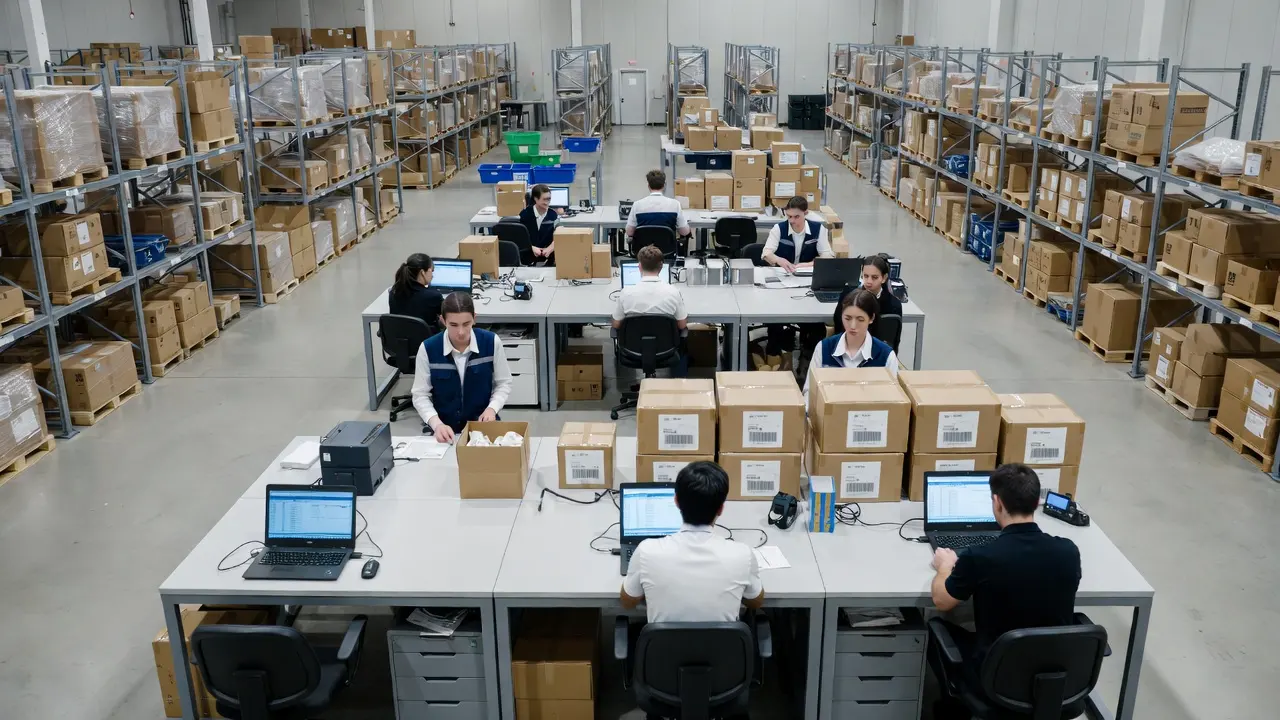
A practical ecommerce reverse logistics process starts with return authorization, then moves through return shipping, receiving, inspection, grading, and final disposition. The process ends when the refund, exchange, reshipment, restock, repair, resale, or disposal decision is completed.
The process usually starts with an RMA, or return merchandise authorization. This connects the customer return to the original order, SKU, reason code, tracking number, and refund or exchange rule. Without this link, the return center may receive the parcel but not know what to do next.
A simple reverse logistics flow looks like this:
- Customer requests a return or exchange.
- Seller approves the RMA and return method.
- Customer ships the item or drops it off.
- Return center confirms receipt.
- Team checks SKU, quantity, condition, packaging, and accessories.
- Item is graded and routed.
- Refund, exchange, reshipment, restock, repair, resale, recycling, or disposal is completed.
For international sellers, the return flow also needs tracking visibility and customs records. A seller using cross-border returns should know when the return was received, whether the item is sellable, and whether the paperwork can support VAT or duty treatment later.
Returns vs RTO: why they need different workflows
A return happens after the customer receives the order. Return-to-origin, often called RTO, happens before delivery is completed. NimbusPost separates these because the causes and fixes are different: RTO may come from failed delivery, wrong address, or refusal, while a return may come from size, damage, quality, or buyer remorse.
Treating both as the same process creates messy data. RTO should be tracked as a delivery failure issue. Customer returns should be tracked as product, policy, inspection, or customer experience issues.
Should returns go to a local return center or back to the origin warehouse?
Local return centers are usually better for fast refunds, inspection, and resale in the destination market. Sending returns back to the origin warehouse only makes sense when the item has enough value, repair need, or consolidation volume to justify cross-border shipping.
Sending every international return back to China is usually a margin leak. It works for high-value, repairable, or consolidated returns, but local inspection is safer for low-value ecommerce SKUs. A $12 phone case returned in Canada should usually go to a local return center, then be restocked, resold as open-box, or disposed of based on condition.
| Return type | Best destination | Why | Documents needed | Best next action |
|---|---|---|---|---|
| Low-value accessories | Local return center | Cross-border return shipping can exceed recovery value | RMA, order ID, item photos | Restock, resale, or disposal |
| Apparel size exchange | Local return center | Fast inspection and exchange protect the sale | RMA, SKU, size, condition check | Reship replacement |
| Electronics | Local inspection center | Needs function test and serial check | RMA, serial number, invoice | Restock, repair, or refurbish |
| Battery products | Specialist return handler | Safety and carrier rules matter | RMA, product details, safety notes | Inspect or quarantine |
| Damaged goods | Local center first | Damage proof helps claims and refunds | Photos, receipt proof, invoice | Claim, repair, or disposal |
| Warranty items | Origin or repair hub | Repair may need supplier support | Warranty record, invoice, fault note | Repair or replace |
| Rejected imports | Customs-aware route | Duty and VAT treatment may differ | Import entry, rejection proof | Claim or re-export |
| Customer exchange | Local return center | Speed keeps customer trust | RMA, exchange SKU, stock status | Reship replacement |
If duty or VAT recovery matters, plan the route before the parcel moves. The wrong return path can make returns duties recovery harder because proof, importer details, and return reason may not match the claim.
What should happen inside a return center?
A return center should confirm what arrived, check whether it matches the RMA, inspect the condition, and update the seller before refund or exchange rules trigger. It should not act like a storage room where returned parcels sit until someone checks them later.
The basic receiving checklist should include:
- Match RMA, order ID, SKU, quantity, and customer reason.
- Check packaging, accessories, labels, serial numbers, and visible damage.
- Take photos for damage, missing parts, or fraud concerns.
- Grade the item and update inventory status.
- Trigger refund, exchange, repair, resale, or disposal rules.
This is where many sellers lose control. Fast refunds are good for customer trust, but blind refunds can be risky for high-value products. For low-risk items, refund on first scan may work. For electronics, luxury goods, battery products, and serial-numbered items, receipt-based or inspection-based refund triggers are safer.
A return center should also create useful records. Photos, receipt dates, condition notes, and disposition decisions help with customer disputes, carrier claims, inventory accuracy, and customs follow-up.
How should returned products be inspected and graded?
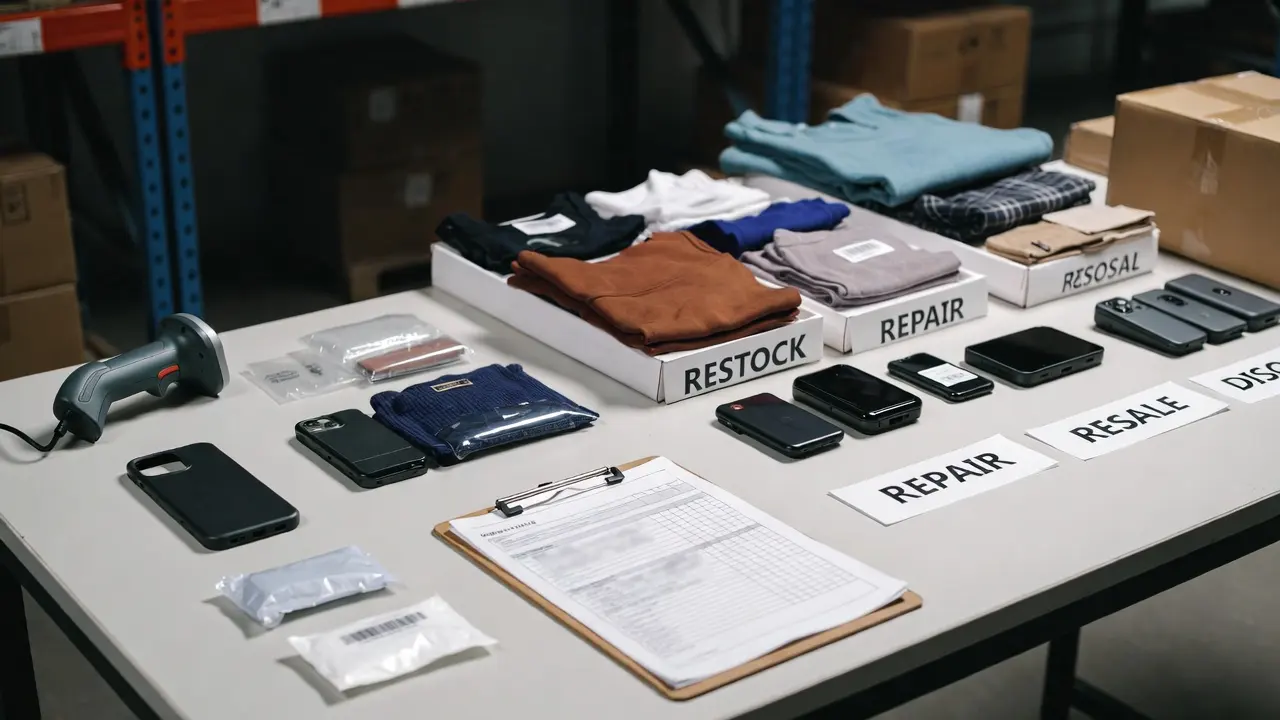
Returned products should be inspected against condition, packaging, accessories, function, safety, and resale value. The grade should decide the next action, not the customer reason alone, because a “wrong size” return can still be restockable while a damaged item may need repair or disposal.
A good inspection process is simple enough for warehouse staff to use every day. It should check what matters for resale and customer promise: is the item complete, safe, clean, functional, and packaged well enough to sell again?
| Grade | Product condition | Packaging and accessory check | Action | Refund or exchange trigger |
|---|---|---|---|---|
| Grade A | Unused or sellable as new | Original packaging and all accessories present | Restock as sellable inventory | Fast refund or exchange |
| Grade B | Open-box or minor packaging issue | Item complete, packaging may need replacement | Repack and resell as open-box | Refund after receipt |
| Grade C | Functional issue or missing low-cost part | Accessory replacement or repair needed | Repair, refurbish, or discount resale | Refund after inspection |
| Grade D | Poor resale value or major damage | Missing key parts or not economical to fix | Parts recovery, recycle, or dispose | Refund based on policy |
| Quarantine | Fraud, safety, contamination, or restricted item risk | Serial mismatch, unsafe damage, hygiene issue | Hold for review | Manual approval |
For example, a Bluetooth speaker returned without its charging cable should not be treated as a total loss too quickly. If the cable costs little and the speaker can be resold profitably, Grade C repair or accessory replacement may recover value. If the resale price is too low, liquidation or recycling may make more sense.
When should you restock, reship, repair, resell, or dispose of a return?
The right return decision depends on recovery value, item condition, customer promise, and processing cost. Restock sellable goods quickly, reship when an exchange protects revenue, repair higher-value items, and liquidate or recycle goods that lose money if handled twice.
Every return needs a disposition rule. This rule tells the team what to do after inspection. Without it, staff guess, refunds slow down, and sellable inventory may sit outside the active stock pool.
| If the return looks like this | Best decision | Why it works |
|---|---|---|
| Unused phone case in clean packaging | Restock | Low handling effort and quick resale |
| Hoodie returned for size exchange | Reship replacement | Keeps revenue instead of issuing a full refund |
| Bluetooth speaker missing cable | Repair or re-kit | Small accessory cost may protect resale value |
| $300 electronics item | Inspect before refund | Serial and function checks reduce fraud risk |
| Damaged carton but product works | Repack and resell | Packaging fix may recover most value |
| Low-value item with heavy damage | Recycle or dispose | Extra handling may cost more than resale value |
| High-value warranty item | Repair or supplier return | Recovery value justifies deeper handling |
An apparel size exchange is a good example. If a customer returns a medium hoodie and wants a large, reshipping the right size can protect the sale. A refund ends the transaction. An exchange gives the customer what they wanted and keeps inventory moving.
This decision also connects to inbound and storage cost. Sellers using Amazon or marketplace fulfillment should check their FBA inbound cost strategy before sending returned goods back into a network that may create more prep, split, storage, or handling cost.
What causes customs delays in cross-border ecommerce returns?
Customs delays in ecommerce returns usually happen when the return shipment does not clearly prove what the goods are, why they are coming back, who imported them, and whether duty or VAT relief applies. Clean RMA, invoice, MRN, EORI, and export proof reduce friction.
Cross-border returns need better paperwork than domestic returns. Customs teams need to understand whether the item is a normal import, a rejected import, a repaired item, a returned sale, or a product coming back for resale. Vague descriptions such as “return item” can create delays.
Use this customs delay checklist before moving returned goods:
- Original commercial invoice is available.
- RMA and customer return reason are recorded.
- Importer of record is clear.
- EORI is included where needed.
- MRN or import declaration reference is saved.
- Product description, value, and HS details are consistent.
- Proof of export or proof of return can be shown.
- Return reason matches the claim or relief path.
For EU sellers, EU parcel changes can affect how low-value returns are documented and reviewed. If the shipment data is incomplete, even a small return can become slow and expensive.
Returned goods vs rejected imports
Returned goods and rejected imports are not always treated the same way. The UK has guidance for Returned Goods Relief, and separate guidance for repayment or remission on rejected imports.
A UK buyer rejecting goods because cartons arrived damaged before acceptance is different from a customer returning a used product after delivery. The record should show what happened, when it happened, and why the goods are moving again.
Can ecommerce sellers recover duties or VAT on returned goods?
Duty or VAT recovery may be possible, but it depends on the country, importer of record, proof of export, return reason, and VAT registration status. Sellers should plan documentation before returns move, because missing evidence often blocks recovery later.
The UK provides Returned Goods Relief for some re-imported goods when conditions are met. The same guidance explains that VAT relief can depend on evidence and who exported and re-imported the goods. Sellers should not assume every return creates an automatic refund.
| Situation | Possible treatment | What the seller needs |
|---|---|---|
| Goods exported and later re-imported | Returned Goods Relief may apply | Export proof, re-import details, invoice |
| Goods rejected because damaged or defective | Repayment or remission may apply | Rejection proof, claim record, time control |
| UK goods sold by overseas seller | VAT rules may apply to seller role | VAT record, order data, return proof |
| EU VAT paid by eligible business | VAT refund route may apply | Member State rules and claim documents |
| Goods exported for repair and re-imported | Outward processing may help in some cases | Repair proof and customs records |
The UK also provides guidance for VAT and overseas goods sold directly to UK customers, including returned goods. For wider regional rules, sellers should review EU UK import compliance instead of trying to solve every VAT case inside a return center workflow.
EU VAT refunds depend on the business situation and Member State rules, based on the European Commission’s VAT refunds guidance. The EU also explains export and outward processing procedures, which may matter when goods are sent out for repair and later re-imported.
Which reverse logistics KPIs should ecommerce teams track?
Reverse logistics should be measured with a small set of practical KPIs. The goal is to know how fast returns are handled, how much value is recovered, and where customers or warehouses are getting stuck.
| KPI | What it tells you | Why it matters |
|---|---|---|
| Refund cycle time | Days from return request to refund | Shows customer experience speed |
| Return-to-stock time | Days from receipt to active inventory | Shows how fast sellable goods recover value |
| Restock rate | Share of returns returned to sellable stock | Shows product quality and inspection success |
| Recovery value | Money recovered after resale, repair, or liquidation | Shows whether handling is worth the cost |
| Exchange save rate | Returns converted into exchanges | Shows how much revenue is protected |
| RTO rate | Orders that fail before delivery | Shows delivery or address problems |
| WISMO contacts | “Where is my order?” or return-status contacts | Shows tracking and communication gaps |
Do not track only return volume. High return volume may come from product fit, listing accuracy, delivery damage, or customer abuse. The useful question is what the return data tells you to fix.
When should an ecommerce seller outsource reverse logistics?
An ecommerce seller should outsource reverse logistics when returns become cross-border, inspection-heavy, high-volume, or too slow for the internal team. If the product is simple and volume is low, in-house handling can still work.
| Situation | Keep in-house | Outsource |
|---|---|---|
| Low monthly return volume | Works if staff can inspect quickly | Not needed yet |
| Many cross-border returns | Hard without customs support | Better for documentation and routing |
| High-value products | Risky without clear checks | Better with serial and inspection controls |
| Apparel exchanges | Possible with simple stock rules | Useful when volume grows |
| Electronics repair | Hard without testing setup | Better with repair or refurb partners |
| Duty and VAT questions | Hard for general warehouse staff | Better with customs-aware handling |
Outsourcing is not only about labor. A good partner should provide return center coverage, inspection rules, tracking updates, customer-status visibility, photo proof, customs documents, and clear reporting. If international return taxes drive routing decisions, read more about international return taxes before choosing a return setup.
Free returns also need control. They can improve conversion, but without abuse checks and product-specific rules, they become a cost center. Keep refund rules clear, especially for electronics, luxury goods, battery products, and items that need safety checks.
What to Do Next
A strong Reverse Logistics for Ecommerce process starts with one practical decision: where each return should go after the customer sends it back. Build routing rules by product value, condition risk, resale chance, and customs needs. Then add inspection grades, refund triggers, and reshipping rules.
If you sell cross-border, do not treat customs documents as an afterthought. Keep RMA records, invoices, return reasons, proof of receipt, and import references connected from the start. That makes refunds faster, stock recovery cleaner, and duty or VAT follow-up easier to manage.
Frequently Asked Questions
What is reverse logistics?
Reverse logistics is the process of moving products back from customers after purchase. In ecommerce, it includes returns, exchanges, inspection, restocking, repair, resale, recycling, and disposal.
How does reverse logistics work?
Reverse logistics works by authorizing the return, moving the item back, confirming receipt, inspecting it, and choosing the next action. That action may be refund, exchange, restock, repair, resale, recycling, or disposal.
What are the five Rs of reverse logistics?
The five Rs are usually returns, reselling, repairs, repackaging, and recycling. Some companies use slightly different versions, but the idea is the same: recover value before sending goods to disposal.
What is an example of reverse logistics?
A simple example is a customer returning a jacket to an ecommerce seller. The seller receives it, checks the condition, repackages it if needed, and either restocks it, resells it as open-box, or refunds the customer.
How do you lower the cost of reverse logistics?
Lower the cost by routing returns to the closest useful center, inspecting items quickly, restocking sellable goods fast, and avoiding unnecessary cross-border movement. Clear return reasons and grading rules also reduce repeated handling.
Should ecommerce returns be sent back to China?
Not always. Sending returns back to China can work for high-value, repairable, or consolidated goods, but low-value returns often lose more money through shipping, customs, and handling than they recover.
Can import VAT or duties be recovered on returned goods?
Sometimes, but it depends on the country, importer, return reason, and documentation. Sellers should keep the original invoice, export proof, import declaration, MRN, EORI, and proof of return before claiming relief or repayment.


