


Power Supply Shipping: How to Clear Customs Without Being Mistaken for “Built-In Battery”
International shipping of small-batch power supplies can be deceptively tricky. One of the most common—and costly—mistakes is having your products misclassified as “containing built-in batteries” by customs. This error leads to delayed clearance, unexpected hazardous material fees, or even seizure.
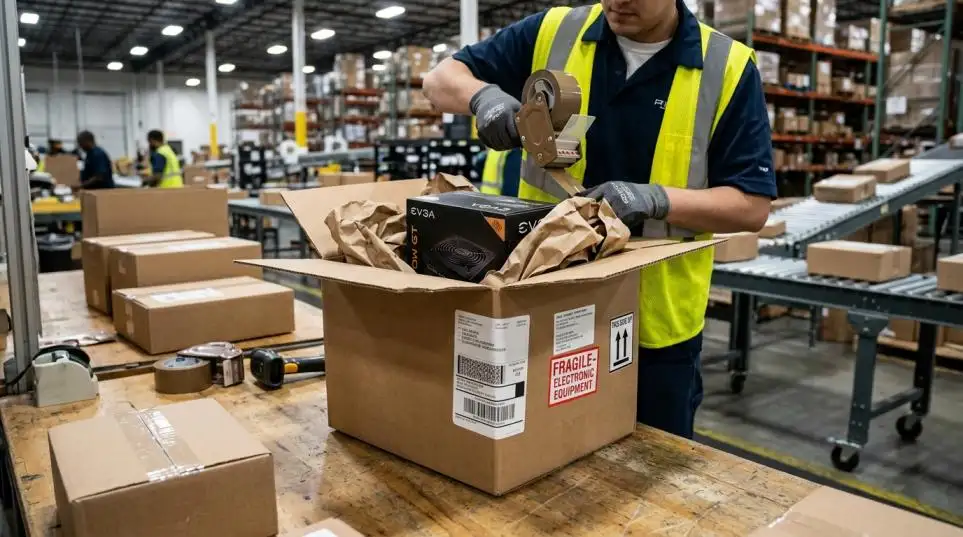
This guide covers the basics of Power Supply Shipping for small batches. In particular, we will examine correct commodity classification, required documentation, and, most importantly, how to circumvent the “built-in battery” trap.
1. Why Does Customs Confuse Power Supplies with Battery-Packing Devices?
Customs officers look at declared descriptions and HS codes and inspect the package. Custom cannot possibly get everything right. A few factors trigger an alarm:
• External resemblance – A laptop-style power adapter looks like it might house a battery.
• Incorrect terminology – Phrases like “power pack” or “energy storage” can have multiple meanings.
• Insufficient technical details – Customs officers looks at power supplies and, if they do not see a clear statement of “no battery”, they assume there is a battery and will use stricter measures.
�� Key point: Pure power supplies contain no electrochemical cells. They convert voltage (e.g., AC to DC) but do not store energy.
Common red flags in Power Supply Shipping documents:
• “Rechargeable” – never use unless it actually includes a battery.
• “Lithium-ion compatible” – this does not mean the supply itself has a battery, but it may cause confusion.
• Omitted specifications – no wattage, input/output voltage, or circuit type.
2. The Right HS Code & Product Description for Battery–Free Power Supplies
2.1 Choosing the correct HS code
For most static converters (switching power supplies, adapters, open-frame PSUs), the appropriate HS code is:
• 8504.40 – “Static converters” (under 8504.40.30, 8504.40.40, 8504.40.85 depending on capacity and use).
Compare this with battery-containing devices:
• 8507.60 – Lithium-ion accumulators (cells and batteries)
• 8504.40 combined with battery packs requires separate declarations.
Best practice for small-batch Power Supply Shipping:
• Always use HS 8504.40 and explicitly state “Does NOT contain any battery – power supply only.”
2.2 Writing a clean, safe product name
Avoid vague names like “portable charger” or “power bank”. Instead use:
• “Switching power supply – no internal battery”
• “AC-DC power adapter – battery-free”
• “Open-frame power supply – for industrial use, no cells”
Example of a bulletproof description line on commercial invoice:
Product: Power supply unit (PSU)
• Model: XYZ-123
• Function: Converts 100-240V AC to 12V DC. Contains no batteries of any type.
HS Code: 8504.40
3. Essential Documents to Prove “No Battery“ Status
For smooth Power Supply Shipping clearance, attach these three documents (even for small batches):
A. Manufacturer‘s declaration of no battery
A one-page statement signed by the sender:
• Confirms the product contains no lithium, lead-acid, NiMH, or dry cells.
• Specifies that energy storage is only in passive capacitors (discharged before shipment).
B. Product data sheet (extract)
Highlight lines showing:
• “No internal battery”
• “Input / output specifications only”
• Compliance with safety standards (UL, CE, FCC) – this indirectly proves it is a static converter, not an accumulator.
C. Packing list with battery–free annotation
Under each power supply line-item, write “Battery-free – not restricted as dangerous goods.”
�� Pro tip: Attach a small printed sticker on the outside of each shipping carton: “NO BATTERY – POWER SUPPLY ONLY.” This helps both courier staff and customs alike.
4. Small–Batch Power Supply Shipping: Courier & Box Specifics
Different carriers have their own forms and interpretation of battery rules. Here is what to watch for:
| Courier | Form / field to handle carefully |
| DHL | “Dangerous Goods” section – check “Not applicable” and add comment: “Pure power supply, no battery.” |
| FedEx | “Battery type” dropdown – select “None” and manually write “No battery installed.” |
| UPS | “Lithium battery” checkbox – leave unchecked, then in Special Handling: “No batteries, power supply only.” |
| USPS (small batch) | Use PS Form 2976 (Customs declaration) – in “Detailed description” write: “Power supply, no batteries, HS 8504.40.” |
Even if the online system asks “Does your shipment contain batteries?” – answer answer No because your cargo is truly battery-free. But beware: some automated systems automatically flag anything under 8504.40. To be safe, attach the no-battery declaration as a PDF in the electronic documents.
5. What If Customs Still Thinks It’s a Battery? (And How to Reply)
Even with the right documents, a random check may lead to a request. Common question:
• “This power supply contains a big capacitor. Does that mean it’s a battery?”
→ Answer: No, a capacitor can only store energy for a short amount of time. Provide a diagram showing the difference.
• “Why does it have a rechargeable symbol on the label?”
→ Reply: That symbol refers to the device it powers (e.g., a drill battery), not the supply itself. Clarify with a photo of the label’s context.
• “Your shipment is held for battery testing.”
→ Action: Immediately send the no-battery declaration again, plus a photo of the opened unit showing no battery compartment.
Response template (short and factual):
This shipment contains only AC-DC switching power supplies (HS 8504.40). None of the units have primary or secondary cells. Please release under non-dangerous goods classification. Attached is the manufacturer’s certificate confirming no battery.
6. 5 Quick Tips for Hassle–Free Power Supply Shipping (Small Batches)
To sum up, follow this checklist every time you prepare a small batch:
✅ Use HS code 8504.40 – never 8507 or 8517.
✅ Write “No battery – power supply only” on the commercial invoice three times line-item package description, and special instructions field).
✅ Include a signed “No battery declaration” even for 2-3 units.
✅ Take a photo of the open unit (showing empty interior) and keep it ready.
✅ Avoid trigger words: “charge”, “rechargeable”, “accumulator”, “energy bank”.
Fexbuy‘s Advantages in Power Supply Shipping Small Batches
For small-batch shipments, speed, compliance, and flexibility often matter more than large-volume freight. Fexbuy offers a reliable International Express Shipping for Small Batches solution for power supplies, lithium batteries, power banks, UPS batteries, and portable power stations.
Benefits:
• Cost-Effective For Small To Medium Orders: Orders of lower volume can be shipped for less compared to busier orders that require a full container to be shipped.
• High Time-Efficiency – Shipments move through specialized rapid-transit networks to ensure minimal airport and port dwell times.
• Simplified Shipping of Dangerous Goods: There is less of a risk to clearance denial due to custom paperwork fulfillment of UN38.3 test summary, MSDS and HS Codes.
• Less Risk of Misclassification: Customs will unlikely misclassify the shipment due to the correct labeling of the shipment and invoice.
• Great for B2B and E-Commerce: Great for returns and orders for Amazon FBA, cross-border e-commerce, and distribution.
• Freight Transparency: Customized assistance and real-time tracking with alerts.
Fexbuy combines express delivery, battery logistics expertise, and customs coordination to make small-batch Power Supply Shipping safer, faster, and more manageable worldwide.
Final Thought: Knowledge Saves Money
One misclassification can cost $50–$200 in amendment fees plus days of cargo delay. For small-batch Power Supply Shipping, the extra five minutes spent on precise documentation will protect both your delivery schedule and your profit margin.
Remember: customs officials are not engineers—they read words and codes. Give them the right descriptions, and your power supplies will sail through customs as the battery-free components they truly are.
Need a ready-to-use “No Battery Declaration” template? Contact Fexbuy’s support team — we provide it free of charge for small-scale shippers.
FAQ
Q1: What types of products can Fexbuy ship in small batches?
A: Power supplies, lithium batteries, power banks, UPS batteries, and portable power stations.
Q2 Are small batch shipments still subject to international regulations?
A: Yes absolutely. Fexbuy has the right to handle dangerous goods as DG with the evidence of compliance of UN38.3 with the customs papers.
Q3 Are e-commerce shipments such as Amazon FBA acceptable to Fexbuy?
A: Yes, small batch shipments to FBA cross border e commerce and distributor shipments are all acceptable.
Q4: How can I verify the real-time status of my small-batch shipment?
A: You can monitor your cargo through our end-to-end digital tracking system, which provides real-time milestone updates and automated delivery alerts. Additionally, our dedicated customer support team is available for direct assistance.
Q5 Will Fexbuy be liable if Customs incorrectly classifies a shipment?A: No, Customs authorities operate as independent government bodies, and the final classification or clearance decision rests entirely with them. While Fexbuy proactively mitigates this risk by pre-vetting invoices, verifying battery-free status, and ensuring proper labeling, we cannot assume liability for sovereign customs actions, random inspections, or regulatory delays.


