


Amazon FBA Seller’s Guide to Portable Power Station Shipping to USA
The increasing popularity of portable power stations on Amazon.com means more sellers will want to offer them. However, these power stations have integrated lithium-ion batteries, and, as such, are regulated as dangerous goods. Sellers using Amazon’s fulfilled by Amazon (FBA) service need to be aware of the specific shipping requirements to avoid shipment rejections, delayed storage, or even worse, a prohibition on listing. This document presents the main steps of the compliance process in a systematic format that is in alignment with industry standards.
1. The Special Handling Requirements for Portable Power Stations
The majority of portable power stations have lithium-ion battery packs with a capacity of over 100Wh. As such, these power stations generally get the following designation for the purposes of international transport regulations: UN3481: Lithium-ion batteries contained in or packed with equipment. Even though they are confined to a piece of equipment, these power modules still pose a risk of fire and thermal runaway, and therefore, are regulated.
Important factors for compliance are:
•Battery capacity (Wh rating): Larger units have more issues with carrier acceptance and more stringent packaging regulations.
•Cell configuration and quantity: Some carriers have restrictions on the total number of cells in a package/shipment.
•Wireless modules: Bluetooth and Wi-Fi may increase the FCC’s concern regarding imports.
2. Necessary Paperwork for Shipping Portable Power Stations to the USA
Customs delays and carrier rejections are often the results of missing paperwork. FBA sellers should make sure to have the following paperwork prepared:
| Document | Purpose |
| UN38.3 Test Summary | Reports that the battery pack has passed safety tests for altitude, vibration, thermal, shock, and short circuit test |
| MSDS (Material Safety Data Sheet) | Contains the battery’s chemistry and its classification, as well as guidance on how to deal with the battery in case of an emergency |
| Dangerous Goods Declaration (DGD) | Official declaration and assignment of the Dangerous Goods classification according to IATA / IMDG |
| FCC SDOC / FCC ID | Needed for goods that have wireless communication modules |
| UL or equivalent safety report | While this is not a transport safety requirement, it is often requested to be on file to satisfy Amazon’s compliance review requirements. |
�� Additional Notes:
•UN38.3 Test Summary: Generally required for lithium battery shipments and along the transport chain
•MSDS: Carriers and warehouse staff use this to formulate the battery transport safety guidelines
•DGD: Must be signed and completed by a certified DG handler
•FCC compliance: If not present, customs holds are likely to be placed on wireless devices
•UL certification: Often required during Amazon FBA safety compliance reviews
3. Dangerous Goods Review Process for Amazon FBA
Amazon assesses potential Dangerous Goods (DG) risks for inventory with lithium batteries prior to accepting such inventory at their fulfillment centers.
The process includes the following:
•Either a Safety Data Sheet (SDS) or the Amazon DG Exemption Questionnaire must be submitted.
•Battery specifications or additional compliance questions must also be submitted. Battery specifications are comprised of the watt hour rating, battery chemistry, and battery cell configuration.
Incomplete information and/or inconsistent information may result in any of the following:
•Classification of the product as a “Dangerous Good” in Amazon’s system
•Storage of the product in restricted areas of Amazon’s fulfillment centers with limited fulfillment services
•Delaying or removing the product’s listing on Amazon
The approval process for shipping Portable Power Stations to the USA will be better if the required information is prepared correctly.
4. Lithium Battery Shipment Packaging Standards
Lithium batteries pose unique risks that may be exacerbated during normal shipping, handling, and storage. The risk may be mitigated and the transport regulations may be met with proper packaging.
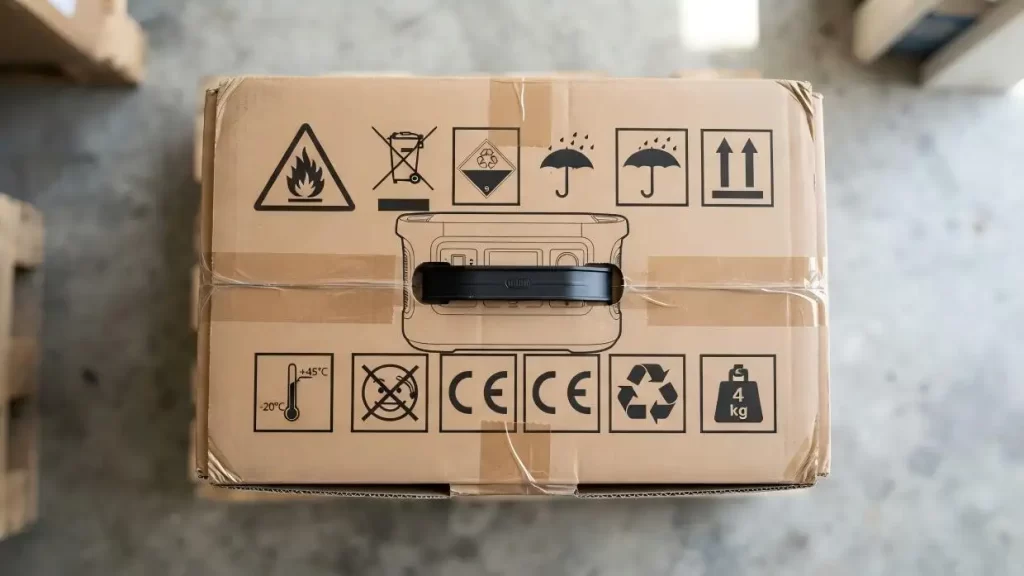
The packaging must ensure battery terminals are protected (e.g. with non-conductive tape or covers), contain cushioning to prevent damage (e.g. with foam), and must be outer packaging that has the proper UN-certified hazardous materials labeling. The outer packaging must meet the UN’s requirements for materials that have passed the various packaging tests (i.e. drop, compression, stack).
The packaging must be designed to contain the risk and ensure the product is undamaged as it is transported through and/or fulfilled by the Amazon service.
5. Comparison of Transport Modes for Portable Power Station Shipping to the USA
The various logistics methods available differ in trade-offs for cost, speed, and acceptance for transporting batteries.
| Transport Mode | Transit Time (to West Coast USA) | Battery Acceptance | Other Details |
| Express Courier (DHL, UPS, FedEx) | 3–7 days | Typically ≤100Wh under standard DG agreements | Quickest option, most expensive, and high demand for correct documentation |
| Air Freight (Consolidated) | 5–10 days | Generally supports UN3481 shipments under ~35kg gross weight | Good for time-sensitive shipments, not for large battery shipments |
| Ocean Freight (LCL/FCL) | 25–40 days | Generally broad acceptance for Class 9 DG | Least expensive; must plan for long inventory cycle |
| Dedicated Battery Logistics Lines | 10–20 days | Supports transports of lithium batteries UN3480/UN3481 | Offers DG support, documentation, and carrier coordination |
6. Customs clearance consideration in the USA
Clearing Customs is as important as having all the necessary documents
Some of the requirements are:
•Correct HS decoding: HS code is usually expected to be 8507.60.00, but this may vary based on the design of the particular product.
•Commercial invoice: An accurate commercial invoice reflecting the true value of the transaction helps to prevent disputes regarding the valuation of the goods.
•Labeling for country of origin: The country of origin must be labeled on the product and the packaging, for example, “Made In China”.
•Customs bond: This is usually recommended for the frequent importer, as it helps to facilitate the clearance of customs.
7. Requirements for preparation for FBA Warehouses
After clearing customs, proper preparation must be done for the shipments to the FBA centers.
•FBA Carton Labels: All Cartons must be labeled as FBA and DG where applicable.
•Internal Components Must be Secure: All internal components must be secure and wrappers must be designed to accommodate the need.
•Palletization: In general, there must be standard 48″ × 40″ pallets with no overhang.
•Hazard Marking Visibility: Such Hazard Communication Labels must be affixed to all four sides of the shipment.
In the absence of problems during shipment, shipment tracking should be done based on the shipment plan provided by Amazon.

Final Words for FBA Sellers
Shipping Portable Power Stations to the USA mainly consists of three elements:
•Adherence to applicable norms and standards such as UN38.3, DG, FCC, etc.
• Sufficient packaging and proper labeling
•Planning and arrangement of transport by air and sea.
Consistency in documentation, packaging, and customs activities minimizes delays and interruptions in the process in maintaining FBA inventory.
Logistics Support Overview
Fexbuy makes it easy for Amazon FBA sellers on the continent to send Portable Power Stations to the USA by providing integrated logistics solution that support compliance with battery transportation regulations. Some of the services include:
•Guidance on UN 38.3 compliance
•Packaging solutions for dangerous goods
•Air, sea and specialized transport routes for lithium batteries
•Warehousing and preparation services for FBA that are ready for dangerous goods
With logistics and transportation services from the initial pick up to final delivery, Fexbuy aids sellers in navigating the dynamic International Air Transport Association (IATA) regulations and customs requirements throughout the global supply chain.
Frequently Asked Questions
Q1. Are wireless products subject to FCC certification?
Yes, all wireless products, including Bluetooth and Wi-Fi, must be certified.
Q2. Are portable power stations considered to be dangerous goods?
Yes, they all contain lithium-ion batteries.
Q3. Are UN38.3 reports required for FBA shipments?
Yes, UN38.3 is required for the majority of lithium battery products.
Q4. Is it possible to ship power stations by air?
Yes, only under strict dangerous goods regulations and capacity limits.
Q5. What is the required label for lithium batteries?
Lithium batteries handling label along with dangerous goods markings.


