


Power Bank Sea Freight Shipping 2026: Rules, Real-World Challenges & Global Policy Updates
Starting 2026 Power, Bank Sea Freight Shipping has become even more challenging. International law creates additional challenges with a disrupted supply chain, shifting regulations on commerce, and the need for strategic planning and compliance to accompany every shipment. Here is what you need to know.
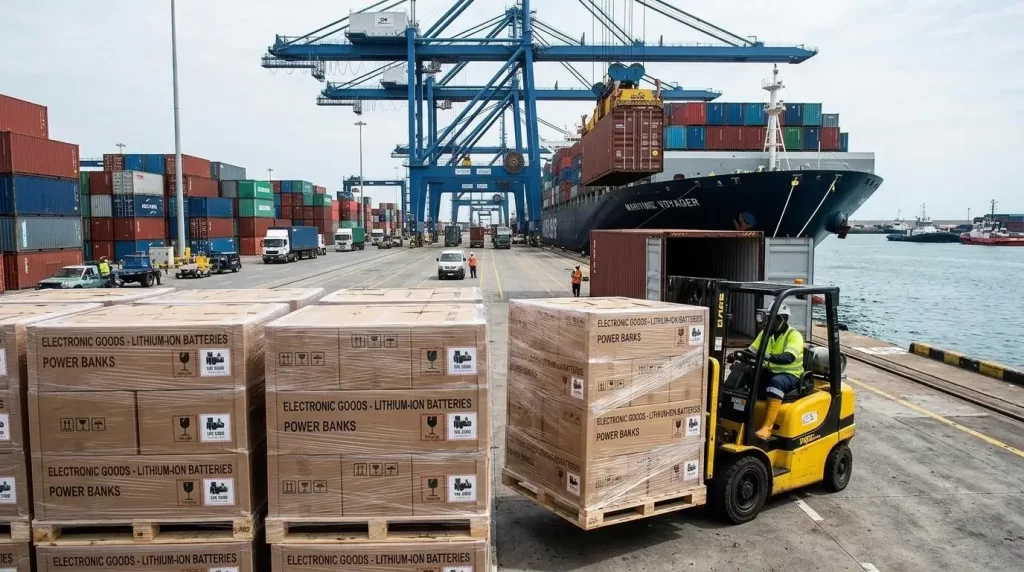
Value of Power Bank Sea Freight Shipping
Portable power banks were a USD 19.81 billion industry in 2025, are projected to be USD 22.31 billion in 2026 with a 13.02% growth rate, and 2025 showed a strong first quarter. Geopolitical tensions have raised awareness to a systems vulnerability to power (electricity) and made portable power solutions very attractive, even to the established businesses.
•The maritime transport of power banks is critical to the trade, with over 62% of power banks exported by China being shipped via ocean freight.
•Premium power banks that feature fast-charging and solar ports are in even more demand as consumers are looking to invest in better quality backup solutions to their power needs.
In the end ensuring compliance and proper planning is critical as the regulations continue to evolve around this trade. Here’s what’s new in 2026.
2026 Regulatory Overhaul: IMDG Code 42-24 Takes Effect
Effective January 1, 2026, the IMDG Code 42-24 Amendment became mandatory, bringing sweeping changes to power bank sea freight shipping.
Key Updates That Impact Power Bank Shipping:
| Change | What It Means for Power Banks |
| New UN Numbers | Sodium-ion batteries now have UN3551/3552; lithium batteries remain UN3480 (standalone) / UN3481 (embedded) |
| 9A Label Mandate | Old Class 9 labels are out. New 100×100mm 9A labels with battery symbol are required—no label = direct return |
| SoC Limit | Batteries over 100Wh (including high-capacity power banks) must be shipped at ≤30% charge |
| SOC 30% Carrier Restrictions | Standalone lithium batteries (UN3480) are increasingly subject to carrier-specific low-SoC policies—a critical booking detail often overlooked |
| Documentation Tightened | Full hazard declarations required; “general cargo” misdeclaration triggers inspections and heavy penalties |
| Stricter Packaging | UN-certified packaging, full insulation of terminals, and 1.2m drop test compliance mandatory |
Power Bank Classification Quick Guide:
•Standalone power banks (pure batteries) → UN3480
•Power banks packed with a device → UN3481
•Sodium-ion power banks → UN3551 or UN3552
Misclassification remains the most common mistake. One wrong UN number can hold your entire container at port.
Global Market Access: Key Requirements by Destination
Different countries have different rules for power bank sea freight shipping. Here’s a comparison of major markets:
| Market | Core Certifications | Key Restrictions | Risk Level |
| USA | UN38.3, UL94, FCC | ≤100Wh (up to 160Wh via select channels); EPA battery registration; CBP Section 321 enforcement tightening | ⚠️Medium-High |
| EU/UK | CE, RoHS, UN38.3, MSDS, EPR battery registration | EU Battery Regulation effective 2025; new PPWR packaging rules effective August 2026; digital battery passport by 2027 for >2kWh units | ⚠️ High |
| Japan | PSE, METI Registration | PSE certification mandatory; Japanese warning labels on all units | ⚠️ Medium |
| Australia | RCM, AS/NZS 62133 | AER battery recycling registration required | ⚠️Medium-High |
| Middle East | SASO (Saudi), UN38.3 | Shipping suspended in Q1 2026 due to Strait of Hormuz closure | ��� High |
������ US Cracks Down on Low-Value Shipments
Since August 2025, the Section 321 de minimis exemption ($800 duty‑free entry) has been largely suspended.
CBP now strictly enforces:
•Accurate HS codes and detailed cargo descriptions
•No package splitting to bypass thresholds
•Penalties up to $5,000 per violation for misdeclaration
������ EU Double Compliance: Batteries + Packaging
Power bank sellers to the EU must now comply with:
•Battery EPR Registration (already in effect since 2025) – separate registration required per EU member state. Non-compliance can lead to listing removal, account freezing, and fines up to €200,000.
•PPWR Packaging Regulation (effective August 12, 2026) – all packaging placed on the EU market must meet stricter sustainability standards.
������ Special Attention: European Major Ports
European ports have distinct enforcement priorities:
| Port | Key Focus |
| Rotterdam, Netherlands | Strict hazardous cargo segregation and container declaration checks; all documents in English/Dutch; fines up to €50,000 for misdeclaration |
| Hamburg, Germany | Batch traceability; strict verification of EU EPR battery registrations and CE compliance data; stringent local environmental storage audits |
| Felixstowe, UK | UN38.3 thermal propagation test reports; no used or damaged batteries allowed |
2026 Logistics Challenges for Power Bank Shipping
Beyond regulations, the shipping environment itself has become unpredictable.Disruptions to Red Sea and Strait of Hormuz Shipping Routes
In 2026, several disruptions to global shipping occurred due to US-Israel and US-Iran conflicts:
•March 2026: major shipping lines MSC, Maersk, and Hapag-Lloyd, among others, banned bookings for shipping to and from the Middle East
•Almost total blockage of shipping containers transiting the Strait of Hormuz
•Shipping analysts expect the Red Sea shipping route to recover from disruptions in the summer of 2026, therefore, shipping lines are forced to divert to the Cape of Good Hope which will result in longer shipping times and higher fuel costs.
World Capacity Constraints
Without considering all the disruptions occurring from geopolitical issues, shipping lines face capacity challenges in 2026. Globally, shipping:
•Is expected to grow by 3% in 2026 as predicted by DHL Global Forwarding
•Faces increasing global port congestion where 3 million TEUs get stuck at ports
•Faces a 1-2% increase in shipping in 2026, while ship lines are forced to remove vessels from operation by blank sailings
For persons shipping power banks, this means that you will have:
•Longer timeframes to schedule shipments
•More frequent alterations to shipping schedules
•Higher shipping costs compared to 2025 levels
Power Bank Sea Freight Shipping Compliance Checklist
For a successful power bank shipping sea freight in 2026, please ensure the following compliance documents are in order prior to shipping:
UN38.3 Test Report – certified on CNAS and includes 8 tests (height simulation, thermal shock, vibration, shock, external short circuit, impact, overcharge, forced discharge)
SDS (16 sections) – English version compliant with IMDG 42-24
Classification Certificate – confirming UN number and hazard class (Class 9)
Dangerous Goods Declaration (DGD) – for power banks only ☐
Class 9 Labels & Lithium Battery Mark – 100x100mm; affixed in accordance with IMDG packaging directives
SoC ≤30% – Carrier‑Specific or Highly Recommended for individual packs exceeding 100Wh
Insulated terminals – battery contacts completely covered
UN-approved packaging – passes a 1.2 meter drop test
EU: EPR battery registration – per each member state sold
EU: CE Verification and RoHS Compliance
US: EPA TSCA verification – if required
Japan: PSE verification
Final Thoughts
The Power Bank Sea Freight Shipping in 2026, is not merely moving a box from point A to point B. It is designed to address:
•A new global market with a unifying regulatory set (IMDG 42-24)
•Competing yet contrasting market regulations in the US, the EU and Asia
•Supply chain disturbances that have become a phenomenon due to political tensions
•Increased port scrutiny and enforcement
To stay the course, the smart way to go is on the path taken by shippers with expertise in moving lithium batteries, adhering to the latest regulations and controlling each step of the process with documentation, and most importantly adding time to the schedule to accommodate the new regulatory environment. The market is moving – your logistics should too.
FAQ
Q1: Can I send power banks via sea freight without declaring them as dangerous goods?
No. All power banks, whether classified as UN3480 or UN3481, are considered dangerous goods, Class 9. If sending this way, a Dangerous Goods Declaration is required.
Q2: What are the implications if the SoC (State of Charge) of my power bank exceeds 30%?
Specific carriers may refuse to load your container.In even more extreme situations, the container can be classified as a “non-compliant container.” You will incur additional fees, your shipment will be returned to you, and there is a possibility of other fines.
Q3: Do you need a UN38.3 every time you send power banks?
Indeed. The transport of a given battery model is only allowed if there is an applicable and valid UN38.3 test report. Customs and transport companies can issue an inspection at any moment.
Q4: Which countries have mandatory battery registration before they allow imports?
Power banks shipped to the EU (either through a given member state EPR registration), Japan (METI), and Australia (AER battery recycling) each require registration prior to import.
Q5: Am I allowed to ship power banks in the same container or shipment with other electronics?
Yes, as long as they are properly separated. In addition, stand-alone power banks (UN3480) must be packed with devices separately and comply with the dangerous goods regulations Cargo Transport Unit Packing Instructions.


