


Lithium Battery LCL Shipping
If your shipment is too small for FCL but too sensitive for ordinary LCL, our team checks the battery classification, documents, packing, labels, customs details, and carrier acceptance before cargo enters the DG warehouse.
What We Ship by Sea LCL
We handle less-than-container battery cargo for manufacturers, Amazon sellers, electronics brands, e-bike suppliers, power-tool distributors, solar and energy-storage buyers, and industrial importers.
Common cargo includes:
- Standalone lithium-ion battery packs
- Lithium metal batteries
- Power banks and portable energy devices
- Electronics packed with or containing batteries
- E-bike, scooter, and mobility battery products
- Power tools, garden tools, and consumer devices with batteries
- Battery-powered equipment and selected energy-storage components
Every shipment is reviewed before booking. Acceptance depends on the UN number, battery chemistry, watt-hour rating or lithium content, state of charge where applicable, battery condition, packaging, labeling, destination country, carrier route, and DG warehouse rules.
For a broader overview of battery freight options, see our lithium battery shipping service.
When Sea LCL Is Better Than FCL
LCL works best when the shipment volume is not large enough to justify a full container, but the cargo still needs controlled DG handling. It is often used for trial orders, replenishment cargo, mixed SKU orders, seasonal stock, and buyers who want to reduce upfront freight cost.
For lithium batteries, LCL is not only about sharing container space. The key issue is whether the consolidator can legally and safely load your battery cargo with compatible goods. A normal general-cargo LCL service may reject the shipment, delay it at the warehouse, or ask for corrected documents after cargo arrival. A DG forwarder should review the file first, then arrange the correct route.
| Factor | Sea LCL Battery Shipping | FCL Battery Shipping |
|---|---|---|
| Best for | Small to medium battery shipments | Large-volume battery cargo |
| Container use | Shared consolidated container | Dedicated full container |
| Cost logic | Pay by volume/weight plus DG handling | Pay for full container and related charges |
| Acceptance risk | Depends heavily on DG co-loading rules | More control over cargo type and loading |
| Speed | Can take longer due to consolidation and CFS handling | Usually more direct once booked |
| Control | Less control over container mix | Higher control over loading and container plan |
| Better choice when | Cargo volume is limited and documents are ready | Volume is high or cargo needs dedicated control |
For larger battery shipments, compare with our lithium battery FCL container shipping service.
DG Co-Loading Compliance for Battery Consolidation
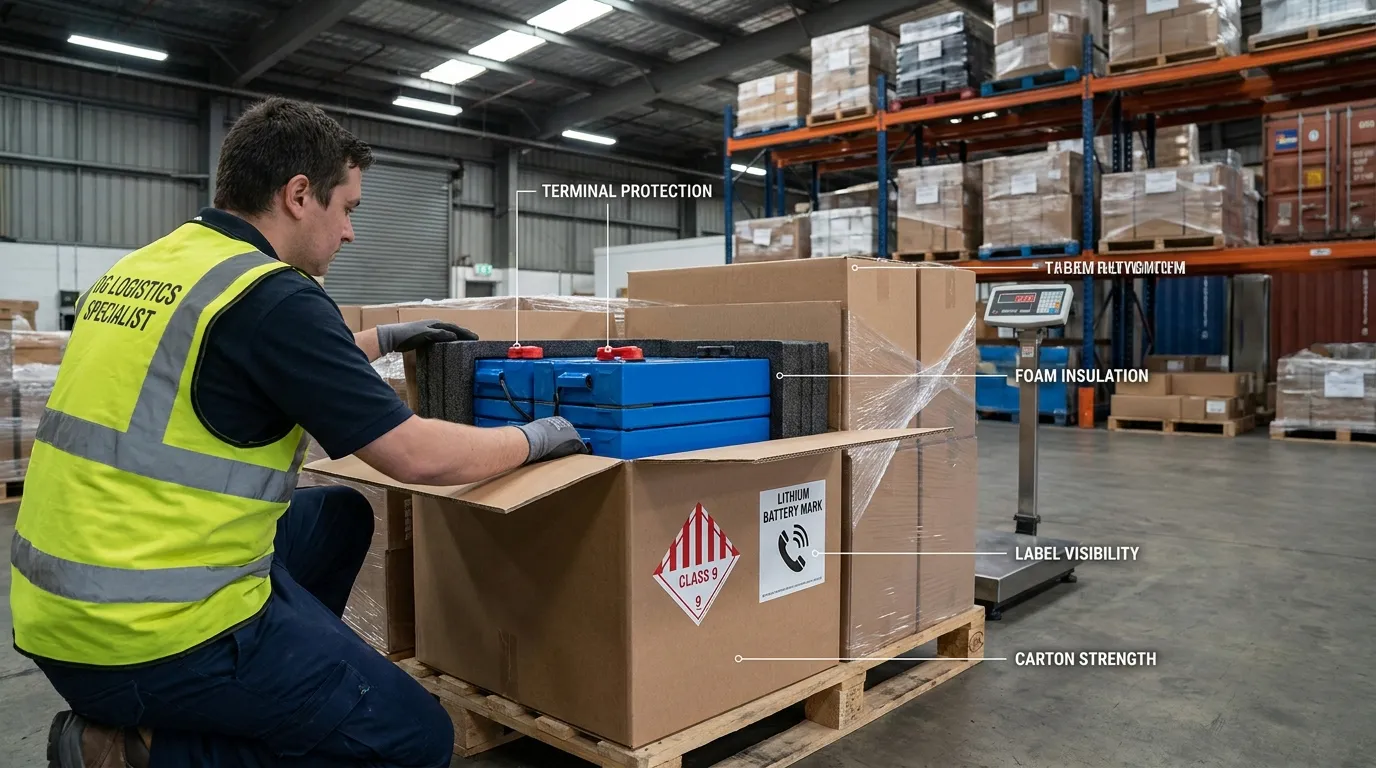
Lithium batteries are Class 9 dangerous goods, so they cannot be treated like ordinary electronics or accessories. In LCL, the forwarder must check whether the cargo can be consolidated with other goods under the carrier, warehouse, and route rules.
Our team reviews:
- UN classification and battery shipping name
- Whether batteries are standalone, packed with equipment, or contained in equipment
- Carton strength, inner protection, and terminal insulation
- Short-circuit prevention and movement control inside the packaging
- Class 9 label, lithium battery mark, UN number mark, and handling marks
- Palletizing, overpack labels, and label visibility
- Whether the cargo is new, used, damaged, defective, or recalled
Damaged, swollen, leaking, defective, or recalled batteries require special review and may not be accepted in standard consolidated sea freight. For normal commercial battery cargo, early document checking reduces the risk of warehouse rejection, carrier refusal, customs hold, storage charges, and missed sailing.
UN Classification and Compliance Checks
Correct classification is the first step. A wrong UN number can cause booking failure, customs questions, or destination clearance problems.
| UN Number | Cargo Type | Common Examples |
|---|---|---|
| UN3480 | Lithium-ion batteries shipped alone | Battery packs, power-bank cells, rechargeable battery modules |
| UN3481 | Lithium-ion batteries packed with or contained in equipment | Electronics, tools, devices with rechargeable batteries |
| UN3090 | Lithium metal batteries shipped alone | Non-rechargeable lithium metal batteries |
| UN3091 | Lithium metal batteries packed with or contained in equipment | Devices using lithium metal batteries |
| UN3171 | Battery-powered vehicle/equipment | E-bikes, scooters, mobility products where applicable |
| UN3536 | Lithium batteries installed in cargo transport unit | Specialized cargo transport unit cases where applicable |
Sea freight primarily follows IMDG requirements. IATA rules matter when the shipment includes an air or express leg, or when a buyer compares sea freight with air options. State-of-charge limits are especially strict for lithium-ion batteries shipped by air; for sea freight, the carrier or DG warehouse may still ask for battery charge details as part of risk review.
Routes, Delivery Terms and Lead-Time Planning
We arrange China export handling and destination delivery for major battery-import markets. Exact transit time is confirmed at the quote stage based on origin city, cargo-ready date, destination address, sailing route, consolidation schedule, customs profile, and final delivery method.
| Route | Service Scope | Planning Notes |
|---|---|---|
| China to USA | LCL sea freight, customs support, door delivery options | Suitable for importers, distributors, 3PLs, and Amazon-related cargo after document review |
| China to UK | LCL consolidation, DDU/DDP options, final delivery | Requires careful customs data, commodity description, and duty/tax planning |
| China to Germany / EU | Sea LCL to EU entry points with customs and delivery support | Good for EU distributors and battery-powered product importers |
| China to Canada | Consolidated sea freight with destination clearance support | Packaging, invoice value, HS code, and importer details must be accurate |
| China to Australia | Sea LCL and door-to-door delivery planning | Battery documents and customs details should be checked before pickup |
For some China-Europe shipments where sea is too slow and air is restricted or too costly, lithium battery rail freight may be considered as an alternative.
Our 5-Step Battery LCL Shipping Process
- Pickup and pre-check
We collect cargo details, battery specs, photos, carton data, destination address, and delivery terms before confirming acceptance. - DG packing and labeling review
Our DG team checks UN marks, lithium battery marks, Class 9 labels, carton condition, palletizing, and short-circuit protection. - Export customs and DG booking
We prepare the booking file, check invoice and packing list details, and coordinate China export clearance. - Sea freight consolidation
Cargo is moved through the approved DG warehouse and loaded under accepted LCL consolidation rules. - Destination clearance and delivery
Depending on DDU, DDP, FOB, or CIF terms, we coordinate customs, taxes where applicable, destination handling, and final delivery.
Documents Required Before Booking
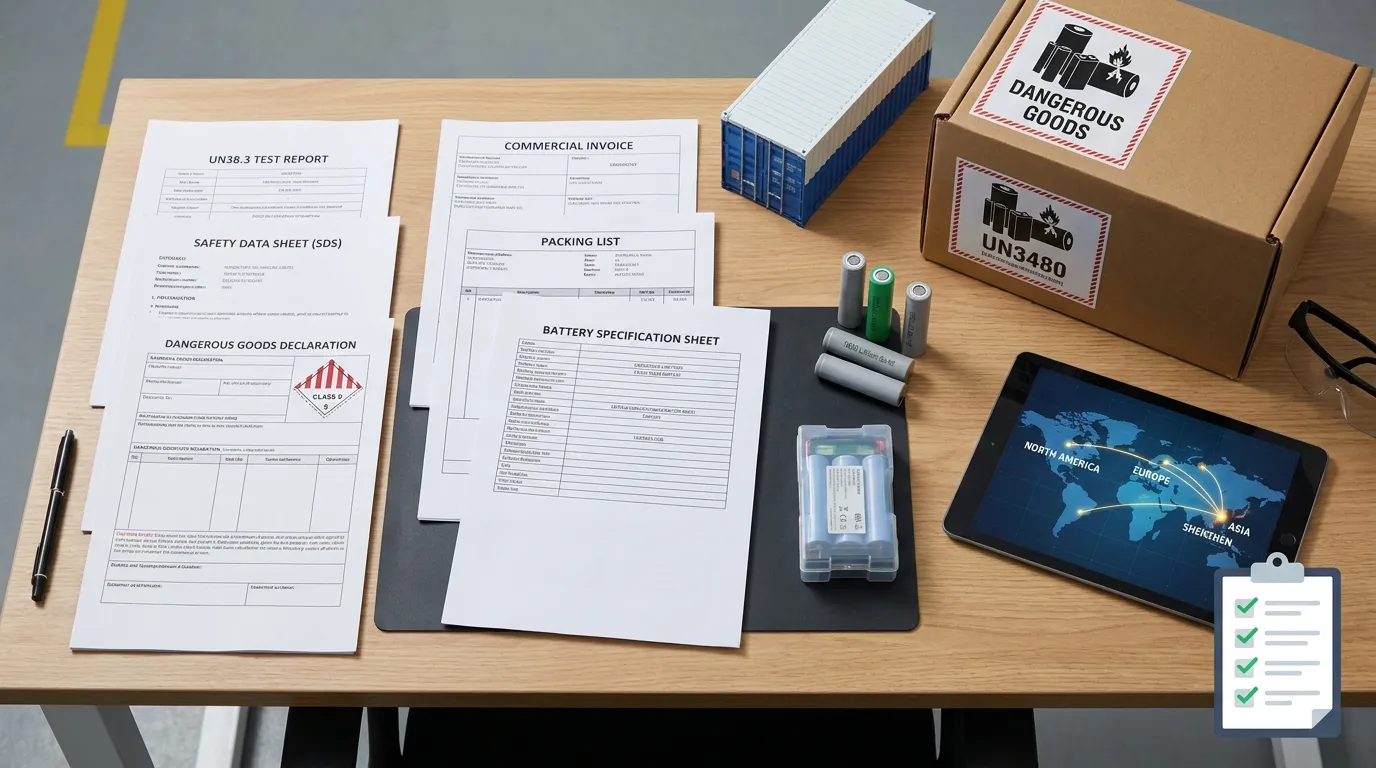
A complete document set helps avoid delays. For most commercial battery shipments, we ask for:
| Document / Detail | Why It Matters |
|---|---|
| UN38.3 test summary | Shows battery transport testing information |
| MSDS / SDS | Provides chemistry, hazard, and handling data |
| Dangerous Goods Declaration | Supports DG booking and carrier acceptance |
| Commercial invoice | Used for export and import customs |
| Packing list | Confirms cartons, weight, volume, and package count |
| Battery specification sheet | Confirms voltage, Wh rating, model, and battery type |
| Product and packing photos | Helps verify labels, cartons, and cargo condition |
| HS code and consignee details | Needed for duty, customs, and delivery planning |
For DDP service, customs data must be especially accurate because duty, tax, product description, and importer details affect clearance risk.
Why Importers Choose Fexbuy
Fexbuy is a Shenzhen-based dangerous-goods freight forwarder with 21 years of lithium battery logistics experience. Our team supports UN38.3, IATA, and IMDG-compliant shipping workflows, with DDP, DDU, FOB, CIF, and door-to-door options.
Importers choose us because we understand the practical problems behind battery freight: rejected cargo, unclear UN numbers, missing MSDS files, wrong carton labels, customs questions, inspection risk, and unclear destination charges. Fexbuy combines DG document checking, China pickup, export handling, sea freight consolidation, customs coordination, and final delivery support under one workflow.
Our reported 98% on-time performance and low inspection rate come from checking the shipment before booking—not after problems appear at the warehouse.
FAQ
Can lithium battery LCL shipping be used for standalone batteries?
Yes, but standalone batteries require stricter review than equipment with batteries. The shipment must have the correct UN number, MSDS/SDS, UN38.3 test summary, DG declaration, proper packaging, short-circuit protection, and accepted DG labels. Final approval depends on the carrier, DG warehouse, route, and destination.
When should I choose LCL instead of FCL?
Choose LCL when your battery cargo volume is not enough for a full container and the shipment can be accepted under DG consolidation rules. Choose FCL when the volume is large, cargo control is more important, or the battery type is difficult to co-load.
What causes battery LCL cargo to be rejected?
Common reasons include wrong UN classification, missing UN38.3 or MSDS, poor packaging, incorrect labels, unclear battery specs, damaged cartons, undeclared batteries inside products, swollen or defective batteries, and cargo arriving at the warehouse before DG approval.
Can you ship batteries DDP door to door?
Yes, DDP may be available for supported lanes after document and customs review. We need the cargo details, product description, HS code, invoice value, destination address, and consignee information before confirming duty, tax, and delivery arrangements.
Do lithium batteries need special packaging for sea freight?
Yes. Batteries must be protected against short circuit, movement, crushing, and accidental activation. Cartons should be strong, correctly marked, and suitable for DG handling. Pallets or overpacks must keep labels visible and readable.
What information do I need to get a quote?
Send the pickup city, destination address, cargo-ready date, battery type, UN number, MSDS/SDS, UN38.3, carton size and weight, total CBM, product photos, packing photos, invoice, packing list, and preferred term such as DDP, DDU, FOB, or CIF.
Get a Free Quote for Battery Sea LCL from China
Send your battery specs, UN number, MSDS/SDS, UN38.3, packing details, cargo volume, pickup city, and destination address. Fexbuy will review the DG acceptance risk, confirm the suitable sea LCL route, and quote the best available door-to-door, DDP, DDU, FOB, or CIF option.
Contact us through Free Quote or WhatsApp to check your shipment before cargo is sent to the warehouse.


