


Ecommerce Landed Cost: Duties, Taxes, Freight, and Delivery Fees Explained
Ecommerce landed cost is the true total to move a product from your supplier to your customer’s door, not just the freight quote. The full formula: Landed Cost = Product Cost + Freight + Import Duties + VAT/GST + Customs Brokerage + Insurance + Carrier Surcharges (fuel, dimensional weight, remote-area). For an $8/unit product shipped from China to the USA, sea freight landed cost typically runs $9.89/unit versus $13.42/unit by courier, before accounting for delivery area surcharges or returns.
You get a freight quote for $680. The final bill arrives at $1,355. The shipment did not change. The route did not change. So where did the extra $675 go?
This happens to ecommerce sellers constantly, and it is not a billing error. It is a formula problem. Freight quotes cover the cost of moving cargo. Ecommerce landed cost covers everything it takes to move that cargo from a factory floor to a paying customer’s hands. The two numbers are almost never the same.
This article breaks down every fee line in that formula, shows you a real mode comparison across air, sea, courier, and DDP, and gives you a step-by-step method to calculate your true cost per unit before you set a price.
Why Your Freight Quote and Your Final Bill Never Match
A freight quote is a transport estimate. It tells you what a carrier charges to move your cargo from origin to destination under normal conditions, at the time of booking, using the weight and dimensions you provided.
What it does not include is nearly everything else.
The most common charges that appear after a quote is accepted include:
- Import duties applied by customs on arrival, based on your product’s HS code and declared value
- Dimensional weight (DIM) upcharges when the carrier determines your box takes up more space than its actual weight suggests
- Fuel surcharges applied as a percentage of the base rate, adjusted weekly or monthly by carriers and not locked at quote time
- Customs brokerage fees billed separately from the freight invoice, often by a third party
- Remote-area or Delivery Area Surcharges (DAS) triggered by the recipient’s zip code
Here is what that looks like on a real invoice. A seller ships 200 units from Shenzhen to Los Angeles. The courier quotes $680. The final charges break down as: $680 base freight, plus $180 dimensional weight upcharge, plus $260 import duty (6.5% of $4,000 declared value), plus $150 brokerage fee, plus $85 fuel surcharge. Total billed: $1,355. Every line was legitimate. None of it appeared in the original quote.
What Is Ecommerce Landed Cost?
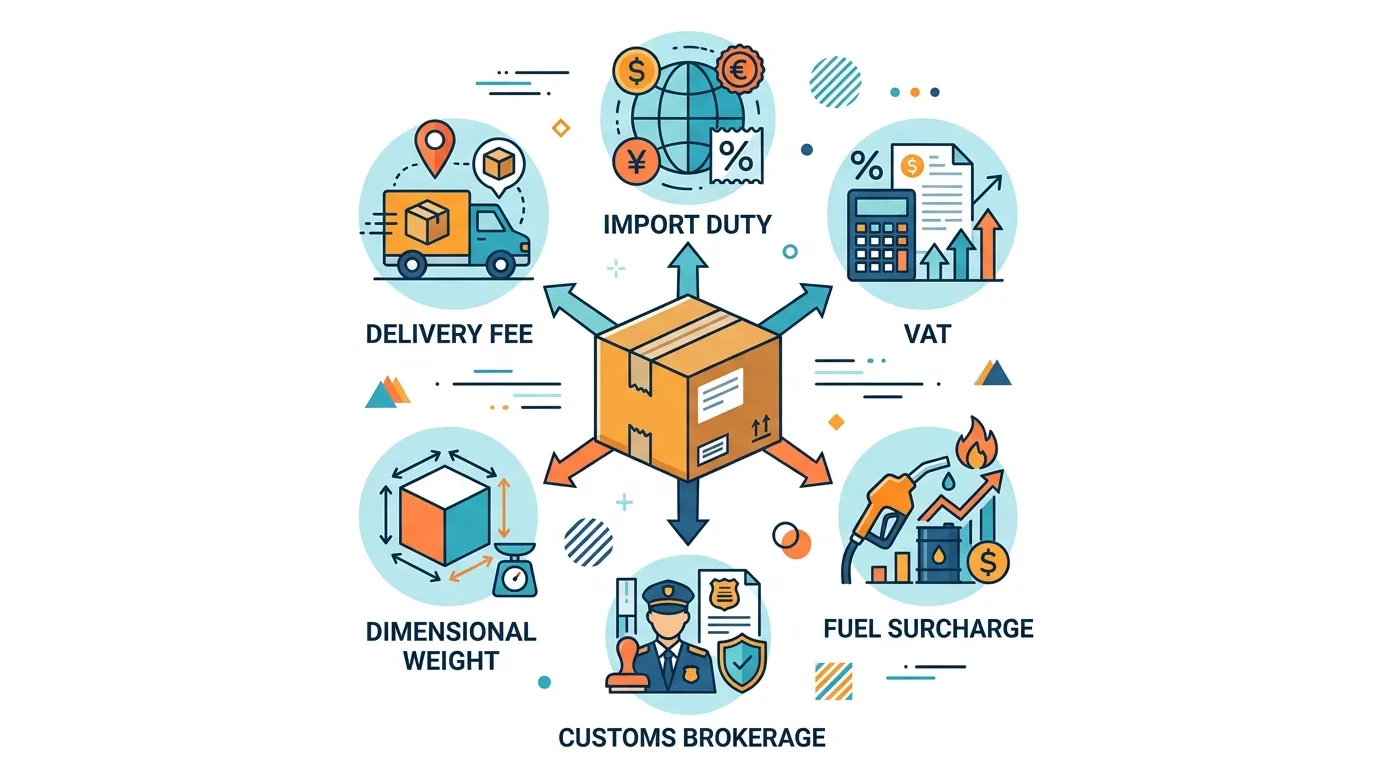
Ecommerce landed cost is the total amount it costs to move a product from your supplier to your customer’s door. It includes the product price, international freight, import duties, VAT or GST, customs brokerage, insurance, and all carrier surcharges. The full formula: Landed Cost = Product Cost + Freight + Duties + Taxes + Brokerage + Insurance + Surcharges.
The term “landed” refers to the point where goods have cleared customs and are ready for delivery in the destination country. Everything before that point, and the last-mile cost to the door, goes into the calculation.
Shipping cost is one component of ecommerce landed cost. It is not a substitute for it. Sellers who price based on a freight quote alone are working from an incomplete number, and the margin difference between the quote and the real bill tends to show up only after the product is already sold.
Every Fee Line in a Real Landed Cost, Broken Down
A landed cost has up to 10 fee lines, not one. Most freight quotes show only the transport charge. The fees that appear later include import duties, VAT or GST, customs brokerage, dimensional weight upcharges, fuel surcharges, delivery area surcharges, origin pickup, port storage, and return freight. Each one is real and calculable before you ship.
Import Duties and Tariffs
Import duties are charged by the destination country’s customs authority when goods cross the border. The rate is set by the product’s HS (Harmonized System) code, applied to the declared value of the shipment.
For example, a 6.5% duty rate on $4,000 worth of electronics equals $260. That rate is not universal. It varies by product category, country of origin, and whether any trade agreements apply between the exporting and importing country. US Customs and Border Protection publishes the US tariff schedule. Most countries maintain a publicly searchable tariff database.
One critical point: online duty calculators return a range, not your rate. The actual number depends on your exact 10-digit HS code, your country of origin, and current trade status. A single-digit misclassification can shift your duty rate by 3 to 8 percentage points, which on a $10,000 shipment means $300 to $800 in unexpected cost. A qualified broker or a pre-shipment duty quote removes this uncertainty.
VAT, GST, and Sales Tax
VAT and GST are applied on top of import duties in most markets, not instead of them. The EU applies VAT rates between 17% and 27% depending on the member state. The UK applies 20% import VAT. Australia charges 10% GST on imported goods. The US does not apply federal VAT, but state sales tax may apply after domestic clearance.
The calculation basis matters. In most markets, VAT applies to the combined value of the goods plus the import duty, not just the product price. On a $1,000 shipment with $65 in duty, a 20% UK VAT applies to $1,065, producing a $213 VAT charge rather than $200.
Customs Brokerage and Clearance Fees
A customs broker is the agent who prepares and submits import declarations on your behalf. For sea and air freight, brokerage typically costs $100 to $300 per entry. Express couriers (DHL, FedEx, UPS) bundle basic clearance into their service but charge a duty advancement fee when they pay duties on your behalf before billing you.
You do not always need a licensed broker. Informal entries (generally under $2,500 in the US) can be self-cleared. For higher-value shipments, commercial imports, or products with compliance requirements, a broker is the practical choice, and the fee is a fixed landed cost line whether you pay it to a third party or factor it into your courier rate.
Dimensional Weight — Why a Light Box Costs More Than Expected
Dimensional weight (DIM weight) is how carriers charge for shipments where the package takes up more cargo space than its actual mass would suggest. The formula is:
DIM Weight = (Length cm × Width cm × Height cm) ÷ 5,000
Or in imperial measurements: Length in × Width in × Height in ÷ 139
If your DIM weight is higher than your actual weight, the carrier bills the DIM weight. A box measuring 40cm × 30cm × 25cm with actual contents weighing 2kg has a DIM weight of 6kg. You pay for 6kg.
This is one of the most reliable sources of quote-versus-bill gaps. A seller quotes a lightweight product, ships it in an oversized box, and the carrier bills at 3× the expected weight. Carriers apply this universally, and it is not negotiable after the fact. The fix is correct packaging dimensions before you quote.
Fuel Surcharge
Fuel surcharges are applied as a percentage of the base freight rate. They are not locked at the time of your quote. Carriers adjust them weekly or monthly based on aviation or maritime fuel indexes, which means the surcharge on your invoice can be higher than what appeared in the estimate you accepted.
Typical fuel surcharges run 10% to 25% of the base freight rate depending on mode, carrier, and market conditions. On a $1,200 air freight invoice, a 15% fuel surcharge adds $180. That $180 was real from the moment you booked. It just was not visible in the headline rate.
Remote-Area and Delivery Area Surcharge (DAS)
Delivery Area Surcharges apply when the recipient’s address falls in a zip code the carrier classifies as remote, extended, or rural. Charges typically range from $2.50 to $8 per shipment for residential or extended zones, and more for premium remote areas.
Carriers reclassify zip codes quarterly. An address that quoted at standard rate three months ago may now carry a DAS. For B2C ecommerce with deliveries spread across thousands of zip codes, the aggregate DAS exposure can be significant, particularly for sellers shipping rural US, regional Australia, or non-metro European addresses.
Origin Pickup (Ex-Works vs. FOB)
FOB (Free On Board) quotes start at the port of origin. The seller has already moved the goods from the factory to the port and cleared them for export. Ex-Works (EXW) quotes start at the factory gate. The buyer covers everything from that point forward: factory pickup, inland haulage to the port, and export documentation.
The difference can be $80 to $300 per shipment depending on factory location and cargo size. Buyers who receive an FOB quote often forget the EXW-to-FOB cost entirely. If your supplier quotes EXW and your freight forwarder quotes FOB, the gap between them is a real landed cost line that belongs in your calculation.
Port Storage and Demurrage
When sea freight cargo is not picked up within the port’s free-time window (typically 3 to 7 days after vessel arrival), the terminal charges demurrage or port storage fees. Rates run $50 to $150 per container per day depending on port and container type.
This cost is avoidable with correct documentation preparation and a clear clearance timeline. It is not avoidable once the clock starts. Sellers using sea freight for the first time frequently underestimate the clearance timeline and absorb a storage charge that never appeared in any pre-shipment estimate.
Returns and Reverse Freight
Return freight is a landed cost when it happens. A refused DDU (Delivered at Place, duties unpaid) shipment means you pay outbound freight, the shipment generates zero revenue, and you then pay return freight to get the goods back or pay for destruction at destination.
On a $600 DHL courier shipment, a refusal can mean $600 outbound plus $400 return plus the duty advancement fee already paid. That is a $1,000-plus landed cost on a transaction that earned nothing. The correct way to account for returns is to include an amortized return freight cost in your per-unit landed cost based on your category’s return rate.
Landed Cost by Shipping Mode — Air, Sea, Courier, and DDP Compared
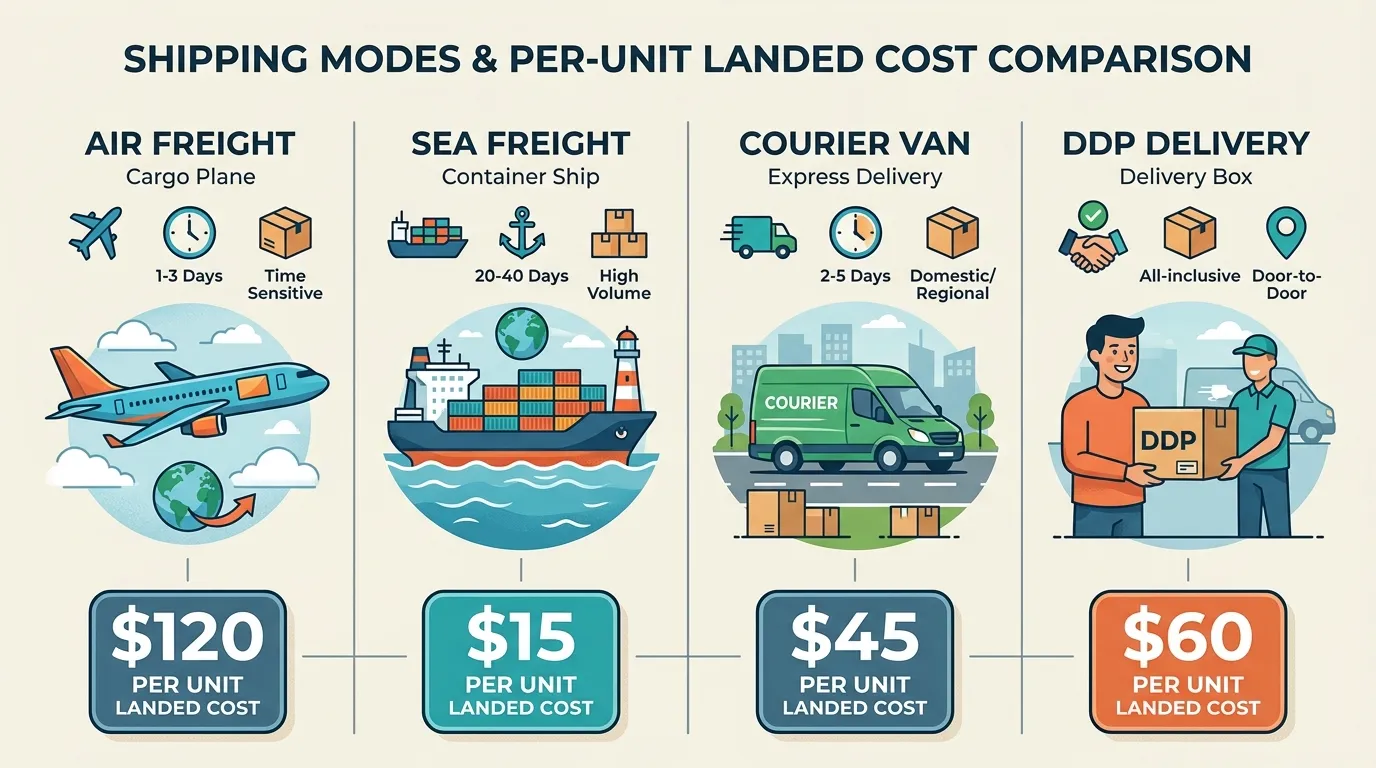
Sea freight has the lowest per-unit landed cost for large shipments but adds port fees, broker fees, and demurrage risk. Air freight is faster but dimensional weight and fuel surcharges often push the billed cost well above the quoted rate. Courier is all-in but expensive per kilo. DDP removes buyer surprise but the seller must calculate duty into the price before listing.
The table below models a single shipment: 500 units of electronics at $8/unit declared value, shipping from China to a US business address. Duty rate used: 6.5% (HS 8517). VAT: $0 (US import). Figures are illustrative estimates; actual DAS and duty depend on delivery zip and exact HS code.
| Cost Line | Air Freight | Sea Freight (LCL) | Courier (DHL/FedEx) | DDP Service |
|---|---|---|---|---|
| Product cost (500 × $8) | $4,000 | $4,000 | $4,000 | $4,000 |
| Freight | $1,200 | $420 | $2,400 | included |
| Import duty (6.5%) | $260 | $260 | $260 | included |
| VAT/GST | $0 | $0 | $0 | $0 |
| Customs brokerage | $150 | $200 | bundled + adv. fee | included |
| Fuel surcharge | $180 | $55 | included in rate | included |
| DAS / remote-area | $0–$40 | $0 | $0–$40 | $0–$40 |
| Insurance | $8 | $8 | $8 | $8 |
| Total landed cost | ~$5,798 | ~$4,943 | ~$6,708 | ~$5,200 |
| Per unit | ~$11.60 | ~$9.89 | ~$13.42 | ~$10.40 |
The $1,765 gap between the lowest cost (sea at $9.89/unit) and the highest (courier at $13.42/unit) does not show up in a headline freight quote. It shows up in your margin.
One thing this table does not show: sea freight is not automatically the right answer for small or time-sensitive shipments. LCL consolidation fees, longer free-time windows, higher demurrage exposure, and the carrying cost of inventory sitting on a vessel for 25 to 35 days can close the gap with air significantly. For orders under 300kg or products with short shelf cycles, air freight’s higher rate often costs less in total than the working capital tied up in a slow sea shipment. For shipments destined for Amazon FBA, see the Amazon FBA inbound cost comparison for mode-specific considerations.
How to Calculate Your Landed Cost Per Unit — Step by Step
To calculate landed cost per unit: take the product cost, add freight (verified for dimensional weight), add import duty (HS code rate multiplied by declared value), add destination VAT or GST, add brokerage and carrier fees, then divide the total by unit count. Always request an itemized quote, not a headline rate.
Here is the process in six steps:
- Get your product cost per unit. This is your supplier invoice price including any tooling or packaging charges billed separately.
- Confirm your freight quote includes dimensional weight. Give your freight forwarder the exact box dimensions and weight, not just the product weight. Ask them to quote the DIM weight explicitly. If they quote on actual weight and your DIM weight is higher, the invoice will be higher.
- Look up your duty rate. Find your product’s 10-digit HS code for the destination country and pull the applicable duty rate. For the US, US Customs and Border Protection publishes the Harmonized Tariff Schedule. For a full breakdown of how international duties are calculated, see the linked guide.
- Add destination VAT or GST. Apply it to the combined value of goods plus duty, not just the product cost. Use the destination country’s standard import rate unless your product qualifies for an exemption.
- Add all fee lines. Customs brokerage, fuel surcharge (ask for the current rate at time of booking), any DAS exposure based on your delivery zip codes, insurance, and origin pickup if your supplier quotes EXW.
- Divide by unit count. This gives you your per-unit landed cost. Your selling price needs to sit above this number by at least your target margin. Price based on anything less and you are selling at a margin that does not exist.
DDP Shipping — When the Seller Absorbs the Full Landed Cost
DDP (Delivered Duty Paid) means the seller pays all import duties, taxes, and customs fees before delivery. The buyer sees one final price at checkout with no surprise charges on arrival. For B2C ecommerce, DDP typically lifts checkout conversion by 15 to 30% by removing the fear of an unknown customs bill at the door — but only when the seller has calculated the full landed cost accurately before pricing.
With DDU (also called DAP, Delivered At Place), the carrier collects duties from the recipient on delivery. For some buyers, an unexpected duty bill at the door means refusal. Up to 39% of international cart abandonment is linked to unexpected costs at checkout or delivery.
The common objection to DDP is that the seller “pays extra.” That framing is incomplete. With DDU, the seller pays outbound freight on every order, including orders that get refused. The refused order then generates a return freight cost and no revenue. When you model both scenarios across a full month of international shipments and include a realistic refusal rate, DDP often costs less per completed sale than DDU.
For sellers shipping from China to US buyers after the removal of de minimis protections, DDP removes a significant customer experience risk. See the guide on China-to-USA DDP options after de minimis changes for the full context on how that regulatory shift affects your duty exposure.
When to choose DDP vs. DDU:
| Situation | Better choice |
|---|---|
| B2C sales to consumers unfamiliar with customs | DDP |
| High-value goods with elevated duty rates | DDP (with accurate pre-pricing) |
| B2B buyers who handle their own clearance | DDU/DAP |
| Test shipment to a new market, no duty rate confirmed | DDU until duty is confirmed |
| Recurring shipments to known buyers | DDP for retention value |
What Sellers Get Wrong When They Price Without a Full Landed Cost
A seller lists an electronics accessory at $20. Their supplier price is $10. They assume a 50% gross margin. Their freight quote is $1.50/unit. The product looks profitable.
Here is what the actual landed cost looks like: $10 product + $1.50 freight (before DIM weight confirmation) + $0.65 duty (6.5%) + $0.30 brokerage amortized + $0.23 fuel surcharge + $0.08 insurance + $0.20 DAS exposure across rural zip codes = $12.96 per unit landed. Margin at $20 retail is now 35%, not 50%. After payment processing, platform fees, and returns, the actual net margin is likely under 20%.
None of this math was wrong. The seller just did not do all of it before pricing.
The DIM weight trap catches sellers who pack products in oversized boxes to reduce damage risk. A 2kg product in a box that quotes $2.50/unit at actual weight may bill at $6.00/unit once DIM weight is applied. That $3.50 difference per unit erases margin on anything priced for the original quote.
Fuel surcharges compound this. A surcharge rate that runs 12% at the time of pricing runs 18% two months later when your shipment actually moves. The rate adjusts regularly and your locked-in retail price does not adjust with it. Sellers who reprice quarterly based on current surcharge levels protect margin. Sellers who price once and forget do not.
How Fexbuy Quotes the Real Delivered Cost Before You Price
Most logistics providers quote freight. Fexbuy quotes delivered cost.
That means before you set a retail price or place a purchase order, you can get a landed cost estimate that includes duties, brokerage, applicable surcharges, and delivery to your destination. You are not discovering the real number after the goods have already shipped.
Fexbuy covers sea, air, rail, and express courier from China and major manufacturing hubs to the USA, EU, UK, Canada, and Australia. DDP and DDU options are available across all routes. With 21 years of freight operations and a no-hidden-costs commitment, the quote you receive reflects what you will actually pay.
For ecommerce sellers calculating margins, this is the difference between a business that scales and one that bleeds cash on international shipping. Price your products on real ecommerce landed cost, not on a freight quote.
Get a full landed cost quote from Fexbuy before your next shipment.
Frequently Asked Questions
Shipping cost is a single line — the freight rate charged to move your parcel from origin to destination. Landed cost is the sum of everything: freight, import duties, VAT or GST, customs brokerage fees, insurance, and all carrier surcharges including fuel and remote-area fees. Shipping cost is one part of landed cost. Using only the shipping quote to price products leaves out duty, tax, and fee lines that can add 20% to 40% to the total delivered cost.
DDP (Delivered Duty Paid) means the seller pays all import duties, taxes, and customs clearance before delivery. The buyer pays one price with no surprise charges. DDU (also called DAP, Delivered At Place) means duties are collected from the buyer on delivery, which frequently leads to refusals and abandoned shipments. For B2C ecommerce, DDP typically increases international checkout conversion by 15 to 30% because it removes unexpected charges at the customer’s door.
Import duties are calculated as a percentage of the declared value of the goods, using the rate assigned to that product’s HS (Harmonized System) code in the destination country. For example, a 6.5% duty on $1,000 of electronics equals $65. The rate varies by product category, country of origin, and any applicable trade agreements. Misclassifying the HS code, even by one digit, is a common cause of duty surprises and can shift your rate by 3 to 8 percentage points.
Yes, when shipping to countries that charge VAT on imports. The EU applies rates between 17% and 27% depending on the member state. The UK charges 20% import VAT. Australia charges 10% GST. In each case, VAT applies to the combined value of goods plus import duty, not just the product price. The US does not apply federal VAT on imports, but state sales tax may apply after domestic clearance depending on your fulfillment setup.


