


Finding the Right Cross Border Freight Forwarder: A 2026 Comprehensive Strategy
A cross border freight forwarder acts as the strategic architect of your international supply chain, ensuring goods move efficiently across complex geopolitical boundaries. In 2026, the global trade landscape is more dynamic than ever. Businesses no longer just ship products; they navigate a web of real-time data, shifting tariffs, and sustainable mandates. Selecting the right forwarding partner is the most critical decision for any brand aiming for global scale.

What is a cross border freight forwarder and why do you need one?
A cross border freight forwarder is a specialized logistics partner that organizes the transport and customs clearance of goods between countries. They act as an intermediary between shippers and various transportation services like ocean freight, air express, and trucking. By managing documentation and compliance, they prevent costly border delays and ensure your inventory reaches its destination legally and efficiently.
Navigating international borders without an expert is like sailing through a storm without a compass. I once witnessed a startup lose its entire Q4 profit because they used a generic courier instead of a dedicated forwarder. A single missing HS code held their shipment in customs for three weeks. A professional forwarder prevents these disasters by auditing your paperwork before the cargo ever leaves the factory floor. They provide the “character” and expertise needed to handle local regulations that AI tools often overlook.
How do forwarders add value beyond simple shipping?
Forwarders offer more than just a space on a ship. They provide risk management, cargo insurance, and warehousing solutions. In 2026, top-tier forwarders also offer “Green Logistics” reporting. This helps businesses meet new carbon footprint transparency requirements. They turn a complex, fragmented process into a single, manageable point of contact.
How does cross-border freight forwarding from China streamline your supply chain?
Cross-border freight forwarding from China streamlines your supply chain by providing local expertise at the point of origin to manage export licenses and quality inspections. These forwarders understand the specific drayage requirements of major hubs like Shenzhen and Ningbo. They ensure that your goods are consolidated correctly, which significantly reduces shipping costs and minimizes the risk of damage during transit.
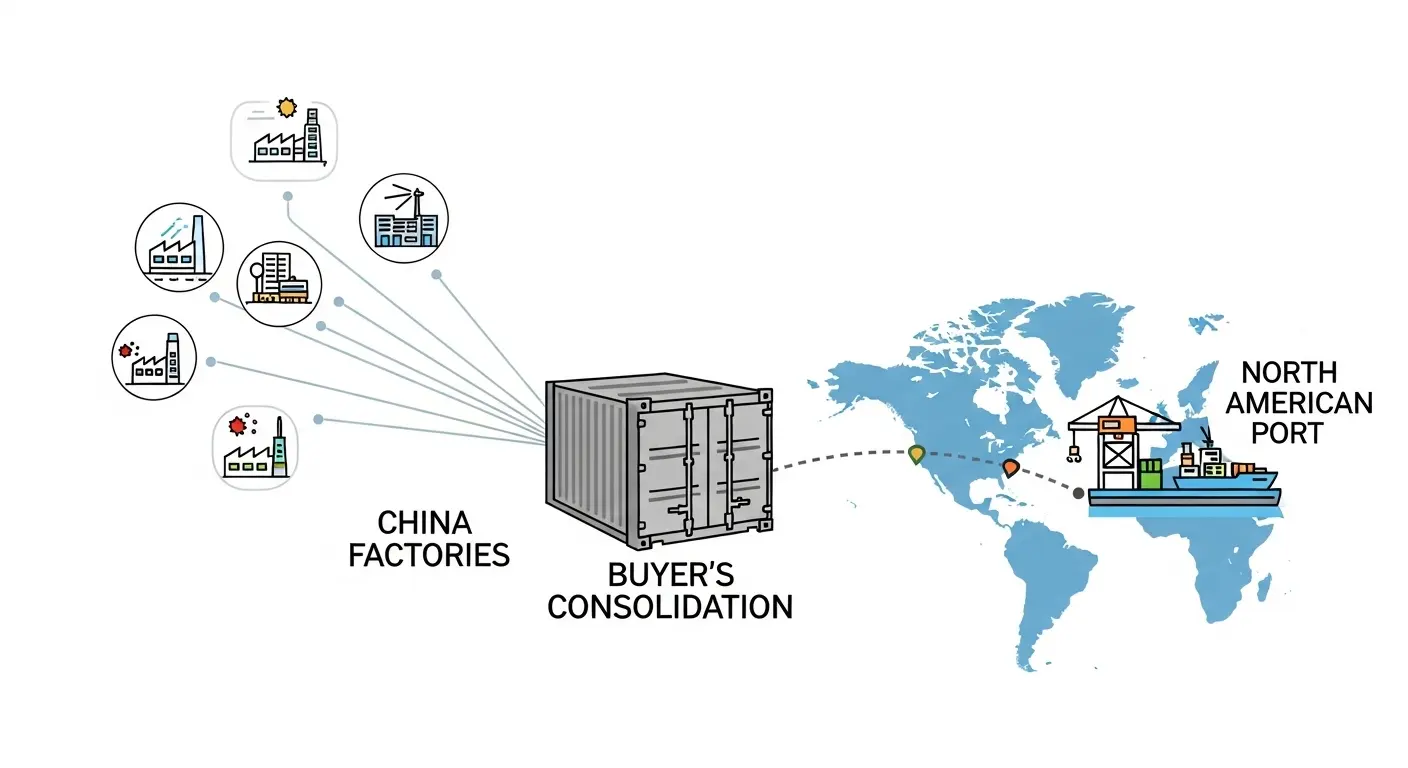
When you source from multiple Chinese suppliers, coordination is your biggest challenge. I’ve found that using a localized forwarder allows for “Buyer’s Consolidation.” This means your forwarder collects small orders from five different factories and packs them into one Full Container Load (FCL). [Data: 2025 Industry Surveys show that consolidation can save mid-sized businesses up to 30% on international freight costs.] This strategy also simplifies your US or European customs entry, as you are dealing with one master bill of lading instead of five separate shipments.
Why is “origin-side” expertise critical?
Chinese export laws change frequently. A forwarder with a physical presence in China can pivot your strategy immediately if a specific port becomes congested. They act as your “boots on the ground,” verifying that the factory has loaded the correct number of pallets and that the packaging meets international sea-freight standards.
What are the key benefits of global cross-border logistics for e-commerce?
The primary benefits of global cross-border logistics include expanded market reach, improved delivery speeds, and enhanced customer trust. By utilizing an integrated logistics network, e-commerce brands can offer “landed cost” pricing at checkout. This transparency eliminates the “sticker shock” customers feel when they are hit with unexpected import duties upon delivery. It transforms an international transaction into a seamless domestic-like experience.
In the modern e-commerce world, speed is the only currency that matters. If your logistics are slow, your reviews will suffer. Leveraging a global network allows you to utilize regional fulfillment centers. Instead of shipping every order from Asia to a customer in Germany, your forwarder can move bulk inventory to a European bonded warehouse. This reduces last-mile delivery times from weeks to just 48 hours.
| Feature | Standard Shipping | Integrated Global Logistics |
| Transit Time | 15 – 25 Days | 3 – 7 Days |
| Tracking | Port-to-Port only | End-to-End Real Time |
| Duty Handling | Customer pays on arrival | DDP (Delivered Duty Paid) |
| Returns | Difficult/Expensive | Localized Return Hubs |
How do you choose the right cross-border logistics services from China?
To choose the right cross-border logistics services from China, you must evaluate their carrier relationships, their digital tracking platform, and their specific experience with your product category. Look for a provider that offers “multi-modal” options, such as Sea-Air or Rail-Sea. This flexibility allows you to balance cost and speed depending on your current inventory levels and market demand.
I always tell my clients to ask a potential forwarder one specific question: “What is your backup plan if the Port of Long Beach is backlogged?” A high-authority forwarder won’t hesitate. They will immediately discuss rerouting through Prince Rupert or utilizing a different shipping lane. In 2026, you aren’t just paying for the move; you are paying for the contingency plan.
Tip: Always check if your forwarder is a licensed NVOCC (Non-Vessel Operating Common Carrier). This ensures they have the legal authority to issue their own Bills of Lading and have secured bond coverage for your protection.
What makes cross-border logistics in North America unique?
Cross-border logistics in North America is unique due to the integrated USMCA trade agreement and the massive reliance on “Intermodal” transport (the combination of ship, rail, and truck). Success in this region requires a forwarder who understands “Section 321” de minimis entries. This allows for duty-free imports on shipments valued under $800, which is a massive advantage for B2C e-commerce brands.
The geography of North America presents a specific hurdle. Once your container hits a West Coast port, it still has to travel thousands of miles to reach the East Coast. A forwarder who excels in this region will utilize “Transloading.” They move your goods from a 40ft ocean container into 53ft domestic trailers. This process is faster and often cheaper than moving the ocean container via rail across the entire continent.
How do Section 321 entries change the game?
For e-commerce sellers, Section 321 is a “cheat code” for profitability. By shipping individual orders directly to US customers from an international hub, you can bypass nearly all import duties. This requires a forwarder with sophisticated software that can handle thousands of individual manifests simultaneously without triggering a customs hold.
Why should businesses explore Africa logistics services in 2026?
Businesses should explore Africa logistics services because the continent represents the next great frontier for manufacturing and consumer growth. With the African Continental Free Trade Area (AfCFTA) now fully operational, intra-African trade is becoming more streamlined. Smart companies are diversifying their supply chains by looking at African hubs as a “China Plus One” strategy to mitigate regional risks.
Africa is not a monolith. The logistics challenges in Nigeria are vastly different from those in Kenya or South Africa. I recently consulted for a textile firm that moved 20% of its production to East Africa. They found that while infrastructure is still developing, the “time-to-market” for European customers was significantly shorter than shipping from East Asia. Success here requires a cross border freight forwarder with deep localized knowledge and established “last-mile” networks.
- Emerging Hubs: Ethiopia and Kenya are becoming major players in air freight.
- Infrastructure Growth: Massive investments in deep-water ports are increasing vessel capacity.
- Trade Agreements: AfCFTA reduces tariffs between 54 African nations.
What are the most common pitfalls in international freight forwarding?
The most common pitfalls include under-declaring cargo value, choosing the wrong Incoterms, and failing to secure comprehensive insurance. Many shippers assume “Freight Insurance” covers everything, but most standard carrier limits are quite low. If a ship encounters a “General Average” event—where cargo is jettisoned to save the vessel—you could be liable for costs even if your specific goods were not damaged.
Warning: Never ship under EXW (Ex Works) unless you have a trusted forwarder who can handle everything from the factory door. Under EXW, you are responsible for the goods the moment they leave the supplier’s warehouse. Most experts recommend FOB (Free on Board) as it shares the risk and cost more equitably between the buyer and the seller.
How to prepare your documentation for seamless customs clearance?
To ensure seamless customs clearance, you must provide a precise Commercial Invoice, a detailed Packing List, and a verified Certificate of Origin. Every item must have an accurate 10-digit HS (Harmonized System) code. In 2026, many customs authorities also require digital “Advanced Electronic Data” (AED) before the plane or ship even departs the origin country.
- Audit your HS Codes: Don’t guess. Use a professional tool or ask your forwarder to verify the codes.
- Match the Documents: The value on your Commercial Invoice must match your wire transfer and your Packing List exactly.
- Include Product Samples/Photos: Digital photos of the labels and the product help customs officers verify your declaration without a physical inspection.
What is the future of cross-border shipping in 2026 and beyond?

The future of cross-border shipping is defined by “Autonomous Orchestration” and “Hyper-Transparency.” We are moving toward a world where AI doesn’t just track your shipment; it predicts delays based on weather patterns and labor strikes. Blockchain technology is finally being used to create “Immutable Bills of Lading.” This eliminates document fraud and speeds up the release of cargo at the destination.
Sustainability is no longer optional. By late 2026, [Data: Global Trade Forecasts suggest that 30% of Fortune 500 companies will only partner with forwarders who offer carbon-neutral shipping options.] This shift will drive the adoption of electric drayage trucks and sustainable aviation fuel (SAF). If you want your brand to be cited as a leader, your logistics must be as clean as your products.
Why a partner is better than a platform
While many “digital-only” platforms have emerged, the most successful brands still rely on a cross border freight forwarder that offers a human touch. When a port is closed due to a strike or a sudden storm, a software algorithm can only tell you that your shipment is late. A partner will pick up the phone, call their contact at the terminal, and find a solution.
Mastering global trade in 2026 is about blending high-tech tools with high-touch expertise. Whether you are scaling through global cross-border logistics or venturing into new markets with Africa logistics services, your forwarder is your most valuable asset. They turn the “scary” complexity of borders into a scalable advantage for your business.


