


Battery Powered Device Shipping Without a UN 38.3 Test Report: What Are the Risks?
Battery Powered Device Shipping does not automatically become impossible because the shipper lacks the full laboratory report. The key questions are whether the lithium cell or battery design passed the applicable UN 38.3 tests, whether a compliant UN 38.3 Test Summary is available, and whether the document matches the battery inside the device.
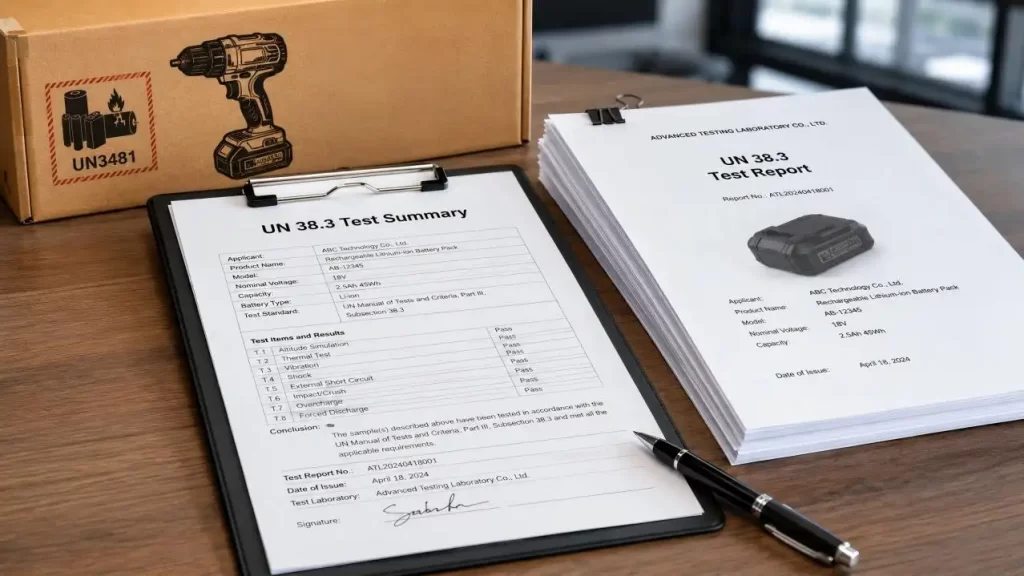
If the battery was never tested, the evidence cannot be verified, or the model details are inconsistent, the cargo may be rejected, delayed, reclassified or sent for additional review.
What UN 38.3 Means for Battery Powered Device Shipping
UN 38.3 is the lithium battery section of the UN Manual of Tests and Criteria. It assesses whether a cell or battery design can withstand transport conditions.
Applicable testing may cover:
•Altitude simulation and thermal cycling
•Vibration and mechanical shock
•External short circuit
•Impact or crush
•Overcharge
•Forced discharge
Testing applies to a battery design type, not every shipment. Lithium cells and batteries offered for routine commercial transport must generally be of a type proven to meet the applicable requirements.
UN 38.3 Test Report vs. Test Summary
These terms should not be used interchangeably.
| Item | What It Provides | Role in Shipping |
| UN 38.3 Test Report | Full laboratory procedures, measurements and results | Detailed technical evidence |
| UN 38.3 Test Summary | Standardized manufacturer, model, laboratory and test information | Supply-chain verification |
| Passed UN 38.3 Testing | Confirmation that the battery design completed applicable tests | Basis for routine commercial transport |
The absence of a complete laboratory report is different from the absence of proof that testing was completed. A brief certificate, product specification or supplier declaration is not automatically a compliant UN 38.3 Test Summary.
Manufacturers and subsequent distributors must make the Test Summary available so that downstream parties can verify the battery design.
Risks of Shipping Without Valid UN 38.3 Evidence
Missing or inconsistent records can disrupt the entire Battery Powered Device Shipping process—not only the initial booking.
| Risk | Typical Cause | Possible Impact |
| Carrier rejection | Battery compliance cannot be confirmed | Refused booking or cancelled capacity |
| Reclassification | Incorrect equipment configuration or UN number | New packaging, labels and declaration |
| Warehouse hold | Battery model mismatch or missing file | Repacking and delayed dispatch |
| Customs inspection | Conflicting battery data, HS code or documents | Detention, correction or return |
| Safety exposure | Battery design performance is unverified | Short circuit, overheating or fire |
| Supply disruption | Multiple battery suppliers used under one device model | Future batches cannot use one compliance file |
Declaring regulated battery cargo as ordinary goods may also lead to penalties, claims or carrier-account restrictions. Classification, packaging, marking and documentation should therefore be reviewed as one connected compliance process.
Why Battery-Powered Devices Develop Documentation Gaps
Battery Powered Device Shipping often involves several organizations:
•Cell manufacturer
•Battery-pack assembler
•Equipment manufacturer
•Brand owner
•Exporter
•Freight forwarder
A documentation gap can appear when:
•A device manufacturer changes its battery supplier
•An OEM product is renamed for another market
•The Test Summary lists a model not shown on the physical battery
•An older product has no traceable manufacturer
•The supplier provides only an MSDS
•Different batteries are installed under the same device model
These problems frequently affect consumer electronics, cordless tools, medical devices, industrial instruments, automotive accessories and IoT products.
Is an MSDS Enough for Battery Powered Device Shipping?
No.
An MSDS or SDS describes chemical hazards, handling precautions, storage conditions and emergency measures. It does not replace:
•A compliant UN 38.3 Test Summary
•The correct UN number and transport classification
•Dangerous-goods declarations where required
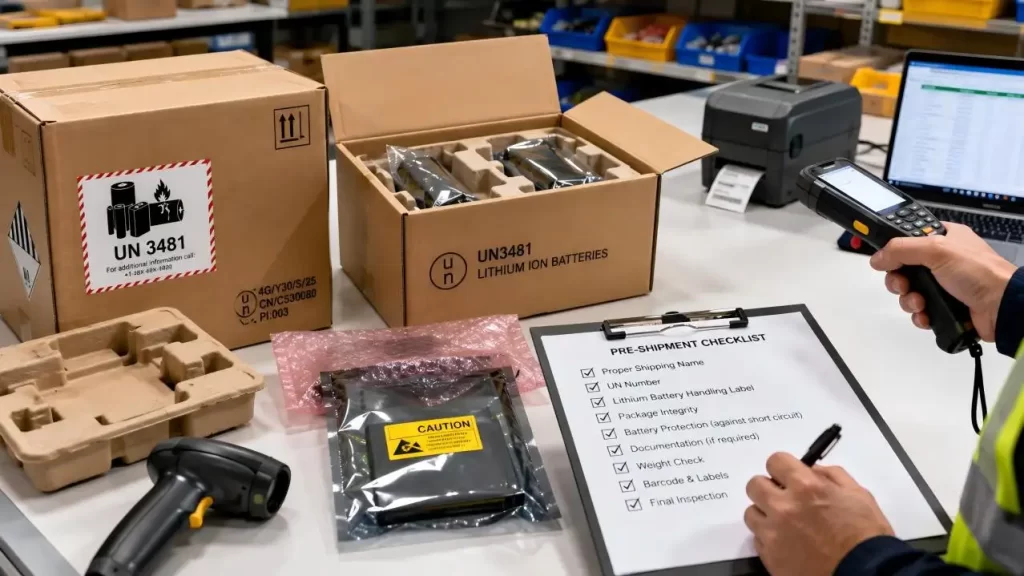
•Compliant packaging, marks and labels
•Carrier-specific acceptance review
An MSDS describes the material hazard. A UN 38.3 Test Summary confirms that a specific battery design passed the applicable transport tests.
Both documents may be requested during Battery Powered Device Shipping, but they serve different compliance functions.
Can Untested Batteries Be Shipped?
Untested commercial batteries cannot normally bypass UN 38.3 requirements through relabeling or by submitting an MSDS.
Special provisions may exist for prototypes, test samples or certain low-production runs. However, these shipments can require:
•Special protective packaging
•Competent-authority approval
•Additional technical documentation
•Advance carrier acceptance
•Restrictions on aircraft or transport channels
These exceptions should not be treated as routine Battery Powered Device Shipping options for regular inventory or e-commerce orders.
What to Do When the Documents are Missing
1. Identify the Exact Battery
Confirm the:
•Manufacturer and battery model
•Battery chemistry
•Rated voltage
•Ah capacity
•Wh rating
•Production version
•Configuration of equipment
Note that whether a battery is shipped, packed or installed with equipment can change transport requirements.
2. Trace the Test Summary
The document should be requested from the battery manufacturer, the brand of the device, an authorized battery distributor or the original test laboratory. It should NOT be requested from the seller of the immediate product.
3. Match the Documents to the Product
Check the manufacturer, model, and Wh rating, against:
•The physical battery label
•Product specifications
•Commercial invoice
•Packing list
•MSDS (or SDS)
•UN 38.3 Test Summary
A similar battery report is NOT acceptable proof of shipping the actual model.
4. Confirm the UN Classification
Some of the most common entries for devices are:
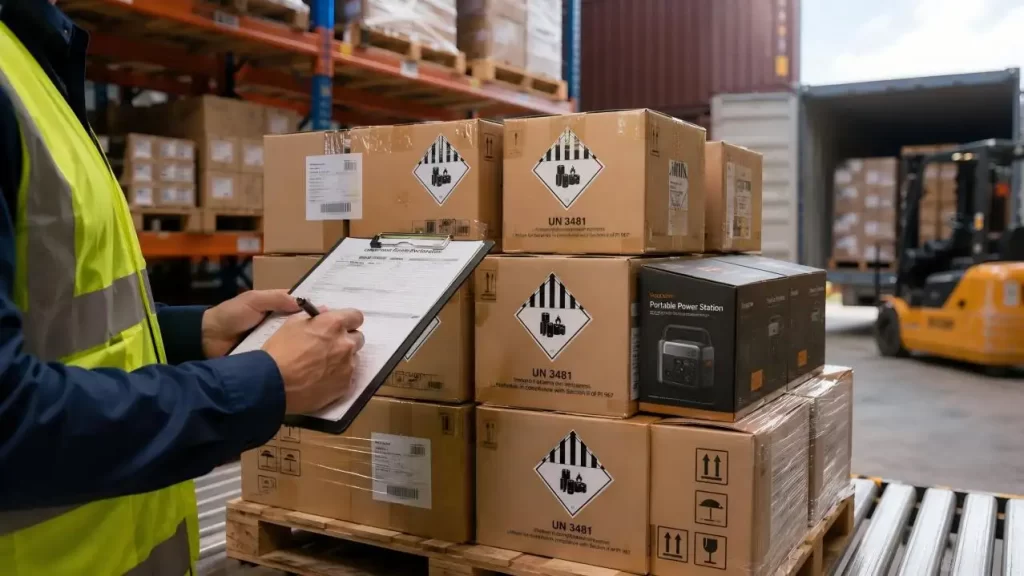
•UN 3481: Equipment containing or packed with Lithium-ion batteries
•UN 3091: Equipment containing or packed with Lithium-metal batteries
The classification should pertain to the battery chemistry and the equipment packing configuration.
5. Escalate Unverified Designs
Where no valid evidence exists, or a design change requires retesting, arrange a technical review rather than using documents from another model. A revised test summary is required when a different battery design necessitates retesting.
Battery Powered Device Shipping Pre-Booking Checklist
Before booking transportation, verify:
•Battery identity, chemistry and Wh rating
•UN 38.3 testing status
•Test Summary availability
•Model consistency across labels and documents
•Equipment configuration and UN number
•Protection against short circuits and movement
•Prevention of accidental device activation
•Packaging, marks, labels and declarations
•Applicable state-of-charge limits
•Carrier and destination-country acceptance
From January 1, 2026, lithium-ion batteries packed with the equipment they power must generally be offered for air transport at no more than 30% state of charge, subject to applicable provisions and approvals. This should not be presented as a universal limit for every battery contained in equipment.
Make Battery Powered Device Shipping Clearer Before Dispatch
Missing a full laboratory report does not always mean Battery Powered Device Shipping must stop. The first step is to establish whether the battery passed UN 38.3 testing, whether a compliant test summary is available and whether the information matches the actual product.
Fexbuy offers support for shipping battery-powered devices with specialized services including document review, UN 38.3 test guidance, MSDS review, dangerous goods classification, battery testing, compliant packaging, air and sea freight, customs clearance, warehouse, overseas distribution, and final delivery.
To initiate a pre-shipment compliance review, please provide us with the quantity being shipped, battery Wh rating, model number of the battery, and the origin and destination.
FAQs
Q1. Can Fexbuy ship battery-powered devices without a complete UN 38.3 test report?
A full laboratory report is not always a deal breaker. Fexbuy can check first if the battery has undergone the appropriate UN 38.3 tests, if a compliant test summary is available and if the battery model described in the test summary is the same as the battery model being shipped.
Q2. What Fexbuy procedures do battery-powered devices shipments undergo?
Fexbuy can examine a UN 38.3 Test Summary, a Safety Data Sheet or Material Safety Data Sheet, battery specifications, product or battery labels, a commercial invoice, a packing list, the transport classification, and import documents for the destination country.
Q3. Can Fexbuy assist in obtaining a UN 38.3 Test Summary?
Fexbuy can detect information gaps and direct the shippers on how to obtain the appropriate Test Summary from the battery manufacturer, device brand, authorized distributors and/or testing laboratories.
Q4. Does Fexbuy perform UN 38.3 tests?
Yes. Fexbuy can offer test guidance and coordinate testing and compliance reviews necessary to ship battery powered devices.
Q5. Can a UN 38.3 Test Summary be replaced with a Safety Data Sheet (MSDS)?
No. An MSDS does not provide information on battery tests. The UN 38.3 Test Summary is a report on the results of battery transport tests. Fexbuy requires both documents for different compliance evaluations.


