


Home Appliance Shipping Service: Customs Documents Guide
International appliance shipping is not complete when the cargo leaves the factory. Customs must be able to identify what the product is, where it was manufactured, how much it is worth, and whether it meets the destination market’s technical requirements.

At Fexbuy, we treat documentation as an operational part of every Home Appliance Shipping Service. A missing battery report or inconsistent model number can delay a shipment just as easily as a missed vessel. Document review should therefore begin before booking, packing, and export declaration.
Why Appliance Customs Clearance Requires Careful Planning
Home appliances combine electrical components, metals, plastics, motors, heating elements, refrigerants, wireless modules, or batteries. Each feature can affect:
•HS classification and import duty
•Product safety and energy-efficiency requirements
•Dangerous goods classification
•Packaging and labelling
•Carrier acceptance
•Customs inspection risk
The documents required for a Home Appliance Shipping Service depend on the product, destination, transport mode, declared use, battery configuration, and agreed Incoterm.
Core Documents for Home Appliance Shipping Service
A standard shipment file normally contains the following documents:
| Document | Customs or Transport Function | Key Details to Verify |
| Commercial Invoice | Supports classification, valuation, and tax assessment | Model, description, quantity, unit value, currency, origin, Incoterm |
| Packing List | Describes the physical shipment | Cartons, pallets, dimensions, net/gross weight, packing method |
| Bill of Lading or Air Waybill | Records the transport route and shipment parties | Shipper, consignee, notify party, cargo description, package count |
| Certificate of Origin | Supports origin verification or tariff preference where applicable | Manufacturing country, exporter, product description |
| Customs Declaration | Formally declares the goods to customs | HS code, customs value, origin, procedure code |
| Insurance Certificate | Confirms cargo insurance coverage | Insured value, risks covered, policy period |
Invoice and Packing List Accuracy
Descriptions such as “electrical goods” or “home appliance parts” are rarely sufficient. The commercial invoice should identify the actual product—for example, “cordless household vacuum cleaner with rechargeable lithium-ion battery.”
For every Home Appliance Shipping Service, Fexbuy checks whether quantities, model numbers, weights, values, and consignee information are consistent across the invoice, packing list, booking data, and transport document.
Product Compliance Documents Importers May Need
Transport documents confirm how cargo is shipped. Product compliance documents establish whether the appliance may be placed on the destination market.
Depending on the product and country, the importer may need:
•Declaration of Conformity
•Electrical safety and EMC test reports
•CE technical documentation for applicable EU products
•Energy-efficiency reports, labels, or product registration
•Radio or wireless compliance records for connected appliances
•Product labels and manuals in the required language
•Import licences or local conformity certificates
EU ecodesign rules, for example, include product-specific technical and information requirements for several appliance groups. Importers should verify the current requirements through the relevant authority rather than assuming one certificate covers every market. See the European Commission’s ecodesign and energy-labelling framework.
Additional Requirements by Appliance Type
A well-prepared Home Appliance Shipping Service reviews the components inside the appliance, not only the finished-product name.
| Appliance Type | Additional Information or Documents |
| Refrigerators and air conditioners | Refrigerant type, charge quantity, energy data, environmental records |
| Smart appliances | Wireless-module details, EMC reports, radio compliance |
| Cordless appliances | Battery specification, UN38.3 test summary, applicable transport records |
| Gas cooking appliances | Gas safety and destination-market conformity documents |
| Wooden-crated appliances | ISPM 15 treatment and marking where required |
| Refurbished appliances | Condition report, test record, valuation evidence, possible import permit |
This review is important because destination countries may restrict certain refrigerants, used electrical equipment, or non-compliant energy-consuming products.
Battery Documents for Smart and Cordless Appliances
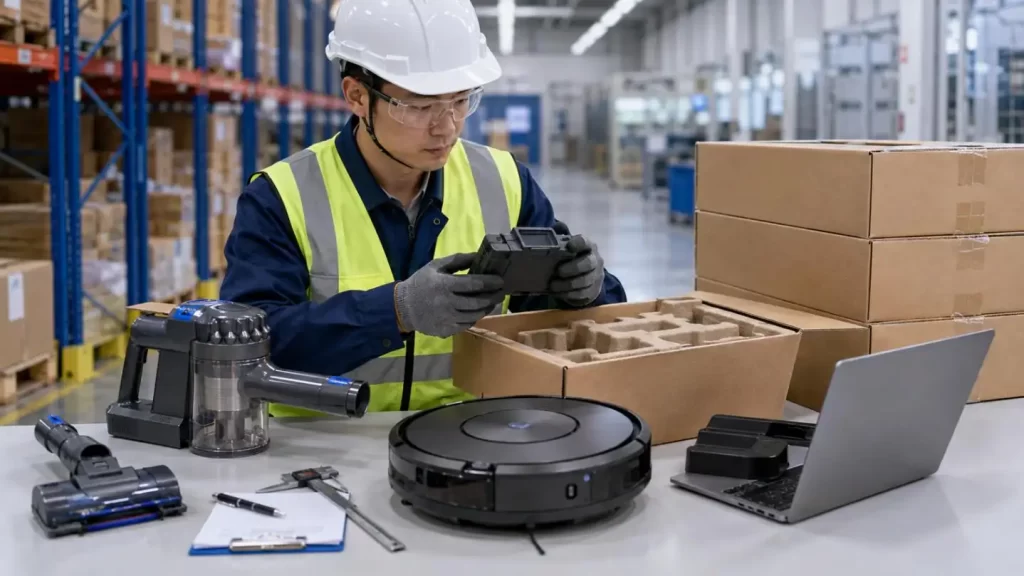
Robot vacuum cleaners, cordless vacuums, portable kitchen appliances, and cleaning devices may contain lithium batteries. Their classification must be confirmed before the Home Appliance Shipping Service requests space from a carrier.
Commonly reviewed information includes:
•Correct UN number and proper shipping name
•Whether batteries are installed in or packed with equipment
•Battery chemistry, quantity, and Watt-hour rating
•UN38.3 test summary
•Safety Data Sheet when requested
•Packaging method and protection against short circuit or activation
•Lithium battery marks and hazard labels
•Shipper’s Declaration when required
UN3481 commonly applies to lithium-ion batteries contained in or packed with equipment, but the actual classification must follow the shipment configuration.
Under the 2026 IATA battery guidance, lithium cells and batteries must pass UN38.3 testing. For air transport, state-of-charge requirements differ between batteries shipped separately, packed with equipment, and contained in equipment. Airline variations may also be stricter than the baseline regulations.
HS Code, Customs Value, and Origin
The HS code should reflect the appliance’s principal function and technical construction. A multifunction kitchen appliance, heating appliance, and motor-driven appliance may fall under different tariff headings even when their retail use appears similar.
Customs clearance also depends on:
•Transaction value and required valuation adjustments
•Freight and insurance treatment
•Country of manufacture—not merely the country of dispatch
•Related-party pricing
•Preferential origin eligibility
•Additional or trade-remedy duties
Fexbuy recommends confirming classification with the importer or customs broker before the Home Appliance Shipping Service submits the export and destination pre-alert data.
Incoterms and Clearance Responsibility
Incoterms allocate costs and responsibilities, but they do not replace compliance documents.
| Incoterm | Export Clearance | Main Transport | Import Clearance and Duties |
| EXW | Usually buyer | Buyer | Buyer |
| FOB | Seller | Buyer | Buyer |
| CIF | Seller | Seller to destination port | Buyer |
| DAP | Seller | Seller | Buyer |
| DDP | Seller | Seller | Seller, subject to a lawful import arrangement |
Before booking, both parties need to agree on who will be the importer of record, who will hold the certifications, who will pay duties, and who will answer customs’ questions.
Custom Delays
Some of the most common document issues are:
•Invoices, packing lists, and bills of lading that do not agree with one another
•Inadequate product information resulting in the use of generic product descriptions
•Harmonized System (HS) codes that have not been verified
•Incorrect country of origin
•Compliance records for electricity or energy have not been provided
•Batteries that do not match the cells in the product
•Wooden packaging has not been marked with ISPM 15
•Incomplete importer tax, EORI, or registration
This can result in the revision of documents, storage fees, demurrage, rejected transport, and return of the shipment.
Fexbuy Pre-Shipment Document Review
Our team recommends a thorough review of documents before using our Home Appliance Shipping Service. This includes, but is not limited to, confirming:
- The appliance being shipped is appropriate for the destination
- The HS classification and the customs value have been determined
- Batteries, refrigerants, or other controlled substances are being shipped
- There is a packing list and label for the booking
- Packing lists and labels for the booking
- Confirming the Incoterm and importer of record.
- Having the documents pre-screened by the carrier and customs (if possible).
Customs Clearance Should Be Planned Prior To Cargo Departure
Using a home appliance shipping service simplifies classification, compliance, packing, carbiner and customs coordination. While it is not possible to totally evade customs inspections, an initial look by customs can solve most problems and result in the least inconvenience and cost.
Fexbuy offers documentation, packaging and transport services for home appliances containing lithium batteries. If you want to use our shipping service, you need to talk to our team to discuss your product. For more information about our battery transport services, please visit Fexbuy Transport Services.
FAQs
Q1. What information does Fexbuy need before arranging shipment?
Fexbuy normally needs the appliance name, model, quantity, package dimensions, gross weight, destination, cargo value, preferred transport mode, and Incoterm. Importers should also identify batteries, refrigerants, magnets, or other controlled components.
Q2. What documents are required for Fexbuy’s Home Appliance Shipping Service?
Typical documents include a commercial invoice, packing list, bill of lading or air waybill, customs declaration, and certificate of origin where required. Product certifications and battery documents may also be necessary.
Q3. Can Fexbuy assist with customs clearance?
Fexbuy can coordinate customs-clearance arrangements depending on the route and selected service. The importer must provide accurate product information and hold any registrations, licences, or tax numbers required by the destination country.
Q4. Can Fexbuy help confirm the HS code for an appliance?
Fexbuy can review product specifications and coordinate classification with customs professionals. However, final classification is subject to the importer’s declaration and the decision of the relevant customs authority.
Q5. Does Fexbuy ship home appliances containing lithium batteries?
Fexbuy supports eligible battery-powered appliances, subject to battery specifications, packaging, documentation, carrier acceptance, and destination restrictions. Examples include cordless vacuums, robot cleaners, and portable kitchen appliances.


