


Rechargeable Power Supply Shipping Packaging Requirements for Lithium Battery Cargo
Rechargeable Power Supply Shipping packaging requirements depend on the battery’s UN classification, watt-hour rating, shipping configuration, condition and transport mode. A suitable package normally needs short-circuit protection, secure inner packaging, cushioning, a strong rigid outer package, correct marks and labels, and supporting documents.

Not every shipment requires the same UN specification packaging. The applicable standard must be determined from the UN number, packing instruction and relevant section.
Why Packaging Requirements Matter
Fire and thermal runaway are potential dangers of short-circuiting, damage, and poor packing of Li-ion batteries. Packaging protects against each of these issues. Packaging should separate and cushion the terminal contacts of batteries and reduce the potential for electric shocks and unintended activation. Packaging should warn the logistics operators of the dangerous nature of the goods being shipped.
💡 Key takeaway: Lithium battery packaging is a risk-control system, not simply a shipping carton.
Start with the Correct Battery Classification
Rechargeable Power Supply Shipping should begin with classification—not carton selection.
| Shipping configuration | Classification | Air packing instruction |
| Batteries shipped alone | UN3480 | PI 965 |
| Batteries packed with equipment | UN3481 | PI 966 |
| Batteries installed in equipment | UN3481 | PI 967 |
Power banks and portable power packs designed mainly to supply another device are generally treated as batteries. Adding a cable, charger or adapter does not automatically make the cargo “batteries packed with equipment.”
Are rechargeable power supplies classified as equipment?
Not necessarily. A rechargeable unit primarily designed to supply external power may be classified as a battery rather than equipment.
Checks Before Packaging
1. Confirm UN38.3 Status
The battery design should have passed the applicable UN Manual of Tests and Criteria, subsection 38.3 tests. Its test summary should identify information such as the manufacturer, model, Watt-hour rating, test laboratory and results.
The test summary does not always need to accompany the shipment as a paper document, but it must be available when required.
2. Verify the Watt-Hour Rating
Watt-hours = nominal voltage × rated capacity in amp-hours
The Wh rating affects the applicable packing section, package performance, quantity limits, marks, labels and dangerous-goods declaration requirements.
3. Check the State of Charge
For air transport, UN3480 lithium-ion batteries shipped alone generally must not exceed 30% state of charge.
From January 1, 2026, PI 966 batteries packed with equipment are also subject to reduced-charge requirements. Section I batteries must not exceed 30% SoC, while Section II batteries above 2.7 Wh must not exceed 30%.
For PI 967 batteries contained in equipment, 30% SoC or 25% indicated battery capacity is strongly recommended rather than universally mandatory.
4. Inspect the Battery Condition
New and undamaged batteries may proceed to normal packaging assessment. Used batteries require additional condition checks.
Damaged, defective or safety-recalled batteries capable of producing dangerous heat, fire or short circuits are generally forbidden from air transport and require specialist evaluation.
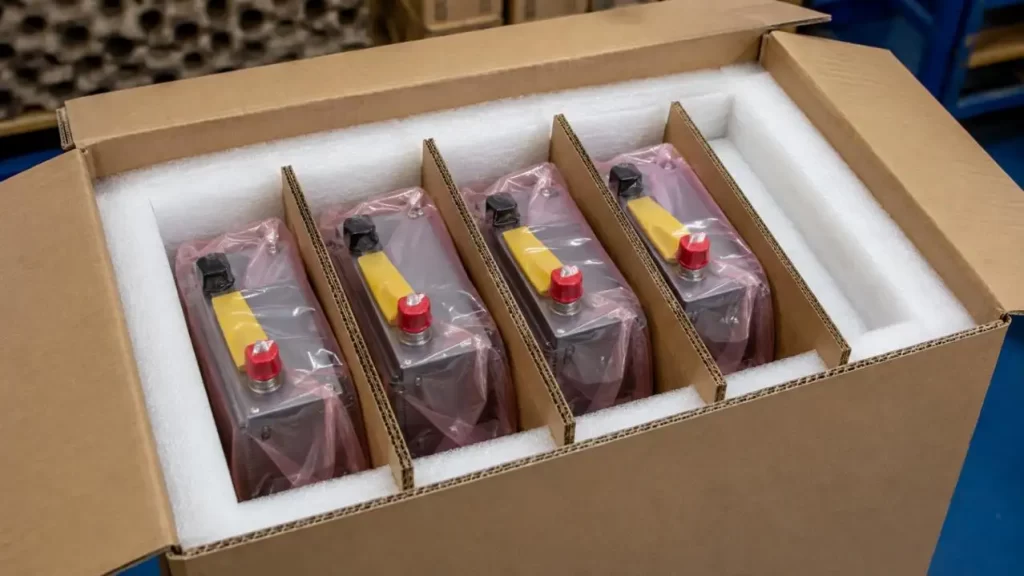
Core Rechargeable Power Supply Shipping Packaging Requirements
Protect Every Terminal
Use non-conductive terminal caps, suitable insulating tape or fully enclosed non-conductive inner packaging.
Batteries must not contact:
•Other batteries
•Metal accessories
•Conductive surfaces
•Exposed wiring or connectors
The outer carton should not be the only protection for exposed terminals.
Separate and Immobilize Each Unit
Use dividers and durable cushioning to prevent rotation, impact and movement. The products should remain securely positioned even when the package is tilted or handled repeatedly.
Heavy rechargeable power supplies may require reinforced bases, corner protection and internal restraints. Terminal protection must not become loose if the contents shift.
Select the Correct Outer Packaging
Possible formats include fibreboard, plywood or plastic boxes, drums and crates. However, strong rigid outer packaging and UN specification packaging are not interchangeable terms.
| Shipment category | General packaging direction |
| UN3480, PI 965 Section IA | UN specification packaging |
| UN3480, PI 965 Section IB | Strong packaging with drop and stacking capability |
| UN3481, PI 966 Section I | UN specification packaging forms part of the system |
| Eligible Section II shipments | Strong rigid packaging and section-specific tests |
PI 966 Section II completed packages must be capable of meeting the applicable 1.2-metre drop requirement. PI 965 Section IB packaging must be capable of withstanding a three-metre stack for 24 hours.
Does every rechargeable power supply need a UN-certified carton?
No. Rechargeable Power Supply Shipping requirements depend on the classification, Wh rating, packing instruction, section and transport mode.
Prevent Accidental Activation
Protect power buttons, touch controls and exposed switches with guards, spacing, switch locks or transport mode. Removable batteries may need to be disconnected where appropriate.
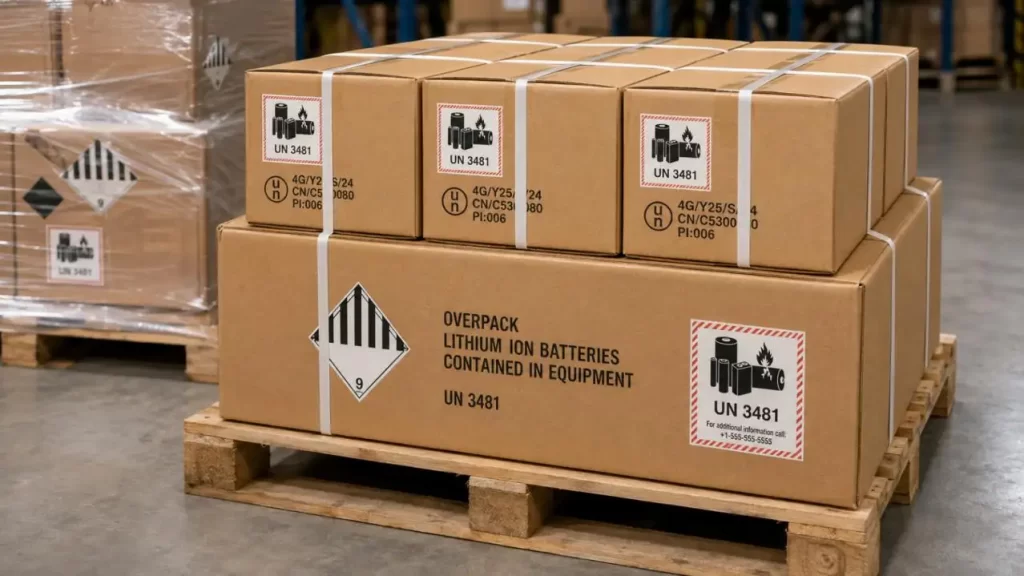
Marks, Labels and Documents
Depending on the shipment, the package may need:
•UN number and proper shipping name
•Lithium battery mark
•Class 9 lithium battery label
•Cargo Aircraft Only label
•Shipper and consignee details
•Net battery weight
UN3480 shipments prepared under PI 965 Sections IA and IB are forbidden as cargo on passenger aircraft and require a Cargo Aircraft Only label.
When an overpack hides the marks or labels on the packages inside, the required information must normally be reproduced outside and accompanied by the word OVERPACK. An overpack cannot correct an incorrectly prepared inner package.
| Document | Information to cross-check |
| UN38.3 test summary | Model, manufacturer and Wh rating |
| MSDS/SDS | Chemistry and handling information |
| Dangerous Goods Declaration | UN number, instruction and quantity |
| Invoice and packing list | Description, quantity and weight |
| Air waybill or bill of lading | Shipping description |
Model numbers, Wh ratings, UN numbers and weights should match across the product, packaging and transport documents.
Air Freight vs. Sea Freight
Air freight follows ICAO Technical Instructions and IATA Dangerous Goods Regulations, with strict controls covering SoC, aircraft type, package quantity and operator acceptance.
International maritime transport of packaged dangerous goods is subject to the IMDG Code. The 2024 Edition of the IMDG Code, replacing Amendment 42-24, came into effect on 1 January 2026.
A packaging design should not be reused across air, sea, rail or road routes without a mode-specific review.
Common Causes of Cargo Rejection
Frequent Rechargeable Power Supply Shipping problems include:
•Classifying a power bank as equipment
•Leaving terminals exposed
•Allowing products to move inside the carton
•Reusing damaged packaging
•Covering labels with stretch film
•Using inconsistent model numbers
•Declaring incorrect Wh data
•Showing different UN numbers on the package and documents
Make Battery Shipping More Manageable
Compliant Rechargeable Power Supply Shipping requires classification, battery testing, package design, marking, documentation, carrier acceptance and customs planning to work together.
Fexbuy supports battery manufacturers, technology companies, healthcare suppliers, industrial exporters and e-commerce businesses with UN38.3 guidance, MSDS review, dangerous-goods classification, suitable packaging, UN3480/UN3481 transport assessment, air and sea freight, customs coordination, DG-capable warehousing, FBA preparation and distribution.
With 21 years of international logistics experience, Fexbuy organizes air, sea, rail, and road transport under the DDP, DDU, FOB and CIF terms. Before shipping, the proposed routes are assessed against the battery profile, documents, and destination requirements.
Provide Fex Buy with the model, Wh rating, quantity, packaging, and destination of the batteries to start a preliminary review of the shipping of Rechargeable Power Supplies.
Request a Battery Shipping Review
FAQs
Q1. What are the shipping services offered by Fexbuy for Rechargeable Power Supply?
Fexbuy offers services for battery classification and review of documents, dangerous-goods packaging, shipping, custom clearance, and further logistics.
Q2. Can Fexbuy organize the transport of batteries of UN3480 and UN3481?
UN3480 batteries shipped alone and UN3481 batteries packed or contained in equipment, both will be assessed. It will depend on the battery specifications, the route, the carrier and the current regulations if we can accept the shipment.
Q3. Does Fexbuy help review lithium battery compliance documents?
Fexbuy does support the review of UN38.3 test-summary, MSDS, the classification of dangerous goods, and preparation of transport documents. We examine shipment descriptions and check quantities and Watt-hours of each battery model for consistency.
Q4. Does Fexbuy provide compliant lithium battery boxes?
Fexbuy can arrange dangerous-goods packaging to include UN certified boxes, as well as terminal insulation, anti-short-circuit materials, and cushioning as well as separating the goods and restricting their movement.
Q5. Does Fexbuy provide both air and sea freight for the power supply?
Yes, we provide compliant air freight, dangerous goods FCL and LCL sea freight, rail freight, cross-


