


18650 Lithium Cell Shipping Service
Loose cells are higher-risk than batteries installed in products because every cell is an individual energy source. Terminals must be protected, cartons must be packed to control movement and short-circuit risk, and standalone lithium-ion cells must follow UN3480 handling rules before a carrier will accept the shipment.
What We Ship
We support international freight for loose rechargeable cylindrical lithium-ion cells, including:
- 18650 lithium-ion cells for battery pack assembly
- 21700 lithium-ion cells for e-bikes, tools, power stations and mobility products
- Sample shipments from Shenzhen, Guangzhou, Dongguan and other China supplier hubs
- Bulk cartons or palletized shipments for distributors and pack manufacturers
- B2B battery cell imports for the USA, UK, Germany, EU, Canada and Australia
- DDP, DDU, FOB and CIF shipping arrangements depending on the buyer’s import setup
This service is for cells shipped alone, not cells already installed inside finished equipment. If you also ship finished battery products, our broader lithium battery shipping service can help compare the correct route, UN number and shipping mode.
Why Loose 18650 and 21700 Cells Need UN3480 Handling
Loose lithium-ion cells are normally treated as UN3480 lithium-ion batteries because they are shipped independently, not packed with or contained in equipment. This matters because UN3480 shipments face stricter carrier screening than many ordinary electronics shipments.
The main risks are practical, not theoretical:
- Exposed terminals can touch metal parts, other cells or conductive packaging.
- High carton density can increase heat and pressure if cells move during transport.
- Poor inner packaging can allow rubbing, impact or short circuits.
- Missing UN38.3 or MSDS/SDS files can stop the shipment before pickup.
- Incorrect labels, marks or declarations can trigger customs or airline rejection.
- Standalone lithium-ion cells shipped by air are subject to state-of-charge control, commonly handled at 30% SoC or less unless an approved exception applies.
For serious importers, the goal is not only “finding a cheap forwarder.” The goal is building a shipment profile that a DG carrier, airline, ocean line, customs broker and last-mile delivery partner can all accept.
18650 Cell Packaging Checklist Before Pickup
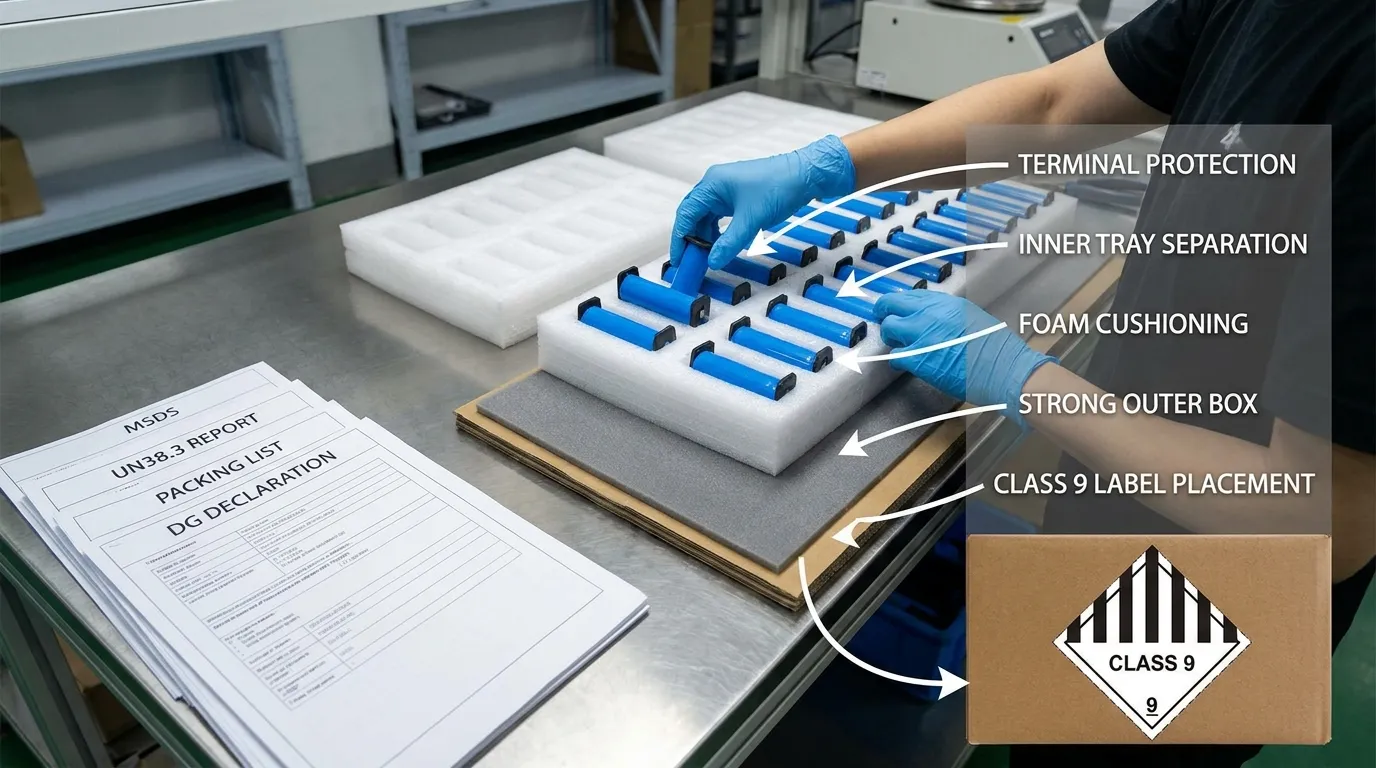
Before pickup, our team checks whether the shipment is packed for DG acceptance. The exact packaging plan depends on quantity, cell type, carton size, mode and destination, but loose cells should normally follow these rules:
| Packaging item | What to check | Why it matters |
|---|---|---|
| Terminal protection | Each cell should be protected from contact with other cells or conductive materials | Reduces short-circuit risk |
| Inner packaging | Use trays, sleeves, dividers or non-conductive separation | Prevents cell movement and abrasion |
| Carton strength | Use strong outer cartons suitable for weight and handling | Avoids crushing, tearing and leakage of contents |
| Packing density | Review cell count, net weight and carton layout | Prevents overweight or high-risk dense cartons |
| No damaged cells | Do not include swollen, leaking, recalled or defective cells | Damaged lithium batteries require separate handling |
| Labels and marks | Apply the correct lithium battery mark, Class 9 label and CAO label when required | Supports carrier and customs acceptance |
| Palletization | Use stable pallet packing for larger shipments | Improves handling and reduces carton damage |
A common rejection reason is not the battery chemistry itself, but weak packaging evidence: loose cells moving inside a carton, incomplete separation, unclear labels or documents that do not match the actual shipment.
UN Classification and DG Compliance
Most standalone rechargeable 18650 and 21700 cells are declared as UN3480 lithium-ion batteries, Class 9 dangerous goods. If the same cells are packed with equipment or contained in equipment, the shipment may fall under UN3481 instead.
Other battery UN numbers should not be mixed casually:
| UN number | Applies to | Relevance to this page |
|---|---|---|
| UN3480 | Lithium-ion cells or batteries shipped alone | Main classification for loose 18650/21700 cells |
| UN3481 | Lithium-ion batteries packed with or contained in equipment | Used when cells/batteries ship with devices |
| UN3090 | Lithium metal batteries shipped alone | Not normally for rechargeable 18650 lithium-ion cells |
| UN3091 | Lithium metal batteries packed with or contained in equipment | Different chemistry and rule set |
| UN3171 / related vehicle entries | Battery-powered vehicles or equipment | May apply to e-scooters or mobility products, not loose cells |
| UN3536 | Lithium batteries installed in cargo transport units | Not used for normal loose cell cartons |
For air freight, standalone UN3480 cells are usually handled as Cargo Aircraft Only and must be prepared under the correct IATA dangerous goods requirements. For ocean freight, IMDG handling still requires correct classification, packaging, marks, documentation and container-level DG planning.
Fexbuy reviews the battery data, shipping documents and packaging photos before confirming the route, so the shipment is not booked under the wrong category.
Shipping Modes, Lanes and Quote-Stage Lead Time
The best mode depends on quantity, urgency, destination, consignee capability and whether the buyer needs DDP or DDU.
| Mode | Best for | Key DG considerations | Lead-time handling |
|---|---|---|---|
| DG air freight | Urgent samples or smaller commercial shipments | UN3480 acceptance, CAO routing, SoC control, DG declaration | Confirmed per lane and airline space |
| DG sea freight | Bulk cartons, palletized stock, lower cost per kg | IMDG declaration, carton/pallet safety, customs documentation | Confirmed by port, sailing and delivery address |
| DDP battery line | Importers needing customs and tax handling support | Requires accurate product, value, weight and consignee details | Confirmed after destination and shipment profile review |
| DDU / airport / seaport service | Buyers with their own broker or importer setup | Consignee must handle destination clearance and duties | Confirmed based on mode and handover point |
| FOB / CIF coordination | Supplier-to-port or China export arrangements | Requires supplier pickup and export document alignment | Confirmed at quote stage |
Core lanes include China to the USA, UK, Germany, wider EU, Canada and Australia. Exact transit time and cost are confirmed after checking cell model, quantity, gross weight, carton size, destination address, Incoterm and document status.
Our 5-Step 18650 Cell Shipping Process
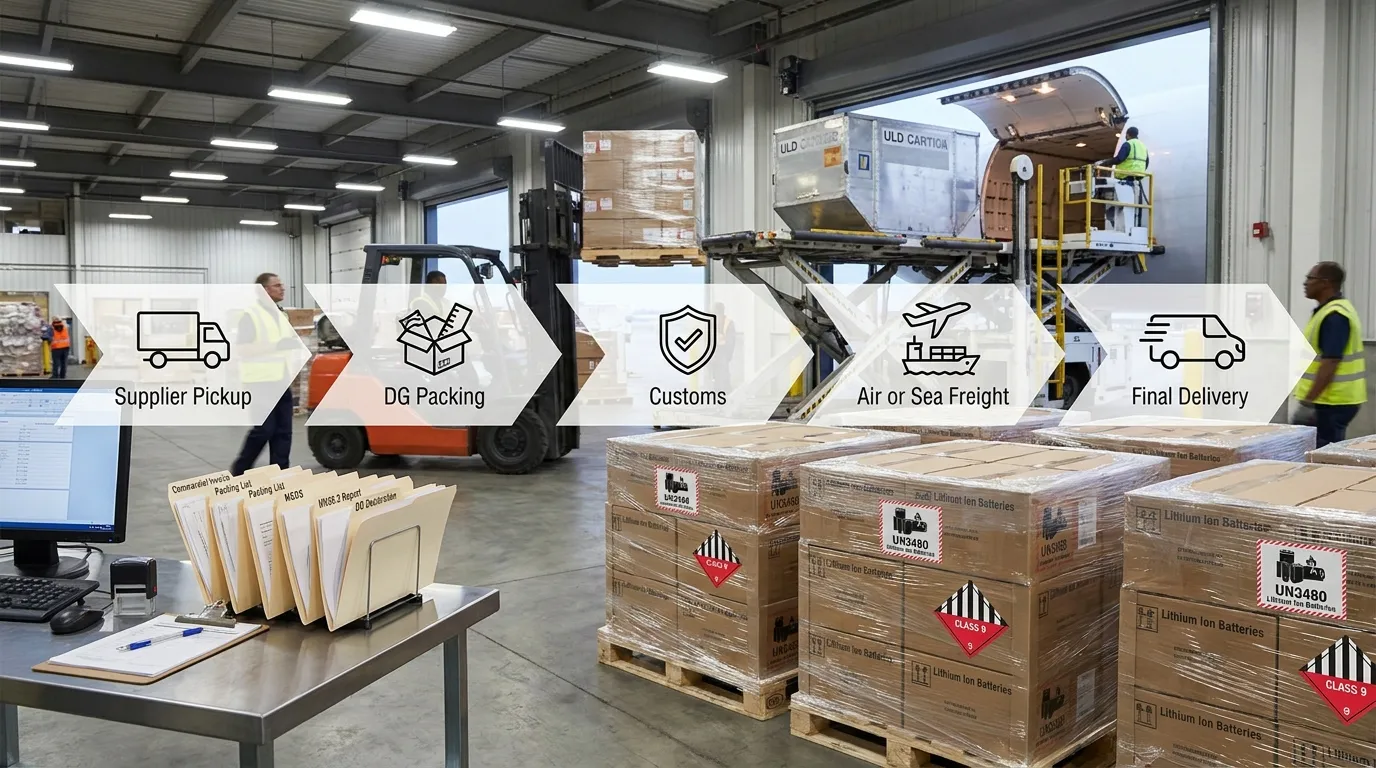
1. Pickup from Supplier
We collect from the battery factory, trading company or consolidation warehouse in China. Before pickup, we request cell specifications, quantity, carton details, destination and available DG documents.
2. DG Packing and Labeling Review
The team checks packaging photos, carton structure, terminal protection, label requirements and whether the shipment needs repacking or relabeling before export.
3. Export Customs and DG Declaration
We prepare or coordinate the required export documents, including commercial invoice, packing list and DG paperwork where applicable. The shipment must match the declared cell model, quantity, net weight and gross weight.
4. Air or Sea Freight Movement
The route is selected based on urgency, shipment size, carrier acceptance and destination rules. For UN3480 air shipments, CAO handling and SoC control are especially important.
5. Destination Customs and Delivery
Depending on DDP, DDU, FOB or CIF terms, we coordinate customs clearance, duty/tax handling where included, delivery appointment and final transport to warehouse, business address or approved receiving point.
Required Documents for 18650 Cell Shipping
Prepare these files before requesting a quote:
| Document | Why it is needed |
|---|---|
| UN38.3 test summary | Shows the cell model has passed required lithium battery transport tests |
| MSDS/SDS | Provides chemistry, hazard and handling data |
| Commercial invoice | Used for export and import customs value declaration |
| Packing list | Confirms carton count, weight, dimensions and item details |
| Battery specification sheet | Confirms cell model, voltage, capacity, Wh rating and chemistry |
| DG declaration | Required for many regulated dangerous goods shipments |
| SoC confirmation | Supports standalone lithium-ion air-shipping requirements |
| Consignee/importer details | Needed for DDP/DDU clearance and final delivery |
If your shipment contains pouch cells instead of cylindrical cells, see our lithium polymer (LiPo) battery shipping service. If you are moving sealed lead-acid or other non-lithium batteries, our lead-acid battery shipping service follows a different DG handling process.
Why Choose Fexbuy for Loose Lithium Cell Freight
Fexbuy is based in Shenzhen, close to China’s battery manufacturing and electronics supply chain. With 21 years of freight experience, DG shipment handling capability and door-to-door routes for major import markets, we help buyers reduce the risk of carrier rejection, customs delay and incorrect battery declaration.
Importers choose us for:
- UN38.3, IATA and IMDG compliance support
- DG document and packaging review before booking
- DDP, DDU, FOB and CIF service options
- China pickup and international door-to-door delivery
- Support for USA, UK, Germany, EU, Canada and Australia lanes
- 98% on-time performance based on Fexbuy’s service record
- Free Quote and WhatsApp RFQ support for fast shipment review
FAQ
Can I ship loose 18650 lithium-ion cells internationally from China?
Yes, but loose cells must be handled as dangerous goods. They need correct UN classification, terminal protection, compliant packaging, UN38.3 documentation, MSDS/SDS and carrier-approved routing.
Are 18650 cells UN3480 or UN3481?
Loose rechargeable 18650 cells shipped alone are normally UN3480 lithium-ion batteries. If the batteries are packed with equipment or installed inside equipment, the classification may change to UN3481.
Can UN3480 18650 cells be shipped by air freight?
Yes, when accepted by the carrier and prepared correctly. Standalone UN3480 lithium-ion cells usually require Cargo Aircraft Only handling, correct DG declaration, labeling, packaging and state-of-charge control.
What state of charge is required for loose 18650 cells?
For standalone lithium-ion cells shipped by air, shipments are commonly prepared at 30% SoC or less, unless an approved exception applies. The SoC should be confirmed before booking.
What packaging is required for 18650 battery cells?
Each cell should be protected against short circuit, separated with non-conductive inner packaging, packed in strong outer cartons, labeled correctly and kept stable during transport. Damaged, leaking, swollen or recalled cells should not be mixed with regular cargo.
What do I need to request an 18650 lithium cell shipping service quote?
Send the cell model, quantity, capacity/Wh, SoC, carton count, gross weight, carton size, UN38.3, MSDS/SDS, supplier city, destination country/address and preferred Incoterm.
Get a Free Quote for 18650 Lithium Cell Shipping
Send your 18650 or 21700 cell details, packing list, UN38.3, MSDS/SDS, supplier address and destination to Fexbuy for review. Our DG logistics team will check the classification, packaging, shipping mode and delivery option, then provide a route plan for China to the USA, UK, Germany, EU, Canada or Australia.
Request a Free Quote or send your shipment specs by WhatsApp to confirm the safest available route.


