


Lithium Polymer (LiPo) Battery Shipping
As a DG battery freight forwarder with 21 years’ experience, we help importers, Amazon sellers, electronics brands, drone/RC suppliers, and manufacturers arrange compliant door-to-door shipping with DDP, DDU, FOB, or CIF options.
LiPo Battery Shipping Service From China
We support rechargeable LiPo pouch-cell shipments used in RC models, drones, power banks, portable electronics, toys, smart devices, medical devices, robotics, and OEM battery assemblies. Cargo may include standalone pouch cells, custom battery packs, batteries packed with equipment, or batteries contained in equipment.
This page focuses mainly on standalone LiPo cells and packs shipped as dangerous goods, especially UN3480 cargo. For broader battery cargo, see our lithium battery shipping service.
Typical shipment types include:
- LiPo pouch cells from China battery factories
- RC and drone battery packs
- Sample shipments for testing or certification
- Bulk cartons for eCommerce or distributor stock
- Batteries packed with electronics
- OEM battery packs for device manufacturers
- Palletized commercial battery cargo
Before booking, our team checks the battery type, watt-hour rating, state of charge, packaging condition, documents, pickup city, destination country, and required Incoterm.
What Is Included in Our LiPo Battery Freight Service?
A compliant LiPo shipment is not only about finding a cheap freight rate. The shipment must be accepted by the carrier, pass export review, move under the correct DG rules, and clear import customs without avoidable delays.
Our LiPo battery freight service can include:
- Supplier pickup in Shenzhen, Dongguan, Guangzhou, Shanghai, Ningbo, Yiwu, or other China locations
- Battery document review before booking
- UN number and shipment type confirmation
- DG packaging and labeling guidance
- Air, ocean, or multimodal route planning
- Export customs support in China
- Destination customs clearance coordination
- DDP, DDU, FOB, and CIF shipping options
- Door-to-door delivery to the USA, UK, Germany, EU countries, Canada, and Australia
- RFQ support by Free Quote form or WhatsApp
For automotive battery cargo with different handling needs, we can also guide shippers to our car battery shipping service.
Why LiPo Pouch Cells Need Special DG Handling
LiPo pouch cells are flexible, lightweight, and energy dense, but the pouch format creates handling risks that importers should not ignore. Unlike hard cylindrical or prismatic cells, pouch cells can be damaged by compression, sharp carton edges, poor pallet stacking, or loose movement inside the box.
The main logistics risks are:
- Swelling: cells may expand if stored, charged, discharged, or packed incorrectly.
- Puncture: pouch film can be pierced by sharp objects, poor dividers, or crushed cartons.
- Short circuit: exposed terminals, loose wires, or metal contact can create heat and fire risk.
- Thermal runaway: damaged or defective cells can overheat and affect nearby cells.
- Carrier rejection: wrong labels, missing documents, or improper SoC can stop the shipment.
For this reason, LiPo pouch cells should be packed with terminal protection, non-conductive separation, anti-puncture cushioning, rigid outer cartons, and proper DG marks. Damaged, swollen, leaking, recalled, or defective batteries need separate review and may not be accepted on standard air routes.
UN Classification, IATA and IMDG Compliance
Most rechargeable LiPo pouch cells are treated under lithium-ion battery rules for transport. The exact classification depends on how the batteries are shipped.
| Shipment type | Common UN number | Typical example |
|---|---|---|
| Lithium-ion/polymer cells or batteries shipped alone | UN3480 | Standalone LiPo pouch cells or battery packs |
| Lithium-ion/polymer batteries packed with equipment | UN3481 | Device and spare battery in the same shipment |
| Lithium-ion/polymer batteries contained in equipment | UN3481 | Battery installed inside a product |
| Lithium metal batteries shipped alone | UN3090 | Non-rechargeable lithium metal cells |
| Lithium metal batteries with equipment | UN3091 | Non-rechargeable battery with/inside device |
| Battery-powered vehicle/equipment | UN3171 | Certain powered equipment or vehicle cargo |
For standalone LiPo batteries under UN3480, air freight rules are stricter. Many shipments require Class 9 dangerous-goods handling, Shipper’s Declaration for Dangerous Goods, Cargo Aircraft Only labeling, and state-of-charge control. For many air shipments, lithium-ion cells and batteries must be prepared at no more than 30% state of charge unless a specific exception or approval applies.
Ocean freight follows IMDG Code requirements and is often more practical for larger or heavier battery cargo, but it still needs correct classification, marks, labels, documents, and customs data.
LiPo Battery Packaging Requirements Before Shipping
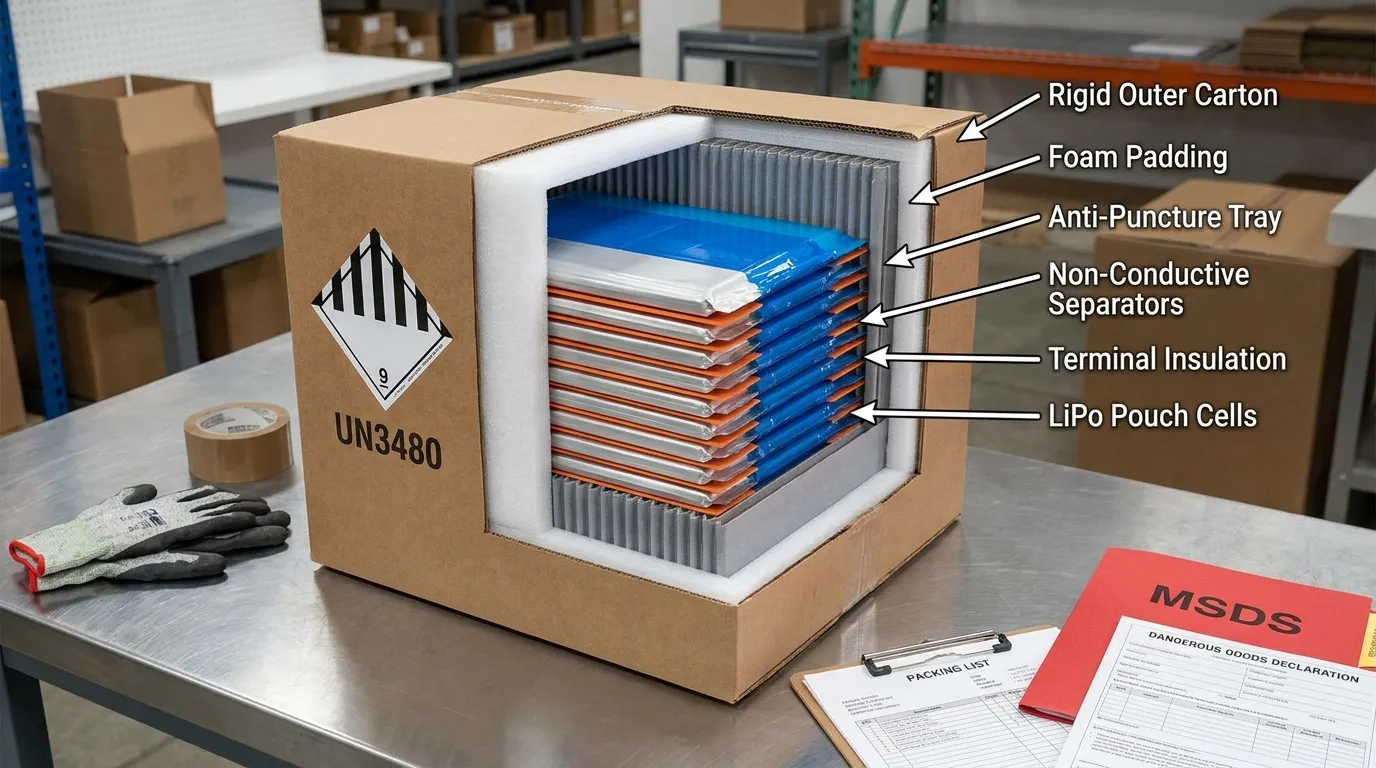
Packaging is one of the biggest reasons LiPo shipments pass or fail carrier review. A forwarder may not accept cargo that arrives in weak cartons, mixed loose cells, missing terminal protection, or packaging that cannot survive normal transport handling.
A compliant packing plan should include:
- Each battery protected against short circuit
- Exposed terminals insulated with caps, tape, sleeves, or equivalent protection
- Non-conductive inner packaging between cells or packs
- No loose movement inside the carton
- Anti-puncture cushioning around pouch cells
- Strong rigid outer cartons
- Correct lithium battery mark and Class 9 DG label where required
- Cargo Aircraft Only label when required for air
- Overpack marking if cartons are consolidated on pallets
- Carton weight, dimensions, and battery net weight clearly recorded
LiPo pouch cells should not be pressed tightly against sharp packaging edges. For bulk cartons, dividers, foam inserts, trays, or reinforced inner boxes may be needed depending on cell size, wire configuration, and quantity.
Shipping Modes, Routes and Transit-Time Planning
The best route depends on destination, shipment size, documents, urgency, carrier acceptance, and whether the cargo is UN3480 or UN3481.
| Mode | Best for | Key DG considerations | Transit-time note |
|---|---|---|---|
| DG air freight | Urgent samples, smaller commercial shipments | SoC limit, CAO rules, DGD, airline acceptance | Confirmed by lane after cargo review |
| Ocean freight | Bulk cartons, pallets, heavier stock | IMDG labeling, container routing, customs documents | Confirmed by sailing and destination port |
| Multimodal DDP | eCommerce stock and importer deliveries | Customs, duties, final-mile delivery planning | Quoted per destination postcode |
| Express DG route | Limited accepted battery shipments | Carrier acceptance is stricter for UN3480 | Checked case by case |
We regularly arrange China-to-USA, China-to-UK, China-to-Germany/EU, China-to-Canada, and China-to-Australia battery shipments. Exact transit time and cost are confirmed at the quote stage because battery type, gross weight, carton count, destination, and service term all affect the route.
Our 5-Step LiPo Battery Shipping Process
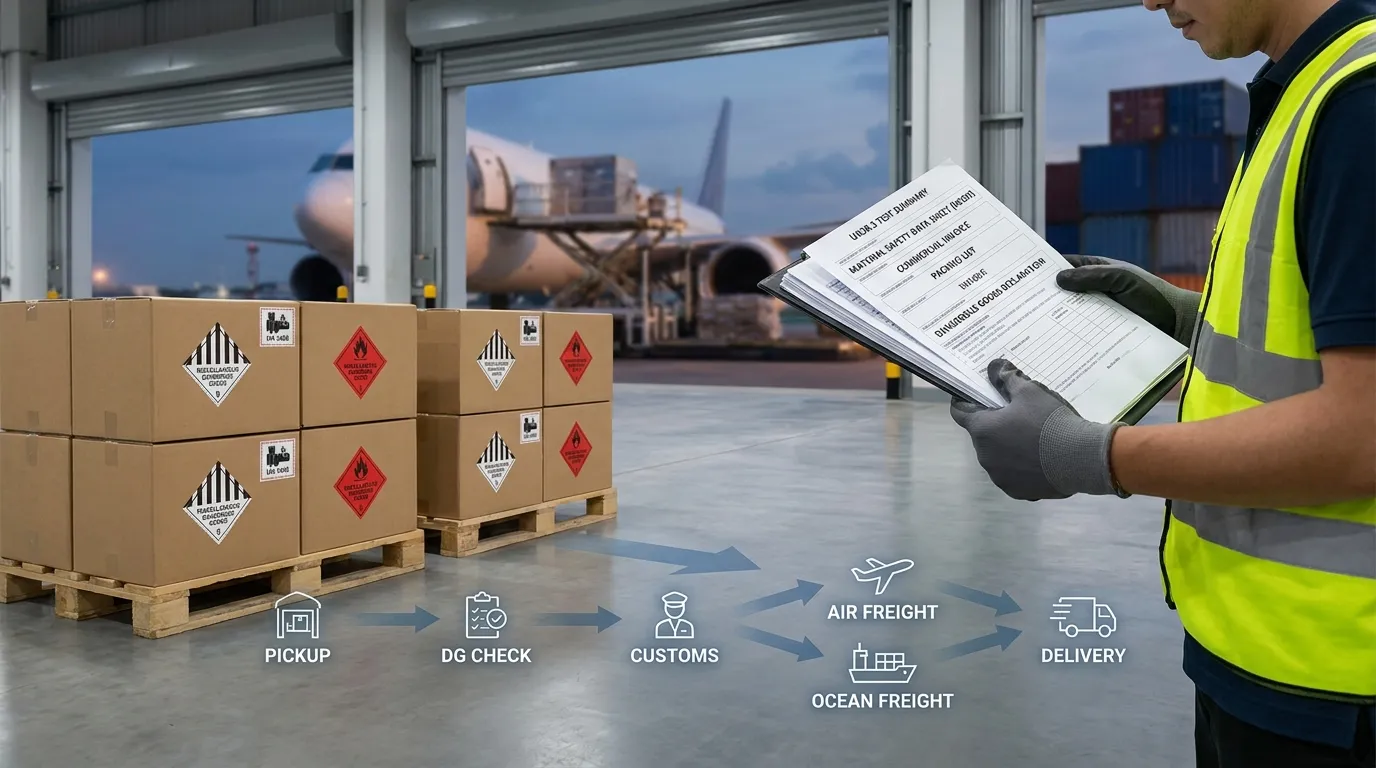
1. Cargo Details and Document Review
Send the battery specification, quantity, carton details, pickup city, destination, Incoterm, MSDS/SDS, and UN38.3 documents. We check whether the shipment is likely UN3480, UN3481, or another classification.
2. Pickup and DG Packaging Check
Cargo is collected from the supplier or delivered to our warehouse. Packaging, labels, carton condition, and battery handling risks are checked before freight booking.
3. Export Customs and DG Booking
We coordinate China export declaration, DG booking, carrier acceptance, and required shipping paperwork. For air cargo, this may include DG declaration and Cargo Aircraft Only handling.
4. Freight Movement
The shipment moves by the selected air, ocean, or multimodal route. We choose routing based on compliance, destination, cargo profile, and buyer delivery requirements.
5. Import Customs and Final Delivery
For door-to-door shipments, we help coordinate import clearance, duties/taxes under the agreed term, and delivery to warehouse, office, Amazon-related receiving address, distributor, or final consignee.
Required Documents for LiPo Battery Shipping
Most commercial LiPo shipments require more paperwork than ordinary goods. Missing or inconsistent documents can lead to carrier rejection, customs delay, inspection, or re-packing cost.
Prepare these documents when requesting a quote:
| Document | Why it matters |
|---|---|
| UN38.3 test summary/report | Shows the battery has passed required transport safety testing |
| MSDS/SDS | Provides battery safety, hazard, and handling information |
| Battery specification sheet | Confirms voltage, capacity, Wh rating, chemistry, and model |
| Commercial invoice | Needed for customs value and trade declaration |
| Packing list | Confirms carton count, weight, dimensions, and item quantity |
| DG declaration / DGD | Required for many regulated dangerous-goods air shipments |
| Product and packaging photos | Helps review labels, carton condition, and packing method |
| HS code and consignee details | Supports customs clearance and duty/tax handling |
For non-lithium battery cargo such as sealed lead-acid batteries, rules and classification may differ. See our lead-acid battery shipping service for that cargo type.
Why Choose Fexbuy for LiPo Battery Freight?
Fexbuy is based in Shenzhen, close to many battery factories, electronics suppliers, and export warehouses. That location helps with supplier pickup, document checking, packaging review, and China export coordination before the cargo is handed to the carrier.
Shippers choose us because we provide:
- 21 years of freight forwarding experience
- Dangerous-goods battery logistics support
- UN38.3, IATA, and IMDG compliance handling
- Door-to-door service to major destination markets
- DDP, DDU, FOB, and CIF options
- Low inspection-rate handling through document and packaging checks
- 98% on-time performance across managed shipments
- Free Quote and WhatsApp support for fast RFQ review
For LiPo pouch cells, the goal is simple: reduce rejection risk before pickup, choose the right route, and move the cargo with documents and packaging that match the shipment type.
FAQ
What is lithium polymer (LiPo) battery shipping?
It is the regulated transport of rechargeable LiPo pouch cells or battery packs by air, ocean, or multimodal freight. Because these batteries are usually dangerous goods, they need correct UN classification, packaging, labels, documents, and carrier acceptance.
Can standalone LiPo pouch cells be shipped by air?
Yes, but not as normal cargo. Standalone LiPo cells are commonly classified as UN3480 and may require Class 9 handling, state-of-charge control, DG declaration, and Cargo Aircraft Only routing. Acceptance depends on the battery details and airline rules.
What is the difference between UN3480 and UN3481?
UN3480 applies when lithium-ion or lithium-polymer cells or batteries are shipped alone. UN3481 applies when the batteries are packed with equipment or contained inside equipment. The packaging, labels, documents, and acceptance rules can differ.
What state of charge is required for LiPo air shipping?
For many standalone lithium-ion/polymer air shipments, cells and batteries must be prepared at no more than 30% state of charge. The exact requirement should be checked against the shipment type, packing instruction, and carrier acceptance policy.
What documents do I need to ship LiPo batteries from China?
You should prepare the UN38.3 test summary or report, MSDS/SDS, battery specification sheet, commercial invoice, packing list, carton details, product photos, and DG declaration where required. The forwarder checks these before booking.
Can you ship LiPo batteries DDP door-to-door?
Yes, DDP door-to-door service can be arranged for eligible shipments to the USA, UK, Germany, EU countries, Canada, and Australia. The final route, duty handling, and delivery method are confirmed after reviewing the cargo and destination details.
Get a Free LiPo Battery Shipping Quote
Send your battery model, UN number if known, voltage, Ah/Wh rating, quantity, carton count, gross weight, pickup city in China, destination country and postcode, MSDS/SDS, UN38.3 documents, and required Incoterm.
Fexbuy will review the shipment type, packaging risk, air/ocean options, customs requirements, and door-to-door feasibility. Get a free quote or send your specs and destination by WhatsApp or email for a compliant LiPo battery freight plan.


