


Lead-Acid Battery Shipping Service
Lead-acid batteries are not handled like lithium batteries. They normally fall under corrosive dangerous goods classifications such as UN2794 or UN2800, with leakage, acid spill, short-circuit, labeling, and packing risks that must be checked before a carrier accepts the shipment.
Lead-Acid Battery Freight We Can Arrange from China
We support international freight for common lead-acid battery categories used in automotive, backup power, solar storage, telecom, industrial equipment, and replacement-parts supply chains.
Typical cargo includes:
- Flooded lead-acid batteries
- Sealed lead-acid batteries
- SLA batteries
- VRLA batteries
- AGM batteries
- Gel lead-acid batteries
- Car and motorcycle batteries
- UPS backup batteries
- Solar and energy-storage batteries
- Telecom backup batteries
- Industrial battery packs and replacement units
For automotive replacement batteries, our car battery shipping service page covers more vehicle-specific shipping scenarios.
Before booking, our DG team checks the battery type, MSDS/SDS, UN number, packaging condition, weight, dimensions, destination country, and whether the cargo is spillable, non-spillable, new, used, damaged, or packed with equipment. This prevents the common problem where a battery shipment reaches the warehouse but is rejected by the carrier because the classification, marks, or paperwork do not match the cargo.
Class 8 Corrosive Handling: UN2794, UN2800, Spill and Leak Control
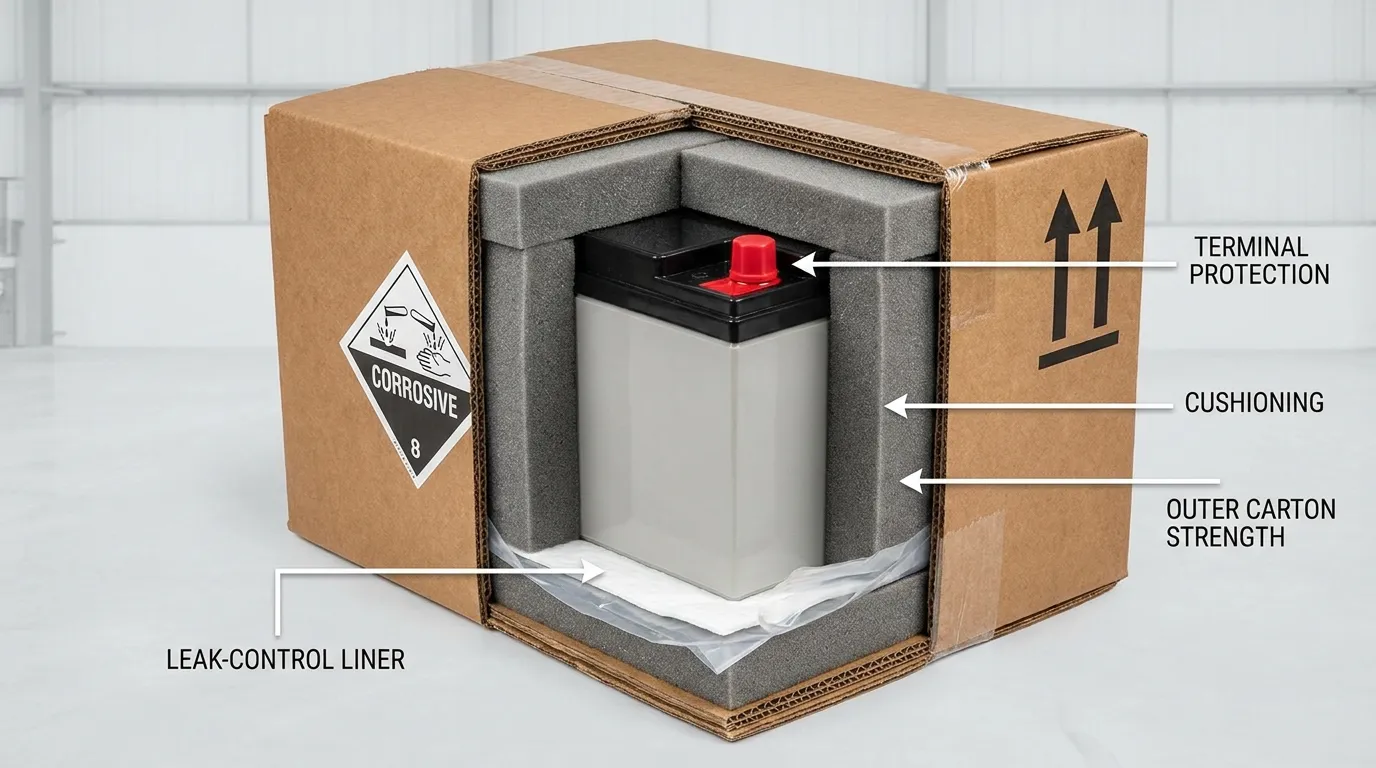
The most important difference is that lead-acid batteries are usually treated as Class 8 corrosive dangerous goods, not Class 9 lithium batteries.
Common classifications include:
| UN Number | Typical Description | DG Class | Practical Shipping Note |
|---|---|---|---|
| UN2794 | Batteries, wet, filled with acid, electric storage | Class 8 | Common for spillable lead-acid batteries with sulfuric acid electrolyte |
| UN2800 | Batteries, wet, non-spillable, electric storage | Class 8 | Used when the battery meets non-spillable conditions and documentation supports it |
| UN2795 | Batteries, wet, filled with alkali, electric storage | Class 8 | Relevant for certain alkaline battery cargo, not standard acid-filled lead-acid batteries |
For lead-acid freight, the forwarder must check more than the carton label. The battery must be protected against acid leakage, accidental activation, terminal contact, shifting, crushing, and incorrect orientation during loading. For sea freight, batteries are often palletized or crated, secured to prevent movement, and prepared with proper outer packaging, overpack marks, orientation arrows, corrosive labels, and UN number marking where required.
Damaged, swollen, leaking, cracked, or poorly sealed batteries create a much higher rejection risk. If there is any sign of leakage or acid residue, the shipment should be reviewed before pickup instead of being pushed into a normal export channel.
Lead-Acid vs Lithium Battery Shipping
Lead-acid and lithium batteries are both regulated, but the shipping logic is different.
| Topic | Lead-Acid Batteries | Lithium Batteries |
|---|---|---|
| Main hazard | Corrosive electrolyte, leakage, acid spill, short circuit | Fire risk, thermal runaway, energy density |
| Common DG class | Class 8 corrosive | Class 9 lithium battery dangerous goods |
| Common UN numbers | UN2794, UN2800, UN2795 | UN3480, UN3481, UN3090, UN3091, UN3171, UN3536 |
| Key document | MSDS/SDS, DG declaration, invoice, packing list | UN38.3, MSDS, DG declaration, lithium battery marks |
| Charge rule | No standard 30% SoC rule like lithium-ion standalone batteries | Lithium-ion standalone shipments often require state-of-charge control |
| Common mode | Sea freight preferred for heavy cargo | Sea, air, truck, courier-special DG depending on battery type |
If your shipment contains lithium batteries instead, see our lithium battery shipping service for Class 9 battery transport. If your medical equipment contains backup batteries, sensors, power packs, or mixed battery configurations, our medical device battery shipping page explains device-related battery logistics.
Shipping Modes and Lane Options
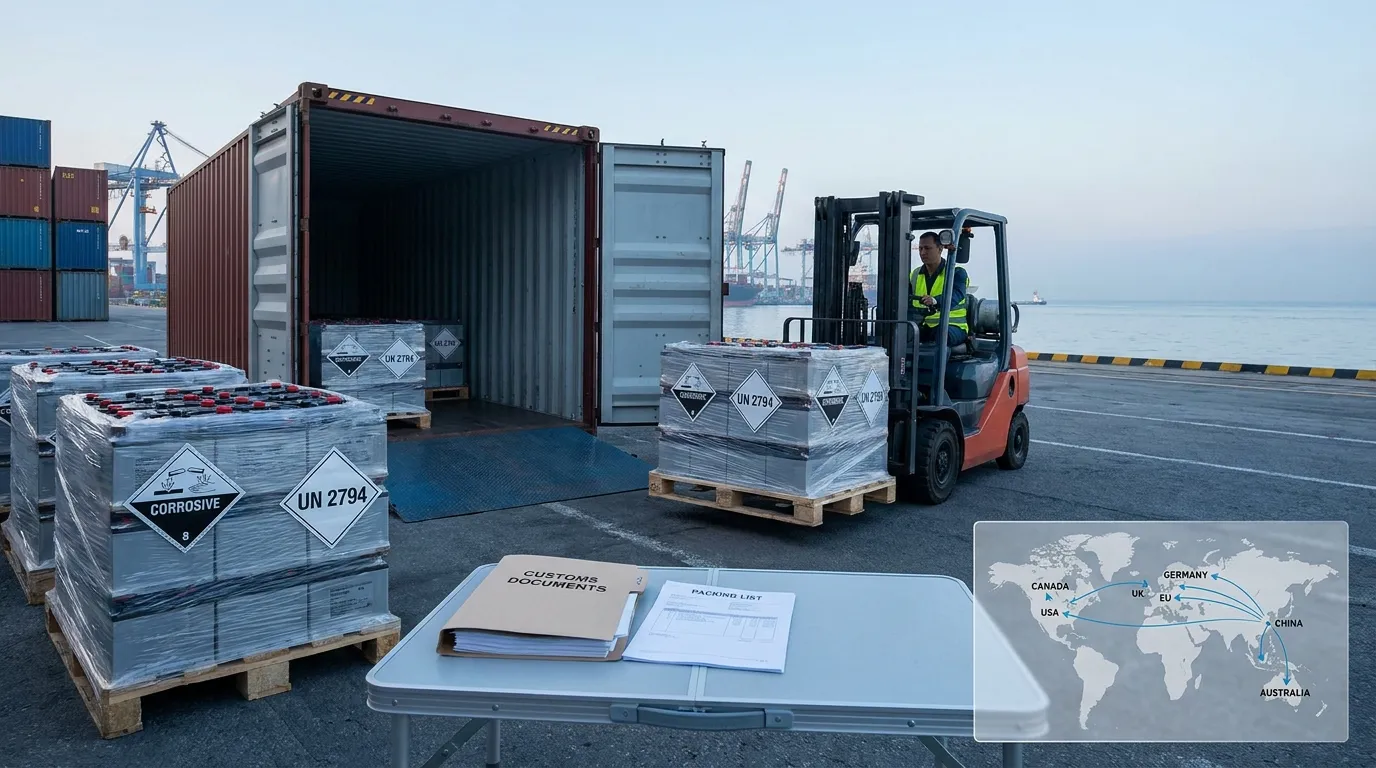
Sea freight is usually the first choice for lead-acid batteries because the cargo is heavy, dense, and often palletized. Air freight may be possible for urgent shipments, but acceptance depends on the battery type, documents, airline DG rules, packing condition, and destination restrictions.
| Mode | Best For | Strength | Watch-Out |
|---|---|---|---|
| Sea freight LCL | Smaller commercial shipments | Better cost control for heavy DG cargo | Needs correct DG booking, labeling, and warehouse acceptance |
| Sea freight FCL | Palletized or container-volume cargo | More control over loading and handling | Requires proper container planning and documentation |
| Air freight DG | Urgent samples or smaller approved cargo | Faster than ocean freight | Stricter acceptance, higher cost, more document review |
| Door-to-door DDP/DDU | Importers who want one forwarder to manage the chain | Pickup, export, freight, customs, and delivery coordination | Duties, taxes, and destination rules confirmed per quote |
| FOB/CIF freight | Buyers working under supplier or port-based terms | Useful for standard trade flows | Scope must be clear before booking |
We arrange battery freight from China to the USA, UK, Germany, wider EU, Canada, and Australia. Exact transit time is confirmed at the quote stage based on origin city, destination postcode, mode, volume, carrier acceptance, customs channel, and delivery term.
Our 5-Step Lead-Acid Battery Shipping Process
1. Pickup and Cargo Review
We collect shipment details from your China supplier or factory, including battery type, MSDS/SDS, photos, packing method, cartons, pallet dimensions, gross weight, destination, and Incoterm. If the cargo appears damaged, leaking, poorly packed, or incorrectly declared, it is reviewed before booking.
2. DG Packing, Labeling, and Marking Check
The cargo is checked for terminal protection, short-circuit prevention, carton or crate strength, pallet stability, orientation, and Class 8 marking needs. Where required, the shipment must show the correct UN number, corrosive label, orientation arrows, overpack marks, and dangerous-goods handling information.
3. Export Customs and DG Booking
We coordinate export customs documents, commercial invoice, packing list, HS code support, DG declaration, and freight booking. The goal is to avoid mismatch between the declared cargo, the MSDS, the UN number, and the label on the package.
4. International Freight Movement
Your shipment moves by sea freight, air freight, or a combined freight solution depending on urgency, quantity, battery type, and destination. For heavy lead-acid cargo, ocean freight is usually the most practical route.
5. Import Customs and Final Delivery
For DDP or DDU shipments, destination customs clearance and delivery can be coordinated to the buyer’s warehouse, Amazon-related receiving address where accepted, distributor, business address, or project site. For FOB or CIF shipments, the handover point is arranged according to the agreed trade term.
Documents Needed for Lead-Acid Battery Shipping
A complete document set helps reduce inspection, rejection, and customs delay risk. The usual file includes:
| Document | Why It Matters |
|---|---|
| MSDS/SDS | Confirms battery chemistry, hazard class, electrolyte, handling, and emergency details |
| DG declaration | Required for many regulated dangerous-goods movements |
| Commercial invoice | Used for export and import customs valuation |
| Packing list | Shows carton count, weight, dimensions, and packing format |
| Battery photos | Helps verify label, terminals, packaging, and visible cargo condition |
| HS code | Supports customs classification and duty review |
| Bill of lading or air waybill | Transport document for sea or air freight |
| UN38.3, if relevant | Usually for lithium battery cargo, not standard lead-acid batteries, but needed if the shipment includes lithium batteries |
Some buyers ask whether lead-acid batteries need UN38.3. For normal lead-acid shipments, the core issue is Class 8 corrosive classification and MSDS/DG documentation. UN38.3 is mainly associated with lithium and certain other battery transport requirements, so it should not be forced into a lead-acid file unless the cargo includes lithium batteries or battery-powered equipment requiring it.
Why Choose Fexbuy for Lead-Acid Battery Freight?
Fexbuy is a Shenzhen-based dangerous-goods freight forwarder with 21 years of battery logistics experience. We support battery exporters, importers, eCommerce sellers, OEM suppliers, and industrial buyers that need compliant China-to-overseas freight instead of a generic shipping channel.
Our advantages include:
- DG specialist handling for battery cargo
- UN38.3, IATA, and IMDG compliance knowledge across battery categories
- Class 8 and Class 9 battery shipment review
- Door-to-door options for USA, UK, Germany, EU, Canada, and Australia
- DDP, DDU, FOB, and CIF shipping terms
- 98% on-time performance
- Low inspection rate through better document and cargo preparation
- Free Quote and WhatsApp support before booking
The result is a cleaner shipping plan: correct classification, safer packing, better carrier acceptance, clearer customs documents, and fewer surprises after your supplier has already prepared the goods.
FAQ
Are lead-acid batteries considered dangerous goods?
Yes. Many lead-acid batteries are regulated as Class 8 corrosive dangerous goods because they contain acid electrolyte and can create leakage or spill risks. The exact classification depends on the battery type, whether it is spillable or non-spillable, and the supporting MSDS/SDS.
What is the difference between UN2794 and UN2800?
UN2794 is commonly used for wet batteries filled with acid, while UN2800 applies to wet non-spillable electric storage batteries that meet the required conditions. The forwarder must verify the MSDS/SDS and battery design before declaring the shipment.
Can sealed lead-acid batteries ship as non-dangerous goods?
Not automatically. “Sealed” does not always mean the shipment is unregulated. The cargo must meet non-spillable requirements, be packed correctly, and have documentation that supports the declaration. If the paperwork is weak, the carrier may still reject it.
Is sea freight better than air freight for lead-acid batteries?
For most commercial lead-acid battery shipments, sea freight is preferred because the cargo is heavy, dense, and often palletized. Air freight may be considered for urgent approved shipments, but it requires stricter DG acceptance and usually costs more.
What documents are required for international lead-acid battery shipping?
The common documents include MSDS/SDS, DG declaration where required, commercial invoice, packing list, HS code, battery photos, and transport document. The exact file depends on UN classification, mode, destination country, and delivery term.
How do I get a quote for lead-acid battery shipping service?
Send the battery type, MSDS/SDS, photos, quantity, carton or pallet size, gross weight, pickup city in China, destination country and postcode, preferred Incoterm, and required delivery timing. Our team will review the DG details and confirm the suitable route.
Get a Free Quote for Lead-Acid Battery Shipping
Send your battery MSDS/SDS, product photos, packing list, pickup address, destination postcode, cargo weight, dimensions, and preferred delivery term. Fexbuy will review the Class 8 classification, packing and labeling requirements, customs route, and available freight options, then provide a practical quote by Free Quote form or WhatsApp.


