


UN-Certified Battery Packaging Service
We do more than provide boxes. Our DG team reviews the battery type, UN number, watt-hour rating, state of charge, documents, packaging method, labels, and destination requirements before cargo is booked, so the shipment is less likely to be rejected by the warehouse, airline, ocean carrier, customs broker, or final-mile network.
What Battery Shipments We Can Pack and Handle
We support compliant packaging and forwarding for common lithium battery cargo, including standalone cells, battery packs, batteries packed with equipment, batteries contained in equipment, power banks, e-bike batteries, energy storage modules, industrial electronics, consumer electronics, and battery-powered devices.
Typical classifications include:
| Cargo type | Common UN number | Examples |
|---|---|---|
| Lithium-ion batteries shipped alone | UN3480 | Battery packs, power bank cells, replacement rechargeable batteries |
| Lithium-ion batteries packed with equipment | UN3481 | Devices shipped with spare batteries in the same carton |
| Lithium-ion batteries contained in equipment | UN3481 | Electronics, tools, meters, medical devices, smart products |
| Lithium metal batteries shipped alone | UN3090 | Primary lithium cells and non-rechargeable batteries |
| Lithium metal batteries packed with or contained in equipment | UN3091 | Devices using lithium metal cells |
| Battery-powered vehicles or equipment | UN3171 | E-bikes, scooters, battery-powered machines where applicable |
| Large battery installations or cargo transport units | UN3536 | Special large-format battery shipments when classification applies |
Normal commercial batteries, damaged batteries, defective batteries, recalled batteries, prototype batteries, and used batteries are not handled the same way. If the cargo is swollen, leaking, overheating, returned from market, involved in an incident, or being recalled, it must be reviewed separately before acceptance.
What Is Included in the Packaging and Labeling Service
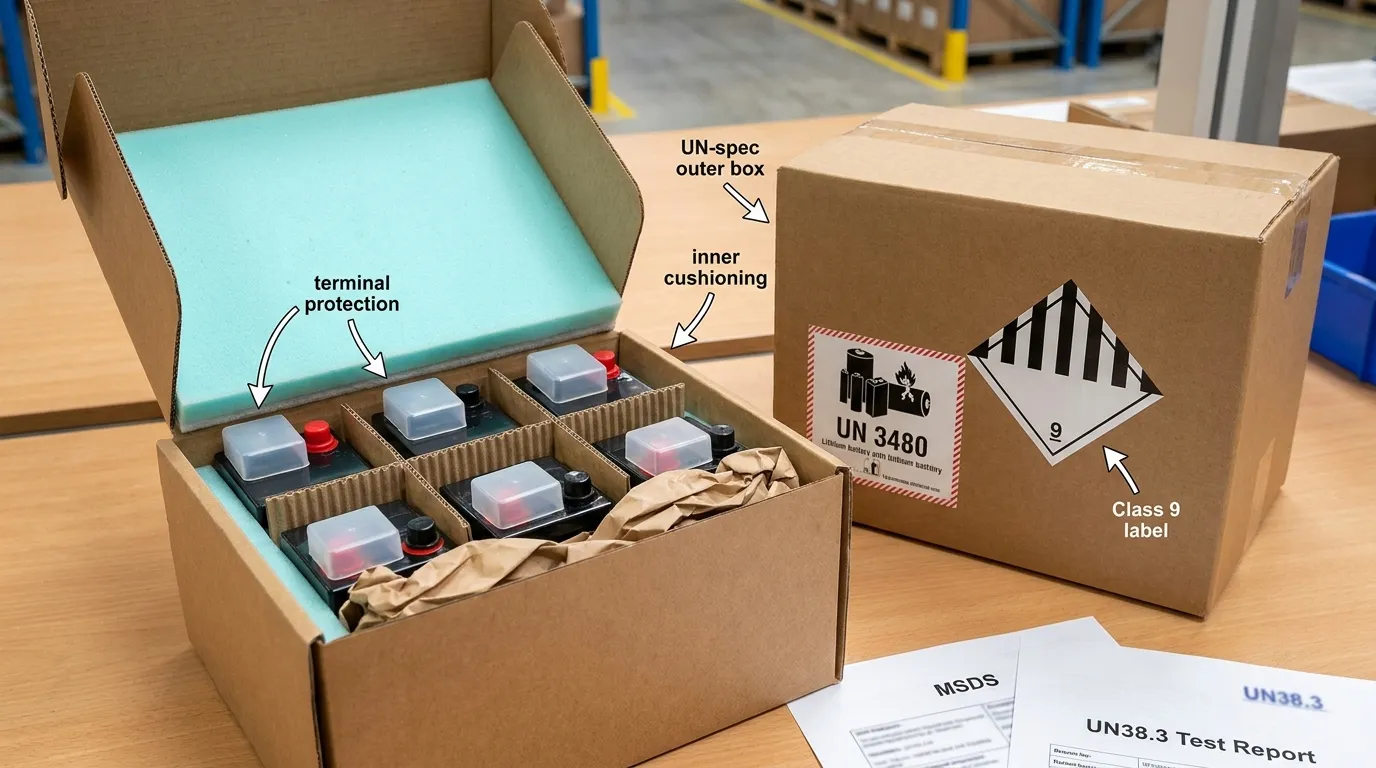
Our service covers the practical work required before a lithium battery shipment can move safely through a DG freight channel:
- Battery classification review by chemistry, configuration, Wh rating, and UN number
- UN-spec outer packaging selection where required
- Inner protection to prevent short circuit, movement, crushing, or terminal contact
- Cushioning, separators, insulation, and void filling based on cargo risk
- Correct Class 9 dangerous goods label and lithium battery mark
- Cargo Aircraft Only label where air transport rules require it
- Carton marking with UN number, consignee/shipper details, and handling marks
- Packaging photo review before freight booking
- DG document check before export customs and carrier submission
- Door-to-door freight coordination under DDP, DDU, FOB, or CIF terms
This makes the service useful for China suppliers that can manufacture batteries but cannot prepare them to airline, ocean, warehouse, or destination customs expectations.
Why Correct Battery Packaging Prevents Rejections
Lithium battery shipments are frequently delayed or refused because the cargo is not presented correctly. A factory carton may look strong enough for ordinary export, but DG shipping requires more than normal packaging.
Common rejection reasons include:
| Rejection risk | What can go wrong | How proper packing helps |
|---|---|---|
| Wrong UN number | Carrier books the shipment under the wrong DG entry | Classification is checked before booking |
| Weak inner protection | Batteries move, terminals contact, or packs are crushed | Separators, insulation, cushioning, and anti-movement packing are added |
| Missing Class 9 label | Warehouse or carrier refuses acceptance | Correct DG labels are applied before handover |
| Missing lithium battery mark | Shipment may be treated as undeclared or incomplete | Required marks are placed visibly on the outer package |
| High state of charge | Air cargo may fail acceptance rules | SoC is checked against the transport mode |
| Poor documents | Customs or carrier requests correction | MSDS, UN38.3, invoice, packing list, and DG declaration are aligned |
For broader transport planning beyond packaging, our lithium battery shipping service covers freight options from China to major destination markets.
UN Classification, Marks, and Compliance Checks
Lithium battery packaging starts with classification. The same product can fall under different transport entries depending on whether the battery is shipped alone, packed with equipment, or installed inside equipment.
For air freight, IATA DGR and ICAO rules are central. For sea freight, shipments follow IMDG Code requirements. The shipment may also require a Shipper’s Declaration for Dangerous Goods, UN38.3 test summary, MSDS/SDS, and correct packing instruction review.
Key compliance checks include:
- Lithium-ion vs lithium metal chemistry
- Cell or battery configuration
- Watt-hour rating for lithium-ion batteries
- Lithium content for lithium metal batteries where relevant
- Net battery weight per package
- Whether batteries are standalone, packed with equipment, or contained in equipment
- State of charge, especially for air transport
- Passenger aircraft restriction and Cargo Aircraft Only marking
- Whether the shipment is normal, damaged, defective, recalled, or waste cargo
Standalone lithium-ion batteries shipped by air are commonly subject to a 30% state-of-charge limit. Other battery configurations may also have specific acceptance limits depending on packing instruction, carrier policy, and approval route. We confirm the practical requirement during shipment review rather than assuming every battery can move under the same mode.
Packaging Checklist Before Pickup or Warehouse Receiving
Before cargo reaches our China warehouse, send the shipment details for review. This helps avoid repacking delays and quote revisions.
| Required detail | Why it matters |
|---|---|
| Battery chemistry | Confirms lithium-ion, lithium metal, or other battery type |
| Product photos | Shows terminals, casing, equipment, and packing condition |
| Existing packaging photos | Helps decide whether repacking is needed |
| UN38.3 test summary or report | Supports transport acceptance |
| MSDS/SDS | Provides chemistry and hazard information |
| Watt-hour rating / voltage / capacity | Needed for classification and air acceptance |
| Quantity, carton count, gross weight, and dimensions | Used for freight booking and packaging planning |
| State of charge | Especially important for air shipments |
| Pickup city in China | Affects pickup and export routing |
| Destination country and address type | Confirms USA, UK, Germany, EU, Canada, or Australia delivery planning |
| Incoterms | Confirms DDP, DDU, FOB, or CIF service scope |
| Cargo condition | Identifies normal, returned, damaged, defective, or recalled cargo |
If batteries are damaged, leaking, swollen, burned, overheating, or suspected unsafe, use our dedicated damaged & defective lithium battery shipping route instead of treating them as normal cargo.
Shipping Modes, Lanes, and Lead-Time Guidance
The best mode depends on battery type, size, urgency, documents, destination, and carrier acceptance.
| Mode | Best for | Compliance level | Lead-time note |
|---|---|---|---|
| Air freight | Urgent approved battery cargo, smaller shipments, commercial restocking | Strictest acceptance, SoC and airline approval important | Confirmed by lane, airline, and DG approval |
| Sea freight LCL | Medium-size battery shipments where cost control matters | IMDG documentation and DG warehouse handling required | Confirmed by port pair and consolidation schedule |
| Sea freight FCL | Larger battery lots, e-bike batteries, ESS modules, industrial cargo | Strong DG declaration and container planning required | Confirmed after vessel and destination review |
| Express or courier channel | Small approved battery-in-equipment shipments where available | Acceptance varies by carrier and destination | Confirmed only after cargo review |
| Door-to-door DDP/DDU | Importers needing customs and final delivery support | Requires aligned invoice, packing list, duties/taxes review, and delivery address check | Confirmed at quote stage |
We handle China export coordination and destination routing for the USA, UK, Germany, EU markets, Canada, and Australia. Exact transit time is confirmed per lane after cargo classification, document review, and carrier acceptance.
Our 5-Step Process: Pickup to Door Delivery
- Cargo and document review
We check battery type, UN number, MSDS, UN38.3, photos, packing condition, quantity, weight, destination, and requested Incoterms. - Pickup or warehouse receiving in China
Cargo can be collected from the supplier or received at our China DG handling point for inspection, repacking, labeling, and document matching. - DG packing and labeling
The team applies suitable inner protection, outer packaging, lithium battery marks, Class 9 labels, UN markings, and other required handling labels. - Export customs and freight booking
Commercial invoice, packing list, DG declaration, and supporting documents are checked before the shipment is submitted to the approved air, sea, or door-to-door channel. - Destination customs and final delivery
Depending on the service term, we coordinate DDP or DDU clearance support and delivery to warehouse, business address, FBA-related destination, or final consignee.
Documents We Prepare and Check
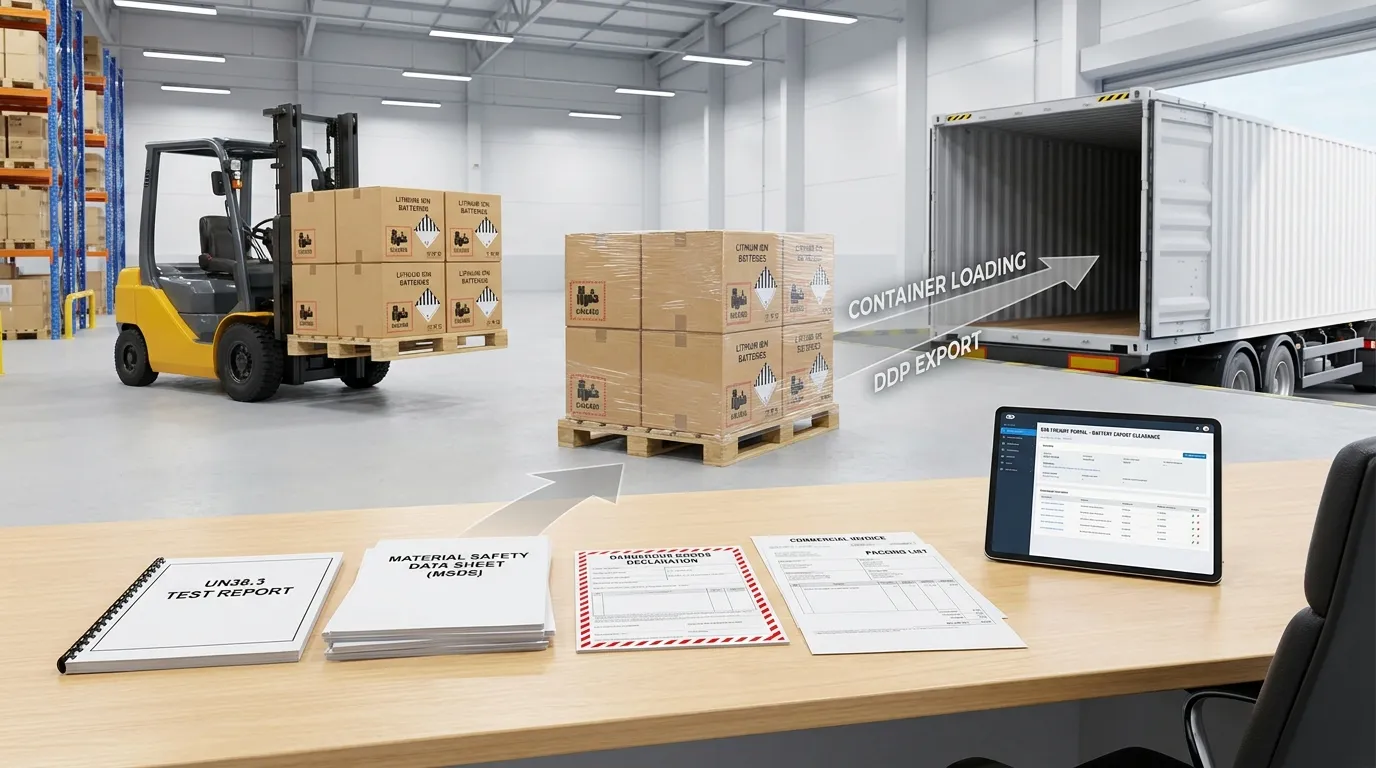
Lithium battery shipments are document-sensitive. A shipment with good packaging can still be delayed if documents do not match the cargo.
Common document requirements include:
- UN38.3 test summary or test report
- MSDS / SDS
- Dangerous Goods Declaration or Shipper’s Declaration where required
- Commercial invoice
- Packing list
- HS code and product description
- Battery specification sheet
- Packaging photos
- Carton marks and label photos
- Air transport identification report where required for China air export review
- Importer details, tax/VAT/EORI details, or consignee information where destination customs require them
For recalled products, do not book as normal stock. Use the dedicated recalled battery shipping service so the return reason, safety condition, packaging route, and carrier acceptance can be reviewed correctly.
Why Choose Fexbuy for Battery Packaging and DG Freight
Fexbuy is a Shenzhen-based dangerous-goods freight forwarder with 21 years of experience in battery logistics. Our team supports UN38.3, IATA, and IMDG compliant handling for lithium battery cargo moving from China to the USA, UK, Germany, EU, Canada, and Australia.
Importers choose us when they need a freight partner that understands both packaging and shipping execution. We can help review supplier cartons, arrange compliant repacking, prepare marks and labels, check documents, coordinate export customs, and quote DDP, DDU, FOB, or CIF options based on the shipment.
Our service is designed for buyers who want fewer inspection problems, fewer carrier refusals, and a clearer quote process before the cargo leaves China.
FAQ
What is included in a UN-certified battery packaging service?
It usually includes classification review, UN-spec outer packaging where required, inner insulation, terminal protection, cushioning, lithium battery marks, Class 9 labels, DG document checks, packaging photos, and freight booking support.
Which UN number applies to my lithium battery shipment?
Standalone lithium-ion batteries are commonly UN3480. Lithium-ion batteries packed with or contained in equipment are UN3481. Lithium metal batteries may be UN3090 or UN3091. Battery-powered vehicles may fall under UN3171. Final classification depends on the actual product and configuration.
Can you repack batteries already packed by my China supplier?
Yes, if the cargo is acceptable for handling and the documents support the shipment. We can review supplier packaging photos, inspect cartons, improve inner protection, add compliant marks and labels, and prepare the cargo for the selected freight mode.
What labels are required for lithium battery shipping?
Depending on the shipment, labels may include the Class 9 lithium battery label, lithium battery mark, UN number marking, orientation marks, handling marks, and Cargo Aircraft Only label for restricted air cargo. The exact label set depends on UN number, mode, and packing instruction.
Do I need UN38.3 and MSDS for battery freight?
In most commercial lithium battery shipments, UN38.3 and MSDS/SDS are expected for carrier, forwarder, and customs review. Some routes may also require a DG declaration, battery test summary, product datasheet, and packaging evidence.
Can damaged, defective, or recalled batteries use the same packing route?
Not always. Damaged, defective, leaking, swollen, returned, waste, or recalled batteries need separate DG risk review and may face stricter mode restrictions. They should not be mixed with normal commercial battery cargo without approval.
Get a Free Quote for Battery Packaging and Shipping from China
Send your battery type, product photos, existing packaging photos, MSDS, UN38.3, watt-hour rating, quantity, carton size, gross weight, pickup city in China, destination country, and preferred Incoterms.
Fexbuy can review the cargo, confirm the likely classification and packing route, then quote the suitable air, sea, DDP, DDU, FOB, or CIF option. Get a free quote or send the shipment details by WhatsApp for fast DG packaging and freight review.


