


Lithium Battery Shipping From China to UK/ USA: New 30% State-of-Charge Rules
Beginning January 1, 2026, air cargo of lithium-ion batteries packaged with equipment under UN 3481 and Packing Instruction 966 will have to be charged to a minimum of 30%. Other battery-powered products will have this requirement phased in.
At Fexbuy, when Lithium Battery Shipping From China to UK/ USA is assessed, we consider four major factors: the battery chemistry, the watt-hour rating of the battery, the packing method, and the method of transport. A shipment will not be compliant with simply discharging a battery to 30%.
What Changed on January 1, 2026?
The 2026 IATA rules distinguish between batteries shipped alone, packed with equipment and installed in equipment.
| Cargo configuration | Classification | 2026 SoC requirement |
| Lithium-ion batteries shipped alone | UN 3480, PI 965 | Maximum 30% SoC |
| Packed with equipment, Section I | UN 3481, PI 966 | Maximum 30% SoC |
| Packed with equipment, Section II, over 2.7 Wh | UN 3481, PI 966 | Maximum 30% SoC |
| Contained in equipment | UN 3481, PI 967 | 30% SoC or 25% indicated capacity recommended, not mandatory |
| Lithium metal batteries | UN 3090/3091 | SoC is not applied in the same way |
According to the IATA 2026 Lithium Battery Guidance Document, PI 966 Section I batteries must not exceed 30% of rated capacity. Under Section II, the restriction applies when the cell or battery exceeds 2.7 Wh.
A PI 966 shipment above 30% SoC may only move with written approval from the State of Origin and State of the Operator under Special Provision A331. Approval does not oblige an airline to accept the cargo.
Classification Comes Before SoC Control
A frequent problem in Lithium Battery Shipping From China to UK/ USA is choosing a packing instruction based on the commercial product name rather than the actual packing configuration.
Batteries Shipped Alone
Battery cells, battery packs, replacement batteries and power banks shipped without the device they power are generally UN 3480 under PI 965. They are forbidden as cargo on passenger aircraft and must move on a Cargo Aircraft Only service.
Batteries Packed With Equipment
PI 966 applies when the battery and the device it is designed to power are packed together, but the battery is not installed.
An adaptor, cable or charger alone does not qualify as “equipment.” For example, batteries packed only with a charging cable remain UN 3480 rather than UN 3481.
Batteries Contained in Equipment
PI 967 applies when the battery is installed inside a laptop, scanner, tool or medical device. The equipment must be protected against accidental activation, movement and damage during transport.
The commonly used thresholds of 20 Wh per cell and 100 Wh per battery determine whether Section I, IB or II provisions may apply. They do not create a general dangerous-goods exemption. Smaller batteries remain regulated even when simplified marking or documentation provisions are available.
Why Does a Lower SoC Reduce Air Cargo Risk?
SoC represents the stored capacity relative to the manufacturer’s rated capacity. A lower SoC reduces the energy available during internal short circuit or thermal runaway.
However, 30% SoC does not address every hazard. A shipment can still be rejected because of:
• Swollen, leaking or physically damaged batteries
• Unprotected terminals or exposed conductive parts
• Inadequate inner packaging
• Incorrect battery-to-document model matching
• Poor protection against equipment activation
• Packaging that fails applicable drop or stacking requirements
Damaged or defective batteries capable of producing dangerous heat, fire or short circuit are generally forbidden for air transport, including when installed in equipment.
Required Compliance Evidence
For Fexbuy, document review is a model-level verification process. Names, ratings and test references must be consistent across the full shipping file.
| Document or record | What it verifies | Common problem |
| UN 38.3 Test Summary | Battery design passed transport testing | Model number does not match |
| SDS/MSDS | Chemistry and safety characteristics | Treated as a substitute for UN 38.3 |
| Specification sheet | Voltage, capacity and Wh rating | Wh value missing or calculated incorrectly |
| SoC record | Factory charge-control process | Unsupported 30% declaration |
| Shipper’s Declaration | Applicable regulated DG compliance | Wrong UN number or packing instruction |
| Invoice and packing list | Commercial cargo identity and quantity | Product description conflicts with DG documents |
The UN 38.3 Test Summary must be available, but a paper copy does not necessarily have to accompany every shipment unless the state or operator requires it. Manufacturers may make it accessible through a URL or QR code.
For exports from China, airlines or booking channels may also request a transport safety appraisal, packaging evidence and a manufacturer’s SoC statement.
Packaging and Acceptance Checks
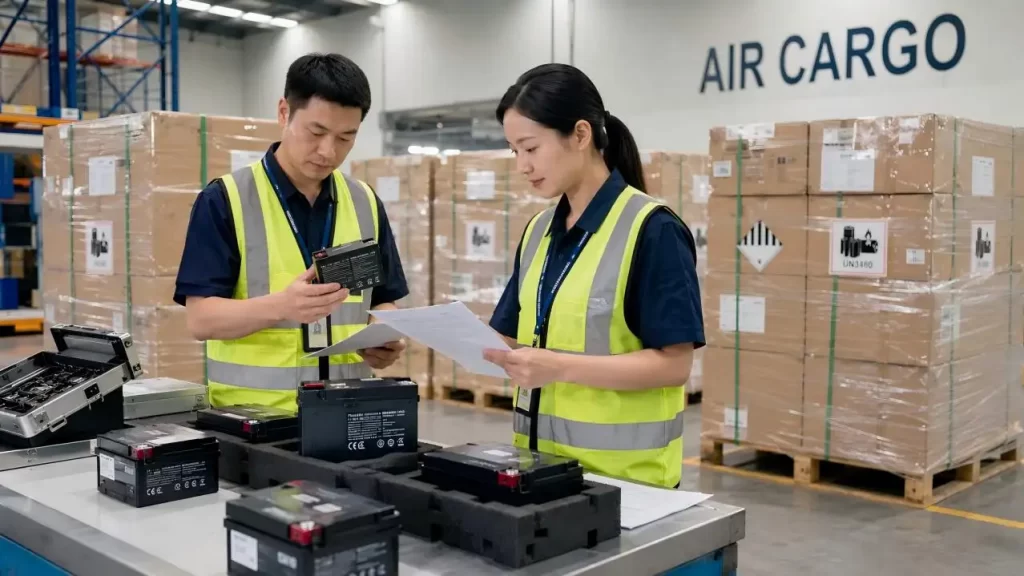
Professional Lithium Battery Shipping From China to UK/ USA should include a physical packaging review, not only a document check.
Key controls include:
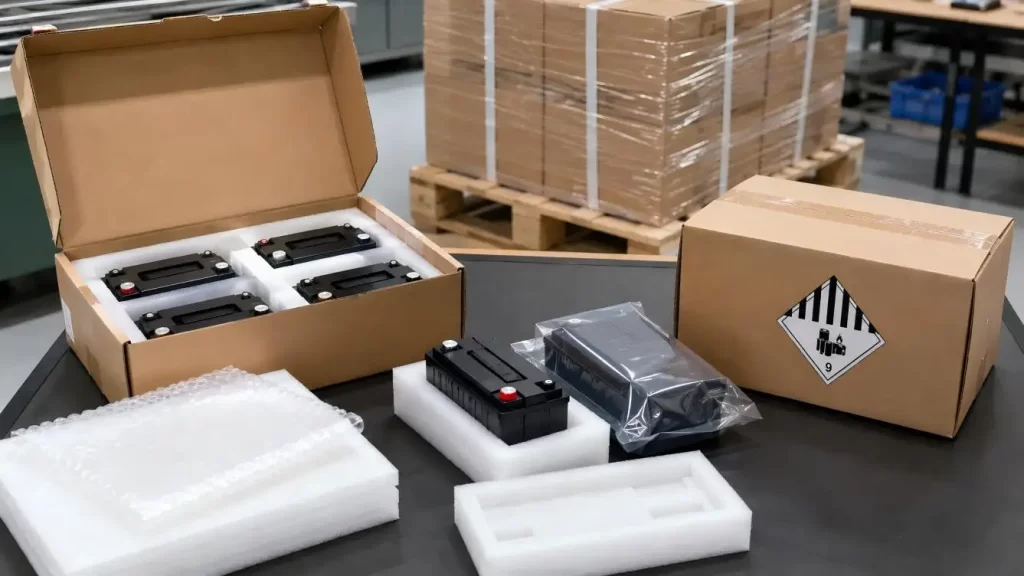
• Individual terminal protection against short circuit
• Non-conductive inner packaging or terminal caps
• Secure positioning to prevent battery movement
• Strong, rigid outer packaging
• UN-specification packaging where required by the applicable section
• Correct lithium battery marks, Class 9 labels and Cargo Aircraft Only labels
• Net battery weight within passenger- or cargo-aircraft limits
• Operator approval before cargo reaches the airport
Airline variations can be stricter than the baseline IATA provisions. Acceptance should therefore be confirmed before final packing and airport delivery.
UK and USA Requirements Are Not Identical
Both destinations use the ICAO/IATA framework for international air transport, but national controls remain relevant.
| Decision area | United Kingdom | United States |
| Aviation oversight | UK CAA | FAA |
| Dangerous-goods authority | UK regulatory framework | DOT/PHMSA |
| Key national rule | UK air DG requirements | 49 CFR §173.185 |
| Carrier restrictions | Operator variations apply | Operator variations apply |
| Import compliance | Separate from transport approval | Separate from transport approval |
The US PHMSA lithium battery guidance confirms that lithium batteries are regulated under the Hazardous Materials Regulations across air, highway, rail and water transport.
Transport approval also does not replace customs or product compliance. HS classification, importer details, product certifications and market-specific battery obligations must be checked separately.
Practical Pre-Shipment Workflow
Make sure you have done the following before requesting a final freight quote at Fexbuy:
- Check the Wh rating, chemistry, model and state of the battery.
- Have the shipping status of the battery determined (alone, equipped, installed).
- Determine the appropriate UN number, packing instruction and section.
- Confirm UN 38.3, SDS and specification are in agreement.
- Carry out SoC control and document the result.
- Check the packages and ensure they are properly marked and labeled.
- Have the airlines, routing and destination approved the shipment.
- Consider air and DG sea freight when restricted air freight assumptions affect cost or lead time.
Ocean freight can be used for larger and less time sensitive cargo, but it does not eliminate IMDG classification, packing, declaration and stowage.
Final Takeaway
SoC, UN classification, Wh rating, packing section and the related documents must be accepted by the carrier. The 30% rule is important, but it is only one component of a compliant shipment. Reliable Lithium Battery Shipping From China to UK/ USA.
Fexbuy batteries undergo classification, and documents are reviewed. DG packaging is also done by Fexbuy, as well as air and sea route planning for shipments from China. For additional information on a battery model you are interested in or on a specific destination, contact Fexbuy directly.
FAQs
Q1. Can Fexbuy ship standalone lithium-ion batteries from China?
Yes. Fexbuy can arrange transport for qualifying standalone lithium-ion batteries classified as UN 3480, subject to UN 38.3 documentation, compliant packaging, SoC limits and carrier acceptance.
Q2. What information does Fexbuy need to provide a freight quote?
Customers should provide the battery chemistry, model, Wh rating, quantity, gross weight, package dimensions, pickup city and destination. UN 38.3, SDS/MSDS and product photographs help Fexbuy evaluate the correct shipping channel.
Q3. Can Fexbuy handle batteries packed with equipment?
Yes. Fexbuy supports UN 3481 shipments packed with equipment under PI 966. The battery must be designed to power the accompanying equipment, and applicable 2026 SoC, packaging and quantity requirements must be met.
Q4. Does Fexbuy check whether batteries meet the 30% SoC rule?
Fexbuy can review the battery configuration and supporting SoC records before booking. The manufacturer or shipper remains responsible for controlling the actual battery charge and providing accurate compliance information.
Q5. Can Fexbuy ship batteries above 30% SoC by air?
Such shipments may require approval from the State of Origin and State of the Operator under Special Provision A331. Fexbuy can assess route feasibility, but final acceptance depends on regulatory approval and the airline’s operating policy.
Share:


