


HS Codes for Ecommerce Shipping: How Wrong Classification Creates Delays and Extra Duties
HS codes for ecommerce shipping are the classification numbers that tell customs what your product is, what it’s made of, and how much duty it owes. A wrong code — or a vague product description — can hold your shipment at customs, trigger unexpected duties, or flag your account for future audits. This guide explains how misclassification happens, what it costs, and gives you a checklist to get it right before every shipment.
Most ecommerce sellers pick up an HS code from their supplier, paste it onto the commercial invoice, and move on. That works until it doesn’t. When a shipment gets held, reclassified, or hit with a duty bill twice the size of the estimate, the root cause is almost always the same: the description on the invoice didn’t support the code on the form. This article breaks down exactly how that happens and what you can do to prevent it.
What an HS Code Actually Does at the Customs Gate
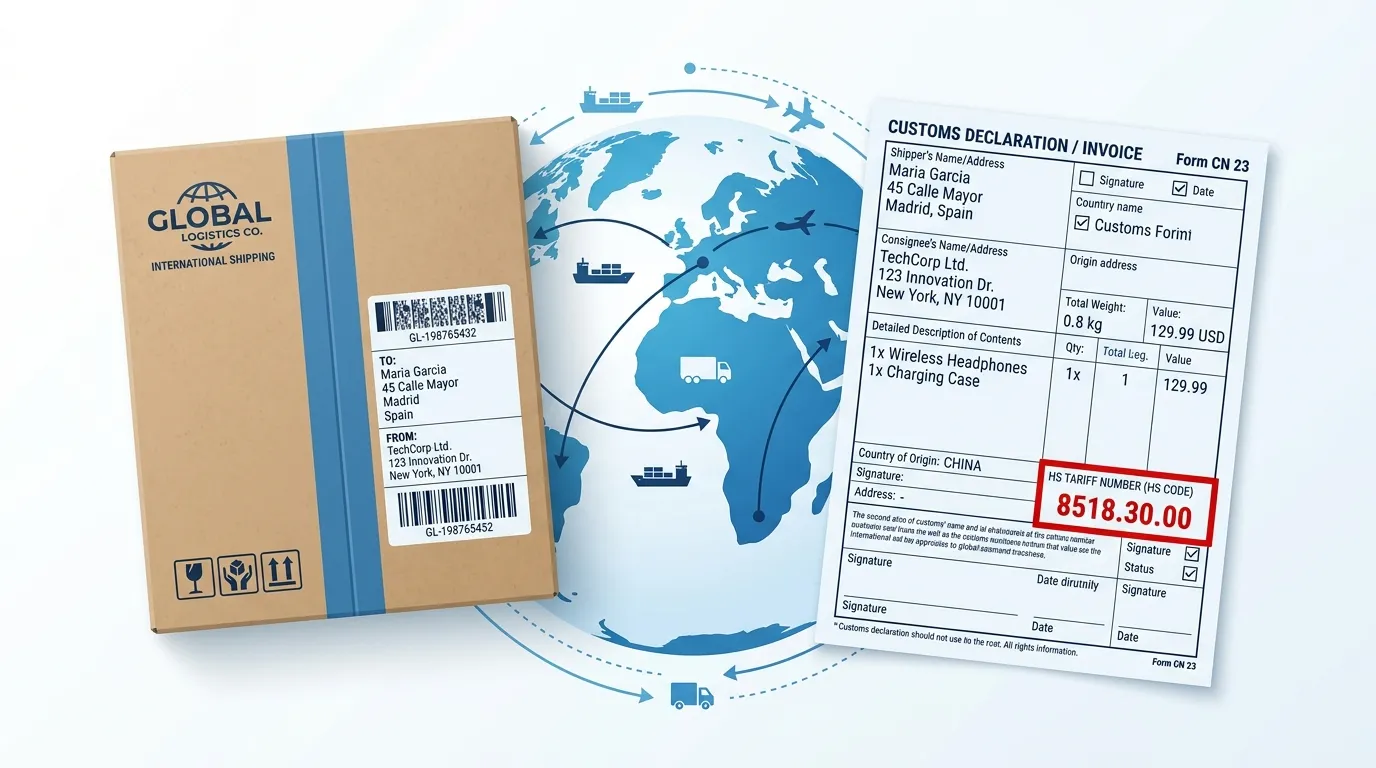
An HS code is a standardized numerical code — typically 6 to 10 digits — that tells customs what your product is, what it’s made of, and how it should be taxed. Every international shipment needs one. The first six digits are universal across more than 200 countries; the additional digits are country-specific and directly determine the duty rate applied to your goods.
When your shipment arrives at customs, the HS code doesn’t just get read by a human officer. It runs through an automated risk-scoring system first. That system checks the code against the declared product description, the declared value, the country of origin, and any flags attached to that code in the destination country’s tariff database. A mismatch at any of those points can stop the shipment before it ever reaches a person.
The code also determines more than just the duty rate. Some codes trigger mandatory permits, restricted-goods checks, or anti-dumping duty assessments on top of standard tariffs. For China-origin goods moving into the US, this is especially relevant. Learn more about how duties affect landed cost when planning your per-unit economics.
Why the Same Product Can Trigger Different Duty Rates
The same physical product can attract different duty rates depending on how it is described. A “textile bath accessory” and a “100% cotton woven bath towel” may be classified under different HS chapters. Customs officers classify based on the information in front of them. Vague descriptions shift that decision away from you — and usually toward a higher-duty outcome.
Two factors drive HS classification more than any others: material and function. A towel made from 100% cotton falls under HS Chapter 63 (other made-up textile articles). Call it a “bath textile accessory” and a customs officer may route it to a different subheading with a higher applicable rate. The physical object is identical. The classification is not.
Function matters just as much as material. A desk lamp with an adjustable arm for office use classifies differently from a “decorative light fixture.” A yoga mat described as “exercise equipment” may land in a different chapter depending on whether the material is identified as PVC foam or rubber. The description drives the code, not the other way around.
According to Hurricane Commerce’s research on customs product descriptions, vague or colloquial product names are the single most common trigger for misclassification holds.
Same SKU, Different Description: How Classification Changes
| Product | Vague Description (Seller-Written) | Risk | Specific Description | Correct Code Direction |
|---|---|---|---|---|
| Bath towel | “Textile bath accessory” | Routes to misc. textiles, higher duty | “100% cotton woven bath towel, 600gsm, 70x140cm” | HS 6302.60 |
| Desk lamp | “Decorative light fixture” | Decorative vs. functional — different duty tiers | “LED desk lamp, adjustable arm, for office use” | HS 9405.20 |
| Phone wallet case | “Mobile accessory” | Misses dual-function composite rule | “Polyurethane phone case with card slots, for smartphone” | HS 4205.00 or 3926.90 depending on dominant material |
| Yoga mat | “Exercise equipment” | Rubber vs. plastic chapter split | “PVC foam exercise yoga mat, 6mm thick” | HS 3926.90 |
None of these are edge cases. They are routine ecommerce products where a one-line description change can shift the duty rate applied at the port.
The Supplier Code Gap: Why 6 Digits Is Never Enough
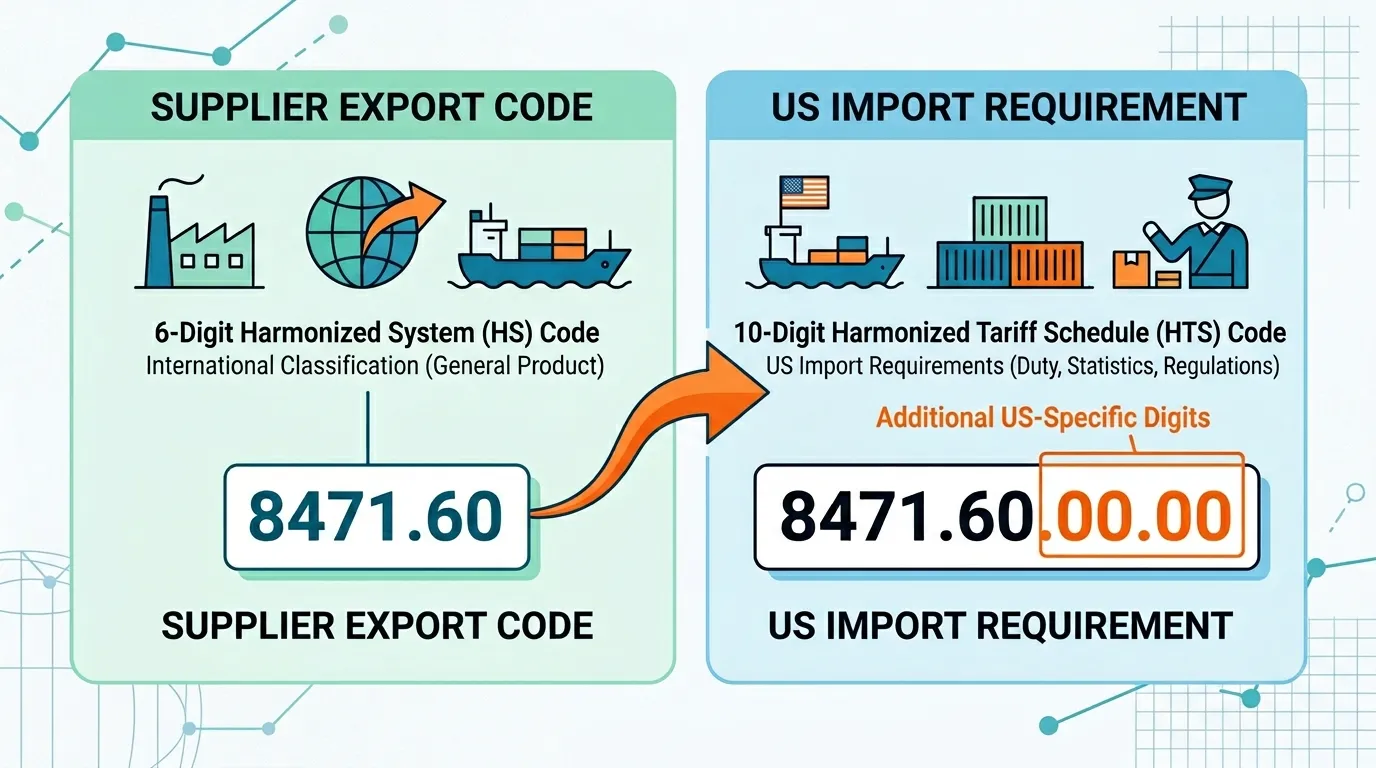
A Chinese supplier’s HS code is accurate for Chinese export — but it stops at 6 digits. The US requires a 10-digit HTS code, and the EU requires an 8-digit CN code. The additional digits are not cosmetic: they set the precise duty rate and determine whether anti-dumping or special tariffs apply. Relying on a supplier-provided code without extending it is one of the most common — and costly — classification errors in ecommerce.
This is where sellers most often go wrong, and it’s not because anyone is being careless. A Chinese manufacturer’s 6-digit HS code is genuinely correct for their export documentation. The problem is structural. The World Customs Organization standardizes the first six digits globally, but every country adds its own digits beyond that to reflect national tariff schedules, trade agreements, and special duty programs.
Take a laptop classified under HS 8471.30. That 6-digit code is valid in every country. But when you import into the US, you need to extend it to a full 10-digit HTS code using the US International Trade Commission’s HTS database. Those final four digits are where Section 301 tariffs on China-origin goods attach. A seller who submits only the supplier’s 6-digit code may clear customs, get reclassified at the national-digit level, and receive a duty bill that reflects a rate they never expected.
The same principle applies to EU imports, where the required 8-digit CN code (Combined Nomenclature) determines whether preferential duty rates from trade agreements apply. The supplier doesn’t know which trade agreement benefits you as an importer. You do — but only if you’ve extended the code correctly for your destination.
What Customs Actually Does With Your HS Code (And When It Gets Flagged)
When your shipment arrives, customs processing isn’t a single check. It’s a sequence. Automated risk-scoring runs first, comparing the declared HS code against the invoice description, declared value, country of origin, and any existing flags on that code. Most shipments clear this stage without human review.
A hold gets triggered when something doesn’t line up. The most common triggers are: an HS code that doesn’t match the invoice description, a catch-all code (codes ending in broad subheadings like .90 or .99) applied to a product that has a more specific code available, or a code that carries anti-dumping duty flags for the origin country. When customs can’t verify what the product actually is from the documentation alone, the shipment goes to physical examination.
Physical examination means storage fees start accumulating. It also means a customs officer makes the classification call, not you. If they reclassify the product, you receive a duty bill at the new rate. If that rate is higher than what you paid, you owe the difference plus interest. For a detailed breakdown of how that duty feeds into your total shipping costs, see our guide to international ecommerce duty calculation.
Reclassification also creates a record. Your importer profile gets flagged, and future shipments of the same product face higher examination rates. One misclassified SKU can affect every shipment of that product going forward.
The Real Costs of Getting It Wrong
Wrong HS codes cost more than the reclassified duty. US Customs can impose civil penalties of up to four times the unpaid duties for gross negligence, plus storage fees during holds. Beyond the immediate shipment, a flagged importer faces higher exam rates on future shipments. For ecommerce sellers moving volume, a single misclassified SKU can compound across hundreds of orders.
The financial hit comes from multiple directions at once. There’s the corrected duty itself. There are port storage fees for every day the shipment sits in exam. There’s the cost of pulling resources to respond to a customs inquiry. And there’s the compounding effect on future shipments if your account gets flagged.
One real-world case: an ecommerce brand shipping lithium battery packs labeled as “electronics accessories” had a shipment held for physical examination when customs flagged the battery content. The reclassification and penalty totaled over $8,000 on a single container. The product itself was legitimate. The documentation wasn’t specific enough to support the declared code.
Budget the unexpected duty costs into your shipping model from the start. The pre-shipment cost forecasting discipline matters here. And if you’re running Amazon FBA, misclassification hits your Amazon FBA inbound cost planning directly, since duty and clearance issues can block inventory from reaching fulfillment centers on schedule.
Penalty Tiers at a Glance (US CBP)
| Violation Level | What Triggers It | Maximum Penalty |
|---|---|---|
| Negligence | Failure to exercise reasonable care | Up to 2x unpaid duties |
| Gross Negligence | Significant failure of care or deliberate indifference | Up to 4x unpaid duties |
| Fraud | Intentional misclassification | Full value of merchandise |
CBP’s “reasonable care” standard means you can’t outsource the liability entirely to your supplier or freight forwarder. If you provided inaccurate product information, the responsibility traces back to you.
The 5-Point Pre-Shipment HS Code Classification Checklist
Run this check on every new SKU before it moves. It takes ten minutes and prevents the problems described above.
Step 1: State exact material composition with percentages
Don’t write “fabric” or “plastic.” Write “100% cotton” or “80% polyester, 20% elastane” or “ABS plastic housing.” Customs classification is built around material, and “mixed materials” is not a classification. If your product has multiple components, identify the material percentage of each.
Step 2: Describe the product’s primary function, not its name
What does it do? An “LED desk lamp for office use” classifies differently from a “decorative lamp.” A “PVC foam exercise mat” classifies differently from a “yoga mat.” Trade names and product names are not functional descriptions. Write what the product does.
Step 3: Confirm country of origin and check for applicable trade agreements or special duties
Country of origin affects preferential duty rates under trade agreements and determines whether anti-dumping duties apply. For China-origin goods entering the US, verify whether Section 301 tariffs apply at the product’s HTS subheading level. This step also determines whether you can claim duty preference under any applicable FTA.
Step 4: Align your commercial invoice description with the HS code chapter logic
The description on your invoice must be traceable to the chapter notes for the HS code you’ve declared. If your code sits in Chapter 63 (textile articles), your invoice description should reflect textile classification language, not electronics or sporting goods language. A customs officer shouldn’t need to guess how the description connects to the code.
Step 5: Extend the 6-digit code to your destination country’s full digit requirement
Confirm the 10-digit HTS code for US imports using the US ITC HTS database. Confirm the 8-digit CN code for EU imports. Don’t submit a supplier’s 6-digit code as your final import classification. The national-digit extension is where your actual duty rate lives.
Pre-Shipment Checklist
- ☐ Material composition stated with percentages
- ☐ Product function described (not just product name)
- ☐ Country of origin confirmed; anti-dumping/ADD/Section 301 applicability checked
- ☐ Commercial invoice description aligns with HS chapter notes
- ☐ Code extended to full digit requirement for destination country (10-digit US, 8-digit EU)
How to Write a Product Description That Survives Customs
A customs-ready product description leads with material composition, states the product’s function, and avoids colloquial names. “100% cotton woven bath towel, 600gsm, 70x140cm” clears faster and classifies correctly. “Bath textile accessory” does not. The description on your commercial invoice should be traceable to the HS code chapter notes — that is the standard customs uses.
The most common mistake is writing a description for a shopper, not a customs officer. Shoppers respond to brand names, lifestyle language, and product nicknames. Customs officers need material, function, and composition. Those are two entirely different audiences, and your commercial invoice should be written for only one of them.
Here’s what before-and-after looks like in practice:
Product: LED desk lamp
Before: “Modern office accessory, smart home design”
After: “LED desk lamp, adjustable arm, AC-powered, for office use, 12W”
Product: Yoga mat
Before: “Eco-friendly exercise mat, non-slip surface”
After: “PVC foam exercise yoga mat, 6mm thick, 183x61cm, for physical exercise”
Product: Phone wallet case
Before: “Stylish mobile accessory with card holder”
After: “Polyurethane phone case with integrated card slots, compatible with smartphones, primary material: PU leather”
Watch out for words that trigger automated flags unrelated to duty classification. Product names containing words like “tiger,” “lime,” or other food and wildlife terms can cause automated holds in some customs systems, even when the product is completely unrelated. This happens because customs software pattern-matches description text. Keep descriptions functional and neutral.
For composite products (a product with multiple materials or components), identify the component that gives the product its essential character. A phone case that’s 70% PU leather and 30% polycarbonate classifies based on the dominant material. State that percentage on the invoice.
How Fexbuy Helps Sellers Ship with Clean Documentation
Getting your HS code right before a shipment moves is the goal. But most ecommerce sellers don’t have a customs expert reviewing every SKU before departure. That’s where having the right logistics partner changes the outcome.
Fexbuy reviews product type, HS code, and documentation before goods leave China. The pre-departure review catches description mismatches, flags sensitive or potentially restricted items, and checks that the invoice description is consistent with the declared code. For sellers shipping DDP (Delivered Duty Paid), Fexbuy handles customs clearance end-to-end, which means the documentation layer is managed operationally, not left to chance.
This doesn’t mean Fexbuy provides legal classification rulings. It means sellers arrive at the border with documentation that supports their declared code rather than contradicting it. That’s the practical difference between a shipment that clears in hours and one that sits in exam for days.
If you’re shipping from China after the de minimis threshold changes, the documentation requirements for standard entry have shifted. See our full breakdown of shipping from China after de minimis changes to understand how HS code requirements interact with current threshold rules.
Frequently Asked Questions About HS Codes for Ecommerce Shipping
Can I use the HS code my Chinese supplier gave me?
You can use it as a starting point, but not as a final answer. Chinese manufacturers provide 6-digit HS codes accurate for their export classification. The US requires a 10-digit HTS code, and the EU requires an 8-digit CN code. The additional digits control your actual duty rate and whether special tariffs apply. Always extend and verify the supplier code before filing import documentation.
What happens if customs finds the wrong HS code on my shipment?
Customs will either hold the shipment for physical examination, issue a reclassification, or apply the duty rate they determine is correct. If the correct rate is higher than what you declared, you face back-assessment plus interest. Repeated errors trigger higher examination rates on future shipments. In serious cases, US CBP can assess civil penalties up to four times the unpaid duties for gross negligence.
Why does the same product have a different HS code in different countries?
The first six digits of an HS code are internationally standardized by the World Customs Organization. Those digits are identical in every participating country. But each country adds its own digits beyond six to reflect national tariff schedules, trade agreements, and special duty programs. The same product carries the same first six digits globally but can face very different duty rates depending on those final digits in the destination country.
How do I know if my product description is good enough for customs?
A customs-ready description leads with exact material composition, states the product’s function, and avoids trade names or colloquial labels. It should be specific enough that a customs officer could assign the same HS code you declared without needing to ask questions. If your description could plausibly apply to three different HS chapters, it isn’t specific enough. Lead with material, follow with function, then add dimensions or technical specs.
Do HS codes change, and do I need to update mine?
The World Customs Organization revises the global HS nomenclature every five years. The current version is HS2022, with the next update expected in 2027 or 2028. Individual countries update their national extensions more frequently. US HTS codes and EU TARIC codes can change annually. If you’ve been using the same code for more than a year on a product in electronics, textiles, or batteries, verify it is still current before your next shipment.
Is the HS code the seller’s responsibility or the freight forwarder’s?
Both parties have a role, but the legal obligation for correct import classification rests with the importer of record. US CBP’s “reasonable care” standard requires importers to take active steps to verify their classification. Relying entirely on a supplier or forwarder doesn’t transfer liability. A good freight forwarder will flag description issues before departure, but the seller must provide accurate product information to make that possible.
What is the difference between an HS code and an HTS code?
HS code refers to the 6-digit international standard set by the World Customs Organization. HTS code (Harmonized Tariff Schedule) is the US-specific extension to 10 digits, administered by the US International Trade Commission. Both terms get used interchangeably in everyday conversation, but an HS code stops at 6 digits while an HTS code continues to 10. Other countries have equivalent extensions: CN codes for the EU, Schedule B for US exports, and TARIC for EU-level tariff administration.


