


Home Appliance Import Logistics to Europe: CE Marking and F-Gas Requirements
A Chinese exporter shipping washing machines and refrigerators to Germany can use the same container but cannot rely on the same compliance checklist. The washing machines need electrical-safety and energy-labelling checks; the refrigerators also require refrigerant screening.
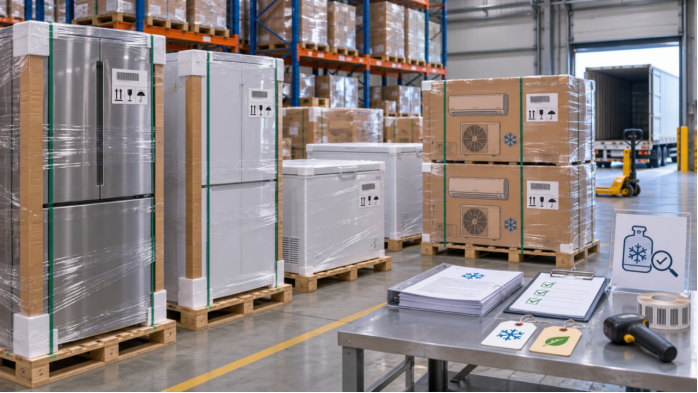
In Home Appliance Import Logistics, the first decision is whether each model is legally eligible for the EU market—not which vessel offers the lowest rate.
1. Identify the Appliance and Its EU Requirements
| Product | Main Checks Before Booking | Particular Risk |
| Washing machine | CE, ecodesign/energy label, WEEE | Model or label mismatch |
| Domestic refrigerator | CE, energy label, refrigerant type | F-Gas market prohibition |
| Split air conditioner | CE, system capacity, refrigerant/GWP | Category-specific phase-out |
| Cordless vacuum | CE, batteries, transport classification | Lithium-battery carrier restrictions |
CE marking addresses applicable EU harmonisation legislation, commonly including the Low Voltage, EMC and RoHS Directives for electrical appliances.
Energy labelling, EPREL registration and WEEE producer obligations must be checked separately.
As regulations vary between the UK and the EU, when creating an EU import plan it is important to specify which Member State will be the final destination.
2. Check C requirements compliance
Home Appliances Imports From EU: Get the manufacturer’s Declaration of Conformity (DoC) and check that it conforms to the following:
•Labeling: Labeling requirements are in compliance.
•Technical Documentation: Information and/or reports have been provided to demonstrate/assess the mitigation of the risks.
•Traceability: CE marking is provided and the importer’s identification number is provided.
•Consumer Aid: Information provided to the consumer is translated into the language of the Member State where the appliance is imported.
•E-marking: Appliance is labeled in accordance with the Directive and included in EPREL.
The function of CE marking is to confirm the manufacturer has complied with EU regulations.
It is the importer’s responsibility to verify that the products manufactured and exported to the EU complies with all EU regulations prior to making such products available on the EU market. A freight forwarder is not authorized to confirm compliance.
3. Check Refrigerants vs. EU F-Gas Regulation
The equipments regulated by the F-Gas Regulation are differentiated by their construction, capacity and refrigerants.
Prior to booking, determine:
•The refrigerant and its composition.
•Quantity of refrigerant per unit.
•The equipment category and GWP.
•Rated capacity.
•The intended use.
•Safety exemptions and prohibition of use Effective dates.
EU F-Gas Restrictions for 2026–2029
| Market Restriction | Effective Date | Scope |
| Domestic refrigerators/freezers containing F-gases | Jan 1, 2026 | Prohibited except where site-safety requirements justify them |
| Split air-to-water systems ≤12 kW, F-gas GWP ≥150 | Jan 1, 2027 | Subject to specified site-safety exception |
| Split air-to-air systems ≤12 kW, F-gas GWP ≥150 | Jan 1, 2029 | Subject to specified site-safety exception |
Other self-contained air-conditioning systems have separate deadlines.
CO₂-equivalent (tonnes) = Refrigerant charge (kg) × GWP ÷ 1,000
This calculation supports HFC accounting but does not independently establish market eligibility.
F-Gas Portal and Import Authorisations
For applicable pre-charged equipment, importers must check:
•F-gas Portal registration and import licensing.
•HFC quota authorisations where required.
•Separate F-Gas declaration of conformity.
•Refrigerant labels and customs declarations.
Portal registration does not automatically provide quota authorisation.
R600a contains no F-gases and has a low flash point. As such, it is considered flammable and requires transportation as freight.
4. Import Home Appliances
| Document | Critical Verification |
| Commercial Invoice / Packing List | SKU, quantity, value, gross weight |
| Bill of Lading / Air Waybill | Consignee, cargo description |
| CN/TARIC Classification | Duty rate, trade measures, origin |
| EORI / Customs Declaration | Importer and customs procedure |
| EU DoC / EPREL Records | Product model and regulatory scope |
| Gas Documentation | Importer registration and applicable authorisations |
Prior to Booking:
•Determine the importer of record.
•Apply Incoterms to the shipment.
•Check the customs value. Change the value as needed.
•Calculation of customs duties, VAT and other taxes.
•Satisfy the requirements of the Member States of the EU.
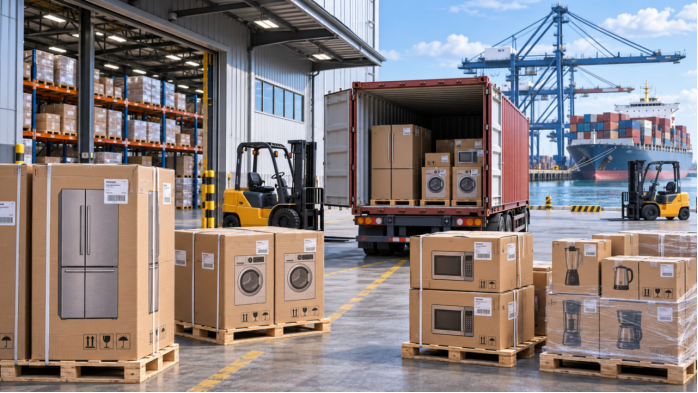
5. FCL vs LCL: Selecting Freight for Home Appliance Import Logistics
| Freight Method | Suitable Application | Main Control Point |
| FCL Sea Freight | Bulk refrigerators and washing machines | Bracing, weight distribution |
| LCL Sea Freight | Small mixed-SKU orders | Rehandling, pallet protection |
| Air Freight | Samples and urgent components | Volumetric weight, carrier acceptance |
| Rail / Multimodal | Eligible China–EU shipments | Transfer points, route restrictions |
Packaging and Transport Risk Management
Larger appliances may require validation of the following:
•Transport locks for washing machine drums.
•How the refrigerators are to be oriented (if at all) and handling instructions (if any) of the manufacturer.
•Cushioning and edge/corner protection and/or moisture control.
•Plans for shipment loading.
•Cargo insurance and/or what/how/when/where it was inspected.
Lithium batteries and refrigerants may require classification as dangerous goods.
CE regulated appliances can not be shipped as non-regulated cargo.
6. Example: Shipping Household Appliances from China to Germany
Washing machines:
•Attached E.U. DoC and energy label.
•The appliance has been shipped with transport locks in accordance with the instructions.
•The consignee has been notified in advance of shipment to ensure that customs documents and entry declarations are complete prior to the appliance’s arrival.
Refrigerators:
•EU DoC and energy label.
•GWP and refrigerant charge and designation.
•F-Gas registration and/or authorization.
•Loading and carriage instructions.
Prior to shipping, the German importer’s EORI should be confirmed as well as the volumes and descriptions of goods shipped.
Delivery appointment and access for unloading should be taken into account for last leg transportation.
7. Services by Fexbuy
Fexbuy reviews the shippers’s cargo, estimates FCL/LCL costs and other freight shipment routes, and expedites the documentation for shipment, customs clearance and final delivery.
We verify the following prior to shipment:
•Customs and delivery documents do not contradict each other.
•Packaging does not offer adequate protection.
•Responsible parties should have registered/authorized F-Gas and legal status as the importer.
•Product compliance is not Fexbuy’s responsibility.
Provide refrigerant information, carton dimensions and quantities, terms of shipment, EU destination, and other applicable information to Fexbuy Logistics to receive an assessment of your shipment.
FAQs
Q1. Can Fexbuy handle Home Appliance Import Logistics from China to Europe?
Yes. Fexbuy coordinates sea, air, rail, and multimodal transportation, customs communication, and final delivery for eligible home appliance shipments to Europe.
Q2. Which European countries does Fexbuy serve?
Fexbuy supports shipments to Germany, France, Italy, Spain, the Netherlands, Poland, Belgium, and other European destinations, subject to route availability.
Q3. Can Fexbuy help verify CE marking documents?
Yes. Fexbuy can check document consistency, including product models and shipping descriptions. Manufacturers and EU importers remain responsible for CE compliance.
Q4. Does Fexbuy assist with EU F-Gas requirements?
Yes. Fexbuy can review refrigerant information and coordinate customs documentation. F-Gas Portal registration and applicable HFC authorisations remain the importer’s responsibility.
Q5. Can Fexbuy ship refrigerators containing refrigerants?
Yes, subject to EU market eligibility, refrigerant classification, documentation, and carrier acceptance. Customers must provide refrigerant type, charge quantity, and GWP.
Share:


