


Home Appliance Shipping Service for Lithium Battery-Powered Appliances: Compliance and Freight Guide
The shipping documentation, the classification, and the packing instruction of robot vacuums with interchangeable batteries have to be evaluated by United Nations (UN) standards, as well as any criteria the carrier may have.
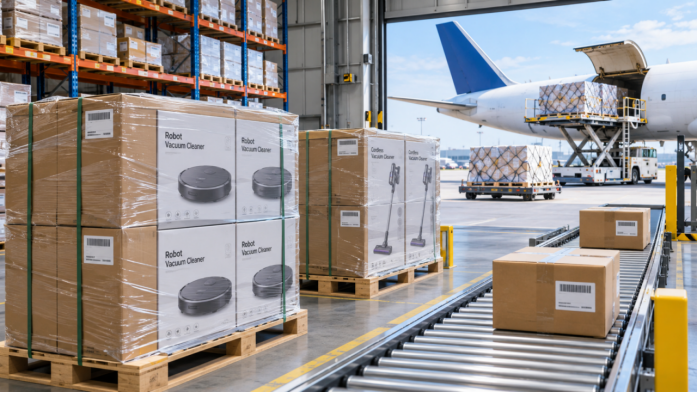
At Fexbuy, Home Appliance Shipping Service, we evaluate lithium batteries contained in shipments and cross-check all relevant laws and regulations prior to quotation of transportation costs. Consequently, our customers that manufacture or import home appliances are protected from surprise shipment rejection, lengthy delays at customs, and costly repack and re-ship of the consignments.
1. Which Home Appliances Require Lithium Battery Shipping Compliance?
Home appliances containing lithium batteries are governed by these regulations.
| Appliance | Battery Configuration | Transportation Risk |
| Robot vacuum cleaner | In-built lithium-ion battery | Switch on during transportation |
| Cordless vacuum cleaner | In-built/detachable lithium battery | Incorrect UN classification |
| Portable blender | In-built lithium battery | Short circuit |
| Cordless floor washer | Battery pack | Moisture exposure |
Other home appliances may fall under UN 3480/UN 3481 transport classification.
We recommend checking the battery datasheet to find out transportation possibilities for home appliances.
2. Classification of UN3480 and UN3481
Batteries shipped as spares, batteries packed with equipment, and batteries contained in equipment need to be considered separately.
| Configuration | UN Number | IATA Packing Instruction |
| Lithium-ion batteries shipped alone | UN3480 | PI965 |
| Batteries packed with equipment | UN3481 | PI966 |
| Batteries installed in equipment | UN3481 | PI967 |
Lithium-metal batteries follow different entries, including UN3090 and UN3091.
Battery energy calculation:
Wh = Nominal Voltage (V) × Capacity (Ah)
For example, a 14.4 V, 5 Ah battery has a nominal energy rating of 72 Wh.
For air transport, 20 Wh per cell and 100 Wh per battery are important thresholds for determining applicable regulatory sections—not general exemptions.
Check the battery model, number of cells, installed configuration and quantity of spare battery.
3. 2026 IATA Requirements: State of Charge and Packaging
The 2026 IATA Dangerous Goods Regulations introduced mandatory state-of-charge (SoC) limits for certain lithium-ion batteries packed with equipment.
| Packing Instruction | 2026 SoC Requirement |
| PI965 | Maximum 30% SoC; cargo aircraft only |
| PI966 Section I | Maximum 30% SoC unless authorized |
| PI966 Section II | Maximum 30% for cells/batteries over 2.7 Wh |
| PI967 | Maximum 30% SoC or 25% indicated capacity strongly recommended |
For PI966 shipments exceeding 30% SoC, applicable State approvals and Section I procedures are required.
In addition, packaging verification needs to consider:
•Terminal insulation and short circuit protection.
•Means to prevent inadvertent operation.
•Shock absorption and battery retention.
•Strength of package and means to stack the package.
Some PI966/PI967 packages require protection to withstand a stack load of 3 meters for a minimum of 24 hours.
A Home Appliance Shipping Service Provider must recognize and communicate to the shipper recommendations and mandates as applicable.
4. Battery Documents and Packaging Review
Since battery shipments require specific consideration and the documentation must be carefully prepared, we cannot issue a quotation without this information.
| Document | Verification Purpose |
| UN38.3 Test Summary | To confirm the battery design testing |
| Battery Specification | To verify the battery characteristics and model |
| SDS/MSDS | Safety information |
| Commercial Invoice | Customs declaration value and product description |
| Packing List | Gross weight and dimensions of a shipping carton |
| DG Declaration | Fully regulated shipments |
UN38.3 does not relieve the shipper from packaging, marking or declaring the shipment.
As part of our Home Appliance Shipping Service, we will review:
•Model number conformity among shipping documents.
•Condition of cartons and/or other means of restraint.
•Presence of battery marks and Class 9 labels.
•Photographs of package and declared quantities.
Batteries that are damaged, defective or recalled can not be shipped via ordinary freight.
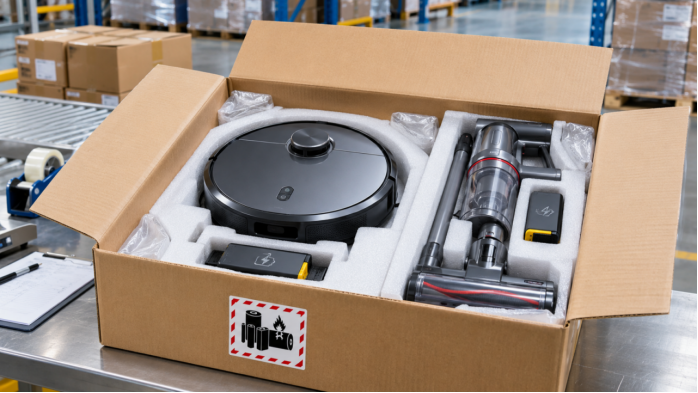
5. What is better, Air Freight or Sea Freight?
This will depend on several factors such as volume of shipment, time sensitivity, limitations of the carrier, and total cost of the shipment.
| Factor | Air Freight | Sea Freight |
| Regulations | ICAO/IATA DGR | IMDG Code |
| Typical application | Urgent replenishment | Bulk shipments |
| Freight calculation | Chargeable weight | FCL/LCL volume and container charges |
| Main restrictions | Aircraft eligibility and SoC | DG acceptance, stowage, port rules |
| Additional charges | DG handling, screening | DG handling, terminal and container fees |
For 2026 maritime shipments, IMDG Code Amendment 42-24 applies.
FCL and LCL: An FCL container is dedicated to a single consignment; an LCL container is shared between several consignments and may impose more stringent consolidation restrictions (e.g. on dangerous goods).
Quotations for Home Appliance Shipping Service should split charges for base freight, dangerous goods, customs clearance and procedures, insurance, warehouse handling and storage, and inland transport.
6. Case Study: Importing Robot Vacuum Cleaners from China to the U.S.
Let’s define a shipment of vacuum cleaners imported from China, which contain 72, 2.6 Ah, built in, liquid lithium-ion batteries.
The evaluation of this shipment is broken down into five steps:
- Classification: Identify the packing instructions pertaining to UN3481.
- Documentation: Prepare and accompany the shipment with UN38.3 declaration and specification.
- Packaging: Package in a manner which prevents activation, and movement during transportation and impact.
- Transport: Choose between ocean and air transport.
- Confirmation: Obtain confirmation from the carrier.
Once the shipment enters the U.S., Classification based on the HS Code, customs valuation and duties, responsibilities of the importer and requirements for filing entry, must be determined.
Allocation of responsibilities based on Incoterms®:
•FOB: Responsibility and costs of transporting the goods to the port of shipment lies with the seller.
•DAP: Responsibility and costs of transporting the goods to the named port of destination, lies with the seller.
•DDP: Responsibility and costs of transporting the goods to the named port of destination and customs of that country, lies with the seller.
Prior to shipment, a Home Appliance Shipping Service should verify the above.
Fexbuy Home Appliance Shipping Service
Fexbuy offers transport and logistics services for household robotic and electronic products. These include review of transport documents and arrangements for packing and shipping by air or sea, as well as delivering the shipment to the consignee’s warehouse.
For more information about our services for the transport of household batteries, visit the website and/or contact Fexbuy Logistics to plan your shipment.
FAQs
Q1. What does Fexbuy’s Home Appliance Shipping Service include?
Fexbuy coordinates international air and sea freight, battery documentation reviews, customs clearance arrangements, and destination delivery for eligible household appliances.
Q2. Can Fexbuy ship home appliances containing lithium-ion batteries?
Yes. Fexbuy supports eligible robot vacuums, cordless cleaners, and rechargeable appliances, subject to battery classification, packaging, documentation, and carrier acceptance.
Q3. What battery documents does Fexbuy require before shipping?
We recommend providing the UN38.3 test summary, battery specifications, Wh rating, SDS when requested, commercial invoice, and packing list. Additional dangerous goods documents may apply.
Q4. Does Fexbuy handle UN3481 shipments?
Yes. Fexbuy coordinates eligible UN3481 shipments involving lithium-ion batteries contained in equipment or packed with equipment, following applicable transport requirements.
Q5. Can Fexbuy arrange air freight for lithium battery-powered appliances?
Yes, where permitted. Air shipment depends on the battery’s Wh rating, packing instruction, state of charge, packaging, and airline acceptance.
Share:


