


Mechanics Logistics Company: FCL vs Flat Rack vs Breakbulk Shipping
A CNC machine may be able to fit in a standard container, but a wider industrial press may require flat rack shipping, even if it weighs less.
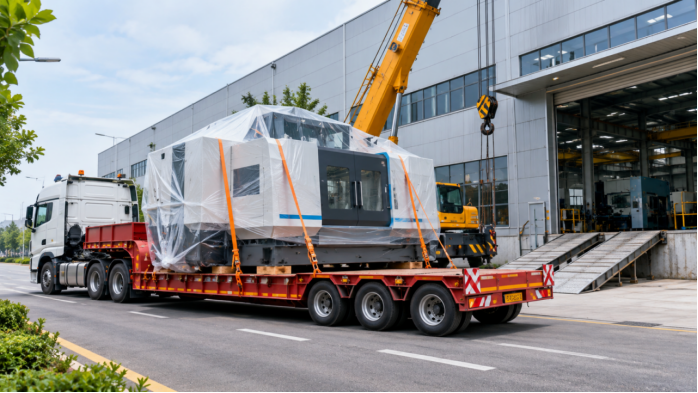
Fexbuy takes several factors into account when determining between FCL, flat rack, and breakbulk shipping. It assesses restraints on inland transportation. It also analyses dimensions and concentration of the cargo and methods of securing the cargo to the vessel.
How Does a Mechanics Logistics Company Decide on Shipping Equipment?
Rate is not the primary consideration for equipment selection in mechanics handling.
Other considerations include:
• Dimension: Protrusions and lifting clearances need to be accounted for.
• Weight: Support point distribution needs to be accounted for.
• CoG: Vertical and Horizontal CoG need to be accounted for.
• Lifting: Slings must be placed and secured to certified lifting points.
• Transport and Destination: Terminal and approach cranes, road clearances and destination unloading equipment must be taken into account.
A machine may be within a container’s maximum payload yet exceed its door opening or allowable concentrated floor load.
FCL vs Flat Rack vs Breakbulk: Technical Comparison
FCL means Full Container Load, whereas flat rack is a container type. Flat racks can also be booked as FCL. The comparison below therefore uses standard dry-container FCL.
| Technical Factor | Standard FCL | Flat Rack | Breakbulk |
| Cargo dimensions | Within container limits | Oversized or irregular | Exceptionally large cargo |
| Loading access | Rear container doors | Top/side crane loading | Direct heavy lifting |
| Load distribution | Container floor | Flat rack deck | Vessel-specific supports |
| Cargo securing | Blocking and internal lashing | Engineered restraints | Project-specific sea fastening |
| Weather exposure | Enclosed | Exposed | Depends on stowage |
| Main cost drivers | Container freight | OOG and handling charges | Heavy lifting and stowage |
Standard FCL: For Machinery Within Container Limits
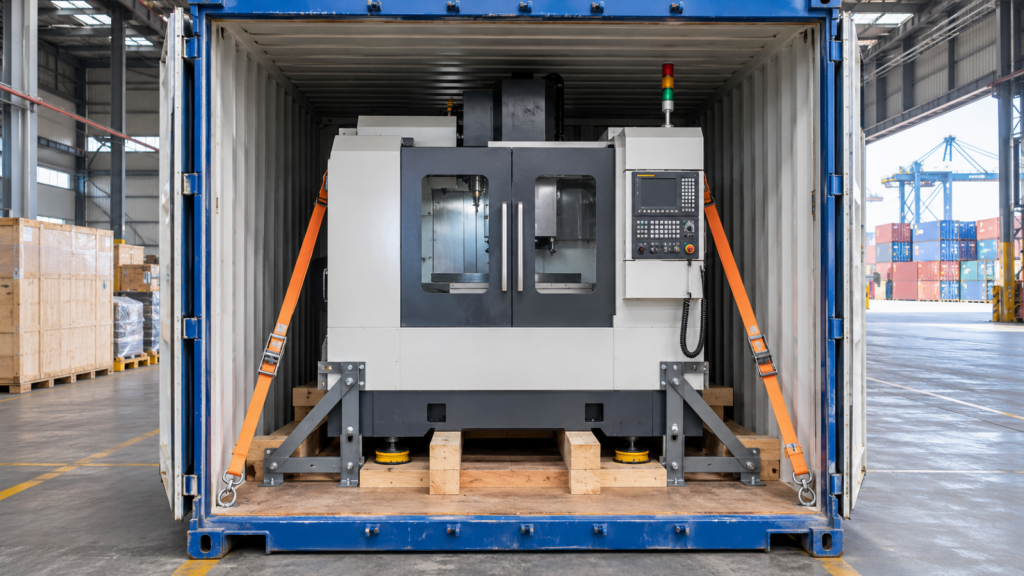
Standard FCL is generally appropriate for compact CNC machines, pumps, compressors, and dismantled production equipment.
When you choose our Mechanics Logistics services, you can expect:
• Sufficient door clearance for final packed dimensions.
• Floor strength of containers is sufficient to support the load.
• Forklift access and loading is in accordance with safe working practices.
Appropriate blocking and lashing is arranged to stabilize and secure the machinery.
Flat Rack for Out-of-Gauge Machinery
Flat rack containers provide an open side and end walls structure and are especially designed to carry over-sized and out of gauge cargo, i.e. long, wide and/or heavy machines.
However, flat rack suitability depends on more than nominal payload.
Critical engineering checks include:
• Concentrated loads beneath machine support points.
• Timber or steel dunnage for load spreading.
• Lashing-point strength and securing geometry.
• Cargo overhang and required vessel slots.
• Terminal and shipping-line OOG approval.
When specifying Out-Of-Gauge (OOG) dimensions, the projections of any packaging and/or securing materials must be included. Incomplete information may result in rejected cargo and/or charging of additional costs.
Breakbulk Cargo: Special Dimensions and/or Weight
Breakbulk cargo includes large and/or heavy pieces of machinery that can not be loaded into a freight container.
Examples include large turbines and heavy presses.
Breakbulk shipment requires assessment of a number of factors including stowage and sea-fastening of the cargo and supporting structures.
Different shipping lines and vessels allow cargo to be transported using different types of non-standard (breakbulk) arrangements.
Which Method of Shipment Should Be Used?
From a Logistics perspective, it is better to assess the shipping constraints of an individual piece of machinery, rather than making generalizations based on the nature of the product.
| Machinery | Initial Option | Main Engineering Concern |
| Compact CNC machine | Standard FCL | Floor loading, vibration |
| Wide injection molding machine | Flat rack | Width, lifting geometry |
| Heavy industrial press | Flat rack / Breakbulk | Concentrated loads, CoG |
| Modular production line | Multiple FCL / Special cargo | Module separation, sequencing |
Example: Injection Molding Machine
A Standard Freight Container is 8′ Wide. An injection molding machine that is larger than this may require a flat rack shipment.
Removal of detachable components may allow shipment as an FCL.
Ultimately, it may not be economical to dismantle, reassemble and export the product if the cost of the components and the manufacturer’s terms also restrict shipment.
What Determines the Total Shipping Cost?
When shipping freight, costs may be broken down into several categories. Our Mechanics Logistics Company recommends analyzing the total logistics costs instead of just focusing on the costs to transport the freight by ocean.
| Cost Component | What Buyers Should Verify |
| Ocean freight | Equipment type, routing, vessel availability |
| OOG surcharge | Space utilization, dimensional restrictions |
| Cargo preparation | Export packing, dismantling, lashing |
| Terminal operations | Crane handling, special equipment |
| Inland transport | Trailer selection, permits, escorts |
| Destination charges | Customs handling, storage, unloading |
Flat rack does not IMMEDIATELY mean a cheaper option compared to break-bulk shipping.
Flat racks are cost-effective when the vessels and equipment needed for transportation are available. Break-bulk shipping is more effective when the cargo is large and requires cranes for lifting and/or distribution.
Quotations must provide an explanation of charges pertaining to shipping, insurance, customs, and ancillary services.
How Does a Mechanics Logistics Company Control Cargo Risks?
1. Load and Cargo Securing
Safety of transported cargo and loads is critical to avoid accidents and injuries.
Prior to transport, the securing plan must take into consideration:
• For a tipping load, the lashings and attachment points.
• For a blocking load, the support reactions.
What loads and cargoes require special attention and/or precautions?
2. Moisture and Corrosion
Protective barriers must be used to prevent moisture from corroding machinery. Barriers can be sealed and lined with desiccants. Vulnerable parts must be protected with covers and/or sealed. Moving parts must be fixed in place.
The IMO/ILO/UNECE CTU Code outlines the international framework for the securing of cargo transport units.
Transport modes and conditions differ, as do the effects they have on the various components of the equipment.
Machinery Shipping: Booking and Compliance Checklist
Similar to booking, several compliance checks must be performed prior to shipment. These checks may be performed by the shipper, freight forwarder, or the shipper’s agent and may vary from country to country.
The shipping documents must include a commercial invoice, packing list, and a commodity/ shipping description classification (HS) code.
The actual or final dimensions of the equipment must be provided as well as the verified weight of the equipment.
Cargo photographs, lifting diagrams, drawings showing the center of gravity (CoG) of the equipment, and a plan showing how the equipment is packed and secured must be provided.
Permits, Paperwork and Restricted Items
Preparations must be made for equipment containing batteries, fuel or other restricted items prior to shipment.
Packed cargo equipment may also be subject to Verified Gross Mass (VGM) as stipulated in the Safety of Life at Sea (SOLAS) convention. Equipment packaged with wood may be subject to International Plant Protection Convention (IPPC) regulations, 2002.
At the destination, checks must be made for permits, restricted equipment, and unloading machinery.
We will assist you to arrange and coordinate the transport of your machinery and equipment.
FAQs
Q1: What does Fexbuy offer as a Mechanics Logistics Company?
Fexbuy helps exporters evaluate machinery freight options, including container shipping, oversized cargo handling, customs coordination, and destination delivery.
Q2: Can Fexbuy arrange FCL shipping for industrial machinery?
Yes. FCL is suitable when machinery meets container dimensions, payload, floor-loading, and securing requirements.
Q3: Does Fexbuy provide flat rack shipping for oversized equipment?
Fexbuy can assess flat rack options based on cargo dimensions, weight distribution, lifting requirements, and shipping-line acceptance.
Q4: When does Fexbuy recommend breakbulk shipping?
Breakbulk is considered when machinery cannot be accommodated safely or practically in standard or specialized containers.
Q5: Can Fexbuy ship CNC machines and injection molding equipment?
Fexbuy can evaluate suitable transport arrangements for CNC machines, injection molding equipment, and other industrial machinery according to their specifications.
Share:


