


Forklift & Industrial Battery Shipping
For importers, equipment brands, warehouse operators and battery suppliers, we support door-to-door, port-to-port, DDP, DDU, FOB and CIF shipping with UN38.3 / IATA / IMDG compliant handling and quote support via Free Quote or WhatsApp.
Forklift and Industrial Batteries We Ship
Heavy battery shipments often involve high gross weight, high energy capacity, restricted handling, and destination unloading requirements. Our team can review and arrange freight for:
- Lithium-ion forklift battery packs
- Lead-acid forklift and traction batteries
- Pallet truck and warehouse equipment batteries
- AGV / AMR industrial battery packs
- Industrial backup and energy storage batteries
- Replacement battery packs for material-handling equipment
- Batteries packed with or installed in industrial equipment
These shipments are different from small parcels or consumer batteries. A forklift battery may need a reinforced crate, palletized loading plan, terminal protection, correct DG labels, carrier pre-approval and forklift access at both pickup and delivery points.
For general lithium cargo categories, see our broader lithium battery shipping service.
Heavy Battery Freight Needs Crating, Handling and DG Control
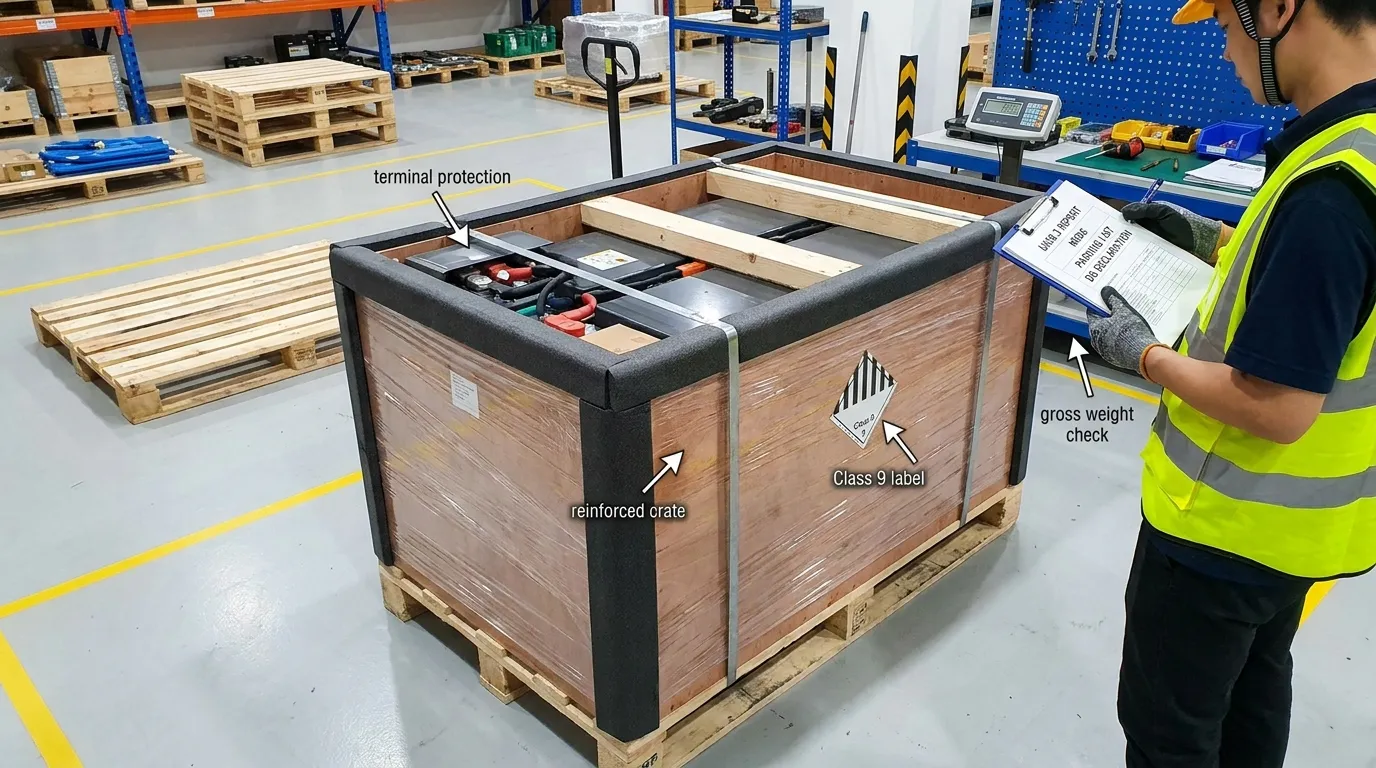
The biggest shipping risk is not only the battery chemistry. It is the combination of weight, dimensions, terminals, liquid or electrolyte risk, and carrier acceptance rules.
Before booking, the cargo should be checked for:
- Battery chemistry: lithium-ion, lithium metal, wet lead-acid or non-spillable
- Whether the battery is shipped alone, packed with equipment or installed in equipment
- Net battery weight, gross weight and crate dimensions
- Watt-hour rating, voltage and capacity
- State of charge for lithium batteries
- Terminal insulation and short-circuit protection
- Wooden crate, pallet or skid strength
- Forklift loading and unloading conditions at both ends
For large industrial packs, sea freight is usually the most practical route. Air freight may be restricted or not economical, especially for standalone lithium batteries with high capacity. Project cargo or special handling may be needed when the battery is oversized, unusually heavy or part of a larger equipment shipment.
UN3480 vs UN2794: Classification Comes First
Correct UN classification decides the packing, label, documents, mode and carrier acceptance route.
| Battery / shipment type | Common UN number | DG class | Key shipping note |
|---|---|---|---|
| Standalone lithium-ion forklift battery | UN3480 | Class 9 | Usually requires lithium battery mark, Class 9 label, DG documents and SOC control |
| Lithium-ion battery packed with or contained in equipment | UN3481 | Class 9 | Classification depends on whether it is packed with or installed in the equipment |
| Lithium metal battery shipped alone | UN3090 | Class 9 | Less common for forklift batteries, but must be checked if chemistry is lithium metal |
| Lithium metal battery packed with or contained in equipment | UN3091 | Class 9 | Used only when the battery chemistry matches lithium metal rules |
| Wet lead-acid forklift battery filled with acid | UN2794 | Class 8 | Corrosive cargo; packing must prevent leakage and acid damage |
| Non-spillable wet battery | UN2800 | Class 8 / regulated conditions vary | Must be supported by correct battery documentation |
| Battery-powered vehicle or equipment | UN3171 / UN3556 | Varies by configuration | Relevant when shipping the powered vehicle or machine, not only a loose replacement pack |
| Lithium batteries installed in a cargo transport unit | UN3536 | Class 9 | More relevant to containerized battery systems than ordinary forklift battery packs |
A lithium forklift battery shipped alone is not handled the same way as a wet lead-acid traction battery. A replacement battery pack is also not the same as a complete forklift or industrial machine. That is why we review the MSDS/SDS, UN38.3 test summary, product photos and packing details before confirming the route.
Shipping Modes and Lane Planning
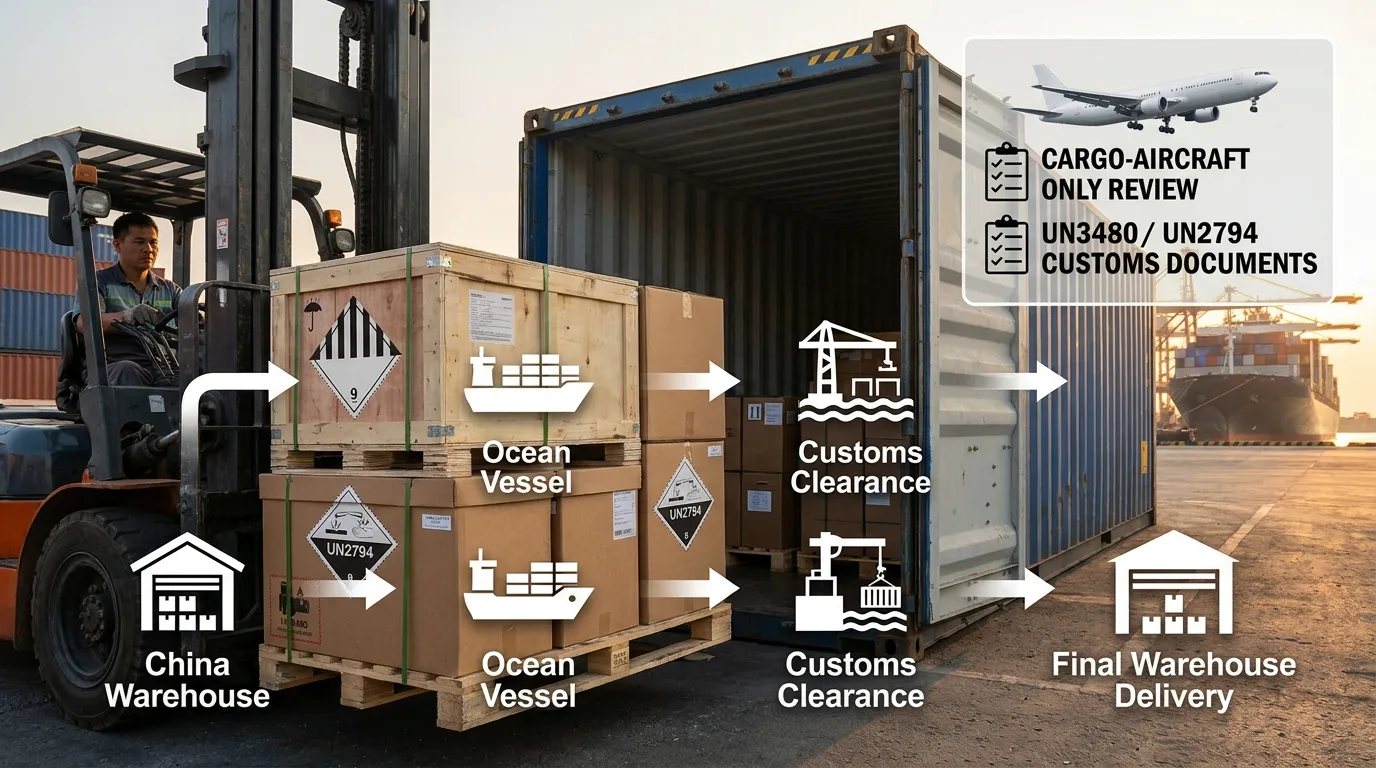
Exact transit time is confirmed at the quote stage because it depends on origin city, destination country, carrier acceptance, port routing, customs status, packing readiness and final delivery conditions.
| Mode | Best for | DG shipping note | Lead-time planning |
|---|---|---|---|
| Sea freight LCL / FCL | Heavy standalone forklift batteries, industrial battery packs, bulk orders | Usually the main option for large lithium or lead-acid battery cargo | Confirm per lane and sailing schedule |
| Project cargo / special handling | Oversized, very heavy or irregular battery shipments | May require special loading, crate design, port handling and delivery appointment | Confirm after dimensions and weight review |
| Air freight review | Urgent, smaller eligible battery shipments | Standalone lithium-ion batteries by air face strict acceptance and state-of-charge limits; cargo-aircraft-only rules may apply | Case-by-case carrier approval |
| Door-to-door DDP / DDU | Importers needing delivery to warehouse, business address or jobsite | Includes customs planning, duty/tax responsibility and delivery coordination | Confirm by country and address type |
| FOB / CIF freight support | Buyers purchasing from China suppliers | Useful when supplier handles export side or buyer controls import side | Confirm by Incoterm and port |
For large lithium packs, standalone lithium-ion batteries shipped by air are commonly subject to a 30% state-of-charge limit under air transport rules. Damaged, defective or recalled batteries require special review and may not be accepted through standard freight channels.
5-Step Shipping Process
1. Cargo Review and Quote
Send the battery type, MSDS/SDS, UN38.3 test summary if lithium, product photos, dimensions, gross weight, quantity, pickup city and destination. We check the likely UN number, mode options and whether DDP, DDU, FOB or CIF is most suitable.
2. China Pickup and DG Packing Check
The cargo is collected from the supplier, factory or warehouse. For heavy batteries, the pickup site should have forklift access, proper palletization and clear loading instructions. If packing is not acceptable, we advise on crate reinforcement, terminal protection and labeling corrections.
3. DG Labeling and Export Preparation
Lithium batteries need correct lithium battery marks, Class 9 labels where required, handling marks and short-circuit prevention. Wet lead-acid batteries need corrosive cargo controls and leakage-prevention packing. The shipment must match the documents exactly.
4. Customs and Carrier Booking
We prepare the booking based on the DG classification, Incoterm and destination. Export customs, commercial invoice, packing list, DG declaration and carrier acceptance are managed before freight departure.
5. International Freight and Final Delivery
Cargo moves by sea, air review route or special project handling depending on the shipment. At destination, customs clearance, duty/tax responsibility and delivery appointment are coordinated. For heavy batteries, the consignee may need a forklift, loading dock or unloading plan.
Documents Needed for Industrial Battery Freight
To avoid rejection, delays or customs questions, prepare these before quoting:
| Document / detail | Why it matters |
|---|---|
| MSDS / SDS | Confirms chemistry, hazard class and handling risk |
| UN38.3 test summary | Required for lithium battery transport review |
| Battery specification sheet | Shows voltage, capacity, Wh rating and model details |
| Product photos | Helps confirm whether the battery is standalone, packed with equipment or installed |
| Commercial invoice | Required for customs value and import clearance |
| Packing list | Shows quantity, weight, dimensions and package count |
| DG declaration | Required for regulated dangerous goods shipments |
| Consignee / importer details | Needed for DDP, DDU and destination clearance |
| Delivery address conditions | Confirms warehouse, business address, forklift access and appointment needs |
For smaller mobility batteries that follow a different shipping profile, see our e-bike battery shipping service. For larger vehicle battery projects, our EV battery shipping service may be more relevant.
Why Choose Fexbuy for Heavy DG Battery Cargo?
Fexbuy is a Shenzhen-based dangerous-goods freight forwarder with 21 years of experience handling battery shipments from China. Our service is built for buyers who need more than a cheap freight quote — they need classification review, carrier acceptance, export control, customs planning and delivery coordination.
Key advantages include:
- 21 years’ experience in China export logistics
- DG specialist support for lithium and industrial battery cargo
- UN38.3 / IATA / IMDG compliant handling
- DDP, DDU, FOB and CIF options
- Door-to-door delivery to the USA, UK, Germany, EU, Canada and Australia
- 98% on-time performance
- Low inspection rate through better document and cargo preparation
- Free Quote and WhatsApp support for fast shipment review
FAQ
What is the best way to arrange forklift & industrial battery shipping?
For heavy battery cargo, start with DG document review before booking freight. Send the MSDS/SDS, UN38.3 test summary for lithium batteries, weight, dimensions, photos, quantity, pickup city and destination. The forwarder can then confirm classification, packing, mode and customs route.
Is a forklift battery UN3480 or UN2794?
It depends on the battery chemistry. A standalone lithium-ion forklift battery is commonly handled as UN3480, Class 9. A wet lead-acid forklift battery filled with acid may be UN2794, Class 8. The MSDS/SDS and battery specification sheet should confirm the correct classification.
Can heavy lithium forklift batteries be shipped by air?
Sometimes, but it is restricted and reviewed case by case. Large standalone lithium-ion batteries face strict air transport rules, state-of-charge limits and carrier acceptance requirements. For oversized or heavy packs, sea freight is usually the more practical option.
What packing is required for a heavy forklift battery?
The battery should be secured against movement, protected from short circuit, placed on a strong pallet or crate, and labeled according to its DG classification. Terminals must be insulated, and the crate should support forklift handling during pickup, warehouse transfer and delivery.
Can you ship lead-acid forklift batteries internationally?
Yes, but lead-acid batteries are not handled the same way as lithium batteries. Wet lead-acid batteries may be Class 8 corrosive cargo and require leakage-prevention packing, correct labels and matching documents. Non-spillable batteries may follow different rules if properly documented.
Can you provide DDP door-to-door delivery?
Yes, DDP and DDU options can be reviewed for eligible lanes. DDP is useful when the buyer wants customs clearance, duty/tax handling and final delivery arranged together. Final availability depends on destination country, cargo classification, shipment size and consignee address conditions.
Get a Free Quote for Heavy Battery Shipping
Send your battery type, MSDS/SDS, UN38.3 test summary, photos, dimensions, gross weight, quantity, pickup city in China and destination country/address. Our team will review the UN classification, packing condition, freight mode, customs route and delivery requirements.
Contact Fexbuy via Free Quote or WhatsApp to arrange compliant battery freight from China to the USA, UK, Germany, EU, Canada or Australia.


