


Direct Injection Shipping from China to USA: When It Beats Postal, Courier, and DDP
Direct injection shipping from China to USA consolidates your parcels at a Chinese bonded warehouse, flies them on a linehaul flight to a US gateway city, clears customs in bulk, and hands each parcel to USPS or a domestic carrier for final-mile delivery. Sellers shipping 20 or more parcels daily typically save 20–40% per parcel versus express courier, with delivery times of 6–12 days. It outperforms postal on reliability and speed, and undercuts courier on cost, without requiring bulk freight volumes.
China Post goes dark for two weeks. DHL invoices arrive and eat your margin. Ocean freight feels like overkill when you’re shipping 200 parcels a day, not 200 cartons. If any of that sounds familiar, you’re in the right place. This guide explains how direct injection shipping from China to USA works, when it makes financial sense, and what to look for in a coordinator who can run the whole lane for you.
What Is Direct Injection Shipping — and Why Sellers Are Switching
Direct injection shipping means consolidating individual ecommerce parcels at a Chinese warehouse, flying them together on a linehaul cargo flight to a US gateway city, clearing customs in bulk, and handing each parcel to USPS or a domestic carrier for final-mile delivery. Sellers shipping 50 or more orders per day typically reach 6–12 day transit times at $3–7 per parcel, compared to $8–20+ for express couriers.
Three problems drive sellers toward direct injection.
Postal services are cheap, but “cheap and unreliable” becomes a customer service problem fast. Tracking goes dark for days. Delivery windows stretch to 15–30 days. Returns spike when customers lose confidence.
Express couriers solve the reliability problem, but at a cost. DHL, FedEx, and UPS charge per parcel based on weight and zone, and the per-unit economics collapse quickly once you’re shipping at volume. A seller moving 100 orders per day at $12 average courier cost pays $1,200 per day in shipping alone.
Ocean freight has nothing to do with parcel ecommerce. It’s built for container volumes, not individual orders going to individual customers.
Direct injection was built for the gap between those three options. According to Borderless360, sellers using the model achieve delivery times of 4–8 days while keeping per-parcel costs well below express courier rates.
How Direct Injection Actually Works: The Four-Stage Flow
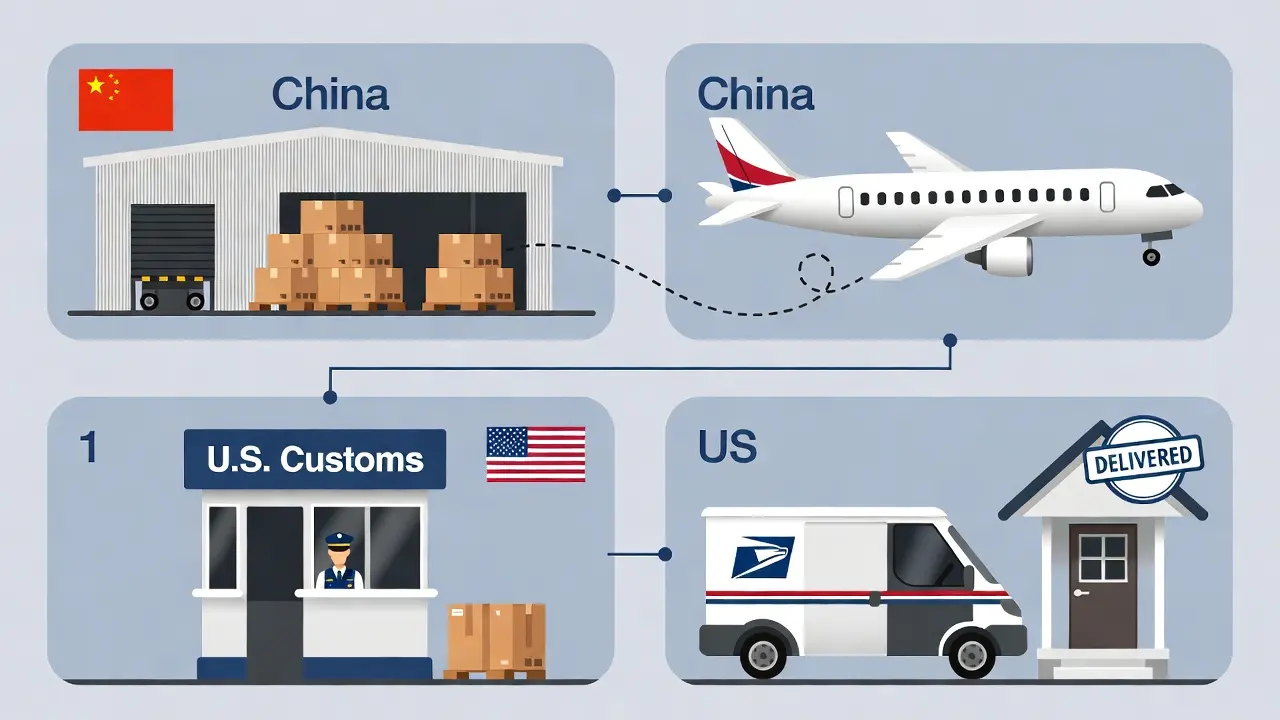
The process runs in four discrete stages. Each one has a defined handoff point, which is part of what makes direct injection trackable and controllable.
Stage 1: China Pickup and Consolidation
Your orders are picked, packed, and labeled at a bonded warehouse near Shenzhen, Guangzhou, or Hangzhou. The coordinator accepts parcels from one or multiple suppliers, scans each barcode, and batches them by destination zone in the US. This consolidation step is where the economics start working: instead of 300 individual freight bookings, you have one consolidated shipment.
Stage 2: Linehaul Air Freight to a US Gateway
The consolidated shipment flies on a commercial or charter cargo flight to a US gateway city, typically Los Angeles (LAX), Chicago (ORD), or New York (JFK). The coordinator books linehaul capacity in advance, which is why minimum daily volumes matter. Shared linehaul consolidation is available for smaller sellers, though cost savings are narrower.
Stage 3: Customs Clearance at an ECCF or CFS
On arrival at the US gateway, parcels clear customs through an Express Consignment Clearance Facility (ECCF) or a Container Freight Station (CFS). Customs data is pre-filed electronically before the aircraft departs China, so clearance begins before the flight lands. This pre-clearance step is what keeps the process moving, and it’s covered in detail in the next section.
Stage 4: Sortation and Final-Mile Handoff
After customs, parcels move to a sortation facility where they are scanned, sorted by zip code, and inducted into the final-mile carrier network. USPS handles the majority of direct injection final-mile volume in the US, though UPS SurePost and FedEx Ground Economy are also common for sellers with specific SLA requirements. From sortation to delivery, domestic transit typically runs 2–5 days.
How Customs Clearance Works Inside Direct Injection
In direct injection, your China logistics coordinator files customs data electronically before the aircraft departs. Individual parcels under the applicable threshold clear as informal entries. Shipments above the threshold require a formal entry with ISF filing. Bulk clearance rates are 30–50% lower per parcel than clearing each package individually through a courier’s brokerage.
The key mechanism is pre-arrival filing. The coordinator or their licensed customs broker submits parcel-level data to CBP (US Customs and Border Protection) before wheels-up in China. When the aircraft lands, the electronic manifest is already in CBP’s system, and release happens within hours rather than days.
The Section 321 de minimis program historically allowed duty-free entry for US-bound shipments under $800. That threshold has been under significant regulatory review since 2025, particularly for goods of Chinese origin. The practical implication for direct injection operators is that formal entry procedures have become more common for China-origin parcel shipments, making your coordinator’s customs knowledge more important than ever.
Understanding the difference between informal and formal entry matters when you’re selecting a coordinator. See formal vs. informal entry rules for a full breakdown of the thresholds and what triggers each type.
Your commercial invoice is the document that drives pre-filing accuracy. A value mismatch between the invoice and the declared value is the single most common reason parcels get held at the gateway. Review commercial invoice requirements before your first shipment goes live.
The Importer Security Filing (ISF) requirement also applies to air shipments above certain thresholds. A coordinator who handles this automatically as part of the pre-clearance process saves you the administrative overhead and avoids the CBP penalty exposure that comes with late or missing filings.
Direct Injection vs. Postal, Courier, and DDP: A Cost and Speed Comparison
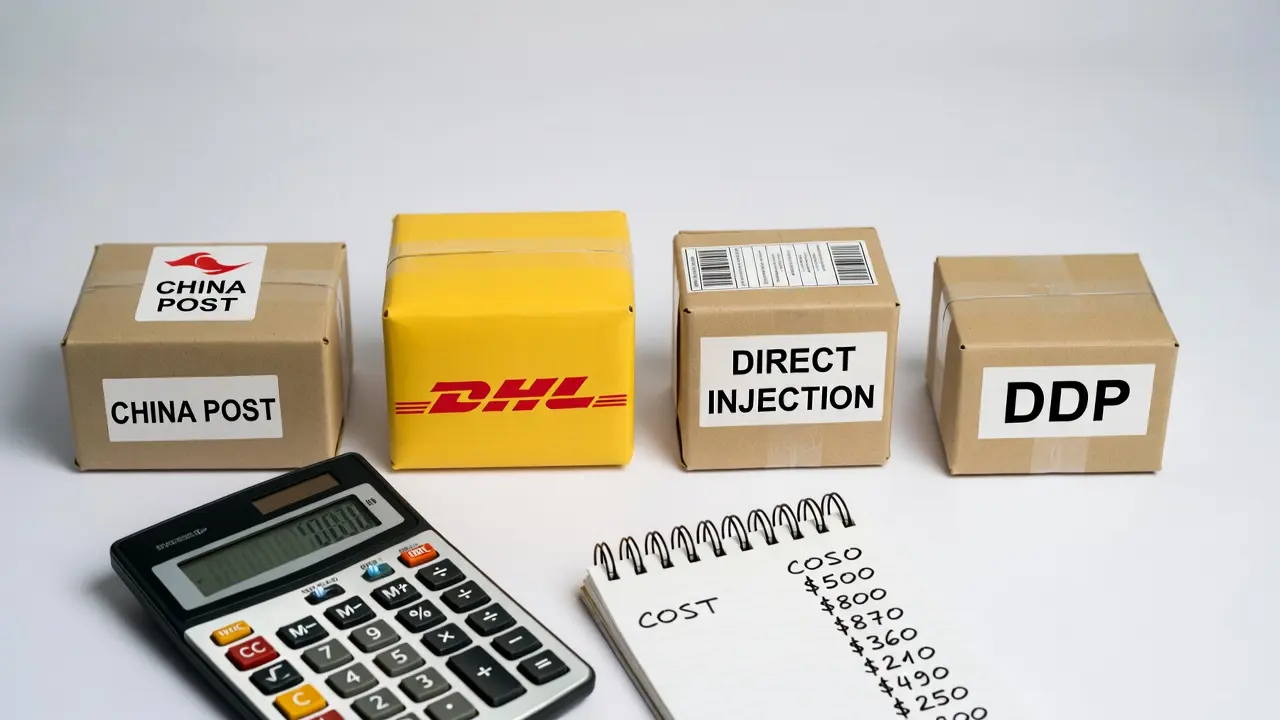
Direct injection hits the middle ground between postal and express courier: 6–12 days at roughly $3–7 per parcel for sellers moving 50 or more orders daily. Postal (China Post/ePacket) is cheaper per parcel for very low volumes but delivers in 15–30 days with inconsistent tracking. Express courier delivers in 3–5 days but costs $8–20+ per parcel depending on weight and zone.
Here’s how the four main options compare for a typical ecommerce parcel (0.3–1 kg, $20–$80 declared value, US residential delivery):
| China Post / ePacket | Express Courier (DHL/FedEx) | Direct Injection | DDP via Freight Forwarder | |
|---|---|---|---|---|
| Transit time | 15–30 days | 3–5 days | 6–12 days | 8–20 days |
| Per-parcel cost (0.5 kg) | $1.50–$3 | $8–$20 | $3–$7 | $4–$9 |
| Tracking visibility | Gaps common | Full scan | Gateway + final-mile scans | Variable by forwarder |
| Customs handling | Individual postal entry | Courier brokerage per parcel | Bulk electronic pre-filing | Forwarder manages (often opaque) |
| Minimum volume | None | None | 20+ orders/day | Typically per-shipment |
| Best fit | Under 20 orders/day, low-value goods | Any volume, sub-5 day SLA | 20–5,000 orders/day, 7–14 day SLA | Mid-volume, hands-off buyers |
DDP deserves a specific note here. A DDP arrangement sounds simpler because the forwarder handles duties, customs, and delivery. But “simple” in DDP often means the seller doesn’t know what entry type was filed, what duty rate was applied, or which carrier received the parcel. When a shipment goes wrong, that opacity becomes a real problem. Direct injection with a transparent coordinator gives you data at every handoff point. DDP does not.
The worked example: Consider a fashion accessories seller shipping 100 orders per day, averaging 0.3 kg per parcel, with a declared value of $35. Over 30 days:
- China Post: $2/parcel × 3,000 parcels = $6,000/month. Delivery in 15–25 days. Return rate elevated due to tracking gaps.
- DHL Express: $11/parcel × 3,000 parcels = $33,000/month. Delivery in 3–5 days.
- Direct Injection: $4.50/parcel × 3,000 parcels = $13,500/month. Delivery in 7–10 days.
The switch from DHL to direct injection saves $19,500 per month, or roughly $234,000 per year, on logistics alone. That math is what’s driving the shift.
To factor in how duties affect your per-order cost on top of shipping, see how duties affect your per-order cost.
The Decision Matrix: Is Direct Injection Right for Your Business?
Direct injection from China makes financial sense when you ship at least 20–30 parcels daily to US customers, your parcels weigh under 2 kg, and your delivery promise is 7–14 days. Below that volume, the linehaul consolidation savings do not offset the fixed coordination costs. Above 1,000 daily orders, consider adding a US bonded warehouse layer for your fastest-moving SKUs.
Use this matrix to find your scenario:
| Daily Order Volume | Parcel Weight | Product Value | Delivery Promise | Recommended Method |
|---|---|---|---|---|
| Under 20/day | Any | Any | Any | China Post / ePacket or shared consolidation |
| 20–100/day | Under 1 kg | $15–$150 | 7–14 days | Direct injection (entry tier, shared linehaul) |
| 20–100/day | Any | Any | Under 5 days | Express courier (DHL/FedEx) |
| 100–1,000/day | 0.1–2 kg | $15–$200 | 7–14 days | Direct injection (dedicated linehaul) |
| 100–1,000/day | Any | Over $200 | Any | Express courier + full insurance |
| Over 1,000/day | 0.1–2 kg | $15–$200 | 7–14 days | Direct injection + US bonded warehouse for top SKUs |
| Any | Over 5 kg | Any | Any | Air freight or ocean freight |
The honest threshold: If you’re shipping fewer than 20 orders per day, direct injection is not the right move yet. The consolidation economics require volume to work. Postal or a shared consolidation service is the correct answer at that scale, and any provider telling you otherwise is optimizing for their revenue, not your costs.
Three scenarios to put the matrix in context:
Scenario A — Fashion accessories seller, 50 orders/day, 0.3 kg avg.: This seller lands squarely in the direct injection entry tier. Switching from DHL saves approximately $6.50 per parcel. At 50 daily orders, that’s $325 per day saved, or $9,750 per month.
Scenario B — Electronics accessories brand, 300 orders/day, 0.8 kg avg., $55 value: At this volume, direct injection with dedicated linehaul capacity is clearly the right fit. The coordinator pre-files Section 321 or formal entry data for all 300 parcels before the flight departs. The 48-hour brokerage hold that DHL typically imposes doesn’t happen here, because clearance is already in process before the aircraft lands.
Scenario C — Startup seller, 12 orders/day: Direct injection is not right yet. The right answer is China Post for low-value items or a shared consolidation service if delivery time matters. Revisit direct injection when daily volume consistently clears 25–30 orders.
What Products Fit Direct Injection — and What to Avoid
Not every product category is a good fit for the direct injection flow. The model is optimized for lightweight, high-frequency parcels.
Products that work well:
- Fashion, apparel, and accessories
- Beauty and personal care items
- Phone cases and electronics accessories
- Home décor and small household items
- Supplements and wellness products (non-regulated)
- Small toys and hobby goods
Products to avoid or handle with care:
- Items over 5 kg (volumetric weight pushes linehaul cost above DDP rates)
- Hazmat and lithium batteries without DG (dangerous goods) certification, though a specialist coordinator can handle certified batteries
- High-value goods over $300 where express insurance is the smarter risk call
- Perishables or temperature-controlled goods
- Oversized or irregularly shaped parcels that don’t fit standard sortation equipment
Sellers with consistent SKU profiles and parcel weights in the 0.1–2 kg range get the most predictable economics from direct injection.
What Can Go Wrong — and How Professional Coordination Prevents It
Direct injection is reliable when it’s set up correctly. But four failure modes appear regularly when sellers use inexperienced coordinators or try to assemble the model from separate vendors.
| Risk | Common Trigger | How It’s Prevented |
|---|---|---|
| Customs hold at gateway | Declared value mismatch or missing invoice data | Pre-clearance filing with a correctly completed commercial invoice; coordinator verifies values before departure |
| Sortation error at ECCF | Mislabeled parcel or missing barcode redundancy | Dual-barcode labeling at China warehouse; re-sort protocol at the CFS |
| Carrier scan gap (USPS) | Tracking goes dark for 48–72 hours in the domestic final-mile leg | Set customer delivery expectation at 7–12 days, not 5–7 days; communicate the normal scan gap upfront |
| Linehaul delay | Weather or capacity disruption at origin airport | Buffer days built into delivery promise; coordinator holds backup linehaul slots for high-volume lanes |
One more risk that often goes unmentioned: regulatory change mid-shipment. The de minimis environment for China-origin goods has shifted significantly since 2025, and it may shift again. Sellers whose parcels were cleared informally are now in formal entry territory for some shipment types. A coordinator who monitors CBP guidance in real time and adjusts filing strategy accordingly is not a nice-to-have. It’s a basic operational requirement. For a full picture of how these regulatory changes affect your shipment strategy, see how the de minimis changes affect your shipments.
How Fexbuy Coordinates Direct Injection from China Pickup to US Final-Mile
Running direct injection through a single coordinator versus assembling a freight forwarder, customs broker, and last-mile carrier separately is a meaningful operational difference.
Fexbuy manages the entire lane:
- China supplier pickup: Fexbuy collects parcels from your supplier or warehouse near Shenzhen, Guangzhou, or Hangzhou.
- Consolidation and labeling: Parcels are scanned, labeled with US carrier barcodes, and batched by destination zone at Fexbuy’s bonded facility.
- Linehaul booking: Fexbuy books cargo capacity on scheduled flights to LAX, ORD, or JFK based on your daily volume and destination split.
- Electronic pre-clearance: Fexbuy’s licensed customs broker files parcel-level data with CBP before departure. You don’t manage this step.
- USPS or UPS injection: After clearance, parcels are inducted into the final-mile carrier network at the sortation facility. Tracking updates from this point are domestic US carrier scans.
- Tracking dashboard: You and your customers get shipment-level visibility from China warehouse scan through to delivery confirmation.
What you manage: your orders, your inventory, and your supplier relationships. What Fexbuy manages: everything in between.
For a broader view of how direct injection fits into your complete China-to-USA ecommerce logistics strategy, including carrier selection, tariff planning, and route optimization, see our full China-to-USA ecommerce logistics guide.
If you’re calculating your total landed cost including duties, freight, and last-mile, the full landed cost breakdown covers that in detail.
If you’re shipping to Amazon FBA rather than direct-to-consumer, the economics and routing are different. Start with the FBA inbound cost strategy guide instead.
Ready to see whether direct injection works for your volume and product profile? Contact Fexbuy for a per-parcel cost estimate based on your actual order data.
Frequently Asked Questions
What is direct injection shipping from China to the USA?
Direct injection shipping from China to USA means consolidating individual orders at a bonded warehouse near Shenzhen or Guangzhou, shipping them together on a cargo flight to a US gateway city such as Los Angeles or Chicago, clearing customs in bulk, then injecting each parcel into USPS or a domestic carrier for final delivery. The result is faster and more reliable than postal services, and cheaper than sending each parcel individually through an express courier.
How long does direct injection shipping from China to USA take?
Standard direct injection transit runs 6–12 business days from the China warehouse to the customer’s door. This includes 1–2 days for consolidation in China, 1–2 days for the linehaul flight, up to 24 hours for customs clearance, and 2–5 days for domestic US final-mile delivery. Express linehaul options can bring total transit to 5–8 days for sellers with higher volume commitments and dedicated flight capacity.
What is the minimum order volume for direct injection shipping?
Most direct injection setups require a minimum of 20–50 parcels per day for the linehaul consolidation savings to outweigh coordination costs. Below that threshold, postal services or a shared consolidation arrangement is a better fit financially. Sellers at 10–20 daily orders can access shared linehaul services, though the per-parcel savings are narrower than at higher volumes.
How does customs clearance work for direct injection shipments?
Your logistics coordinator files shipment data with US CBP electronically before the aircraft departs China. Parcels that meet the applicable informal entry threshold clear without individual duty filings. Parcels above that threshold require a formal entry, including a correctly completed commercial invoice. Filing across hundreds of parcels in a single manifest reduces the per-parcel clearance cost significantly compared to courier brokerage fees applied to each package individually.
Is direct injection shipping cheaper than DHL or FedEx from China?
Yes, for parcels in the 0.1–2 kg range shipped at consistent daily volumes. Direct injection typically costs $3–7 per parcel to US addresses, while express couriers charge $8–20 or more depending on weight and destination zone. The trade-off is transit time: DHL delivers in 3–5 days while direct injection takes 6–12 days. For sellers whose customers accept a 7–14 day delivery window, direct injection is almost always cheaper at 20 or more daily orders.
What happened to de minimis, and does it affect direct injection?
The US de minimis threshold, which allowed duty-free entry on shipments under $800, has been under significant regulatory pressure since 2025, with specific restrictions targeting Chinese-origin goods. Direct injection operators have adapted by routing more shipments through formal entry processes and ensuring pre-filing covers all parcel-level data accurately. Working with a coordinator who stays current on CBP guidance means your shipments clear correctly regardless of which rules are in effect at the time of shipment.
What products are not suitable for direct injection from China?
Products over 5 kg, perishables, temperature-controlled goods, and oversized items that don’t fit standard sortation equipment are poor fits for direct injection. High-value goods above $300 are better moved via express courier with full cargo insurance. Lithium batteries and hazmat items require a coordinator with DG (dangerous goods) certification on the linehaul flight, which is possible but not available from every provider. For standard lightweight consumer goods, the model works well.


