


Commercial Invoice for International Shipping: Fields That Prevent Customs Holds
A commercial invoice for international shipping is the primary document customs uses to assess duties, verify cargo contents, and decide whether to clear or hold a shipment. The most common fields that cause customs holds are vague product descriptions, missing or incorrect HS codes, undervalued goods, wrong Incoterms, and inconsistent currency declarations. This guide walks through every required field with correct and incorrect examples so your invoice clears customs the first time.
Most customs holds are not random. They trace back to a specific field on the commercial invoice that was left blank, filled in vaguely, or copied from a supplier template without verification. If you’re a seller, supplier, or shipping coordinator, this guide gives you a field-level checklist you can run against any invoice before cargo moves.
Why Commercial Invoices Get Shipments Held
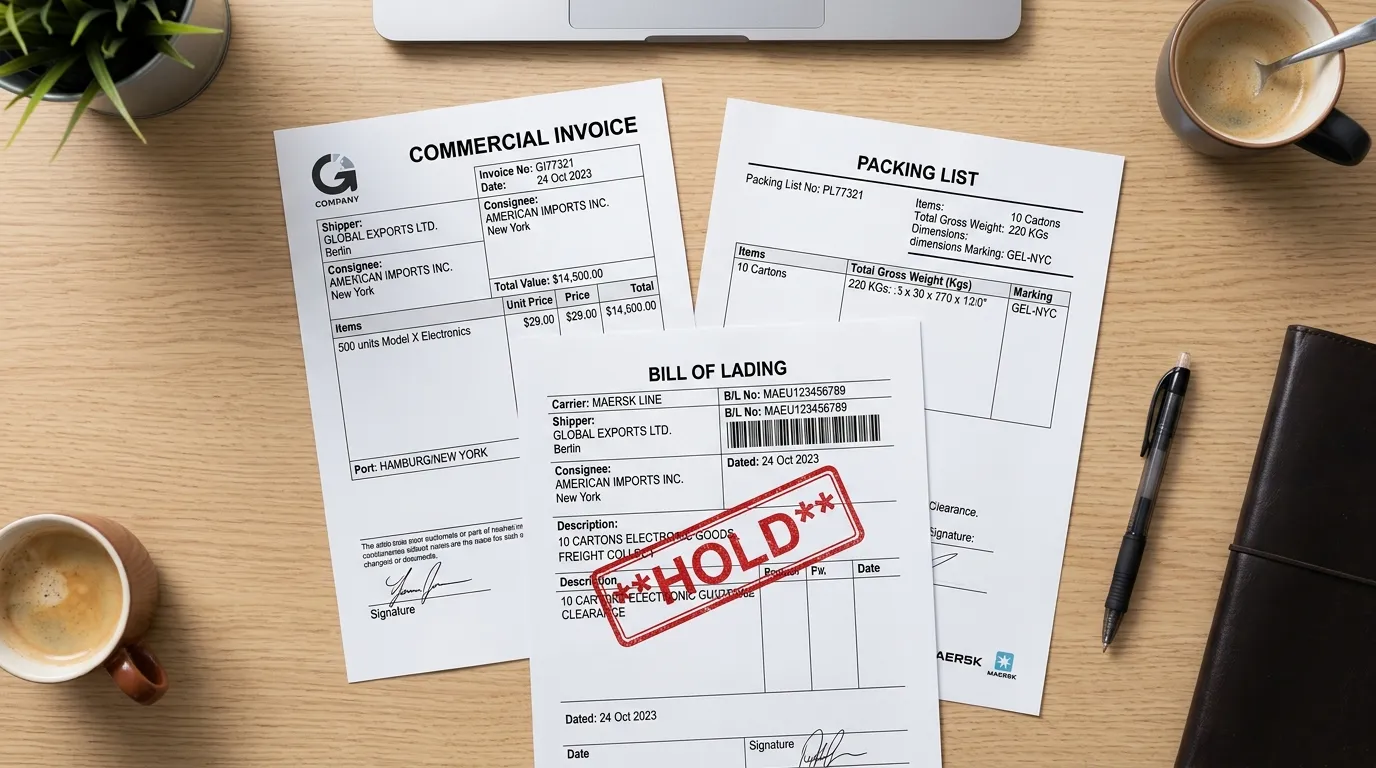
A commercial invoice causes a customs hold when fields are missing, vague, or inconsistent with other shipping documents. The most common triggers are product descriptions that don’t match a tariff classification, incorrect or missing HS codes, undervalued goods, and wrong Incoterms. Customs authorities in the US, UK, and EU all use the invoice as the primary document for duty assessment and clearance decisions.
U.S. Customs and Border Protection treats the commercial invoice as the foundation of every entry. When a field is incomplete, CBP cannot classify the shipment without manual review. That review takes time and starts costing money from day three.
The table below shows the most common field-level errors and what each one actually triggers downstream.
| Field | Common Mistake | What Customs Sees | Likely Outcome | Fix Before Shipping |
|---|---|---|---|---|
| Product Description | “Electronic accessories” | Unclassifiable without manual review | Held for examination | Specific item name, material, function, and HS-aligned language |
| HS Code | Wrong chapter or missing entirely | Duty rate mismatch or classification dispute | Exam request (CF-28) | Verify HS code against product specs, not just product name |
| Invoice Value | Below actual transaction value | Suspected undervaluation | Penalty risk, full exam | Declare the real price paid or payable |
| Incoterms | Missing or wrong term | Dutiable value basis unclear | Manual valuation review | State the correct Incoterm and ensure it matches the shipping contract |
| Currency | Currency not declared | Conversion ambiguity | Entry rejected or delayed | State currency explicitly on every line item |
One pattern shows up consistently: sellers use whatever invoice their supplier sends. The supplier optimizes for their own export process, not for the importer’s customs requirements at destination. That gap is where most holds originate.
The Complete Commercial Invoice Checklist: Field by Field

A compliant commercial invoice must include the full shipper and consignee details, HS code for each line item, a specific product description matched to the tariff classification, quantity and unit value in a consistent currency, the applicable Incoterm, declared country of origin, and the reason for export. Missing or vague entries in any of these fields can delay clearance.
HMRC guidance on UK import documentation confirms that customs authorities require all of these fields to be present and internally consistent before an entry can be processed. The US, UK, and EU all expect the same core data, even if the specific format varies.
Shipper and Consignee Details
The shipper is the exporter sending the goods. The consignee is the legal recipient at destination. Both need a full legal name, complete street address, and a working contact number or email.
A PO Box fails customs systems in many jurisdictions because it cannot be verified as a physical delivery address. Some countries, including the US, require a commercial street address for the importer of record. If your consignee field has a PO Box, replace it before the booking is confirmed.
The consignee and the notify party are not always the same. If a customs broker or freight forwarder is the notify party, list them separately. Putting the broker’s address in the consignee field is a common error that creates a mismatch between the invoice and the bill of lading.
HS Code: The Field Most Sellers Get Wrong
The Harmonized System (HS) code is a standardized numerical classification for every traded product. It determines the duty rate applied at destination. The World Customs Organization maintains the six-digit base code used internationally, while individual countries extend it to 8 or 10 digits for their own tariff schedules.
A wrong HS code doesn’t just change the duty rate. It signals to customs that the product description and the classification don’t align, which triggers a review. For help selecting the correct HS code for your product category, run the classification before you finalize the invoice.
A real example: an invoice declares HS 8517.12 (smartphones) but the product is a smartwatch. Depending on primary function, the correct code is 8517.62 or 9102.12. The duty rate difference can be significant, and a binding ruling from CBP is the only way to resolve a genuine classification dispute without penalty exposure.
Product Description: Specific Over Generic
Customs cannot classify “electronic accessories.” They can classify “wireless Bluetooth earbuds, plastic housing, 5V USB-C charging, 30g unit weight.”
The product description on the invoice should give a customs officer enough information to verify the HS code without opening the box. That means the item name, the primary material, the function, and the technical specification that distinguishes it from similar products.
Generic descriptions are not just unhelpful. They’re the most common reason a shipment enters a manual examination queue instead of clearing automatically.
Quantity, Unit Value, and Currency
State the exact quantity of units shipped and the unit value for each line item. The unit value must match the price in the purchase order or letter of credit. If those documents use USD and your invoice uses EUR, customs at the destination country will flag the inconsistency.
Currency must be declared explicitly on every line. Don’t assume it’s obvious. When the currency field is blank, some customs systems reject the entry outright. Others apply a default conversion that may not match the rate on your transaction date.
Incoterms: Why the Wrong Term Shifts Duty Liability
Incoterms 2020, published by the International Chamber of Commerce, define who pays for freight, insurance, and risk at each point in the shipment. On a commercial invoice, the Incoterm you declare directly affects the dutiable value calculation at destination.
Most countries use CIF (cost plus insurance plus freight) as the basis for customs value. That means freight and insurance are added to the invoice price before duties are calculated. If you declare EXW (ex-works, meaning the buyer pays all freight from the seller’s door), but submit that invoice to a CIF-basis customs authority without adding freight, your declared value is automatically lower than the dutiable value customs will calculate.
This is not a gray area. It produces an undervaluation by omission, not by intent, and it creates exactly the kind of discrepancy that triggers a manual review. State the correct Incoterm and make sure it matches the shipping contract.
Country of Origin and Reason for Export
Country of origin is where the goods were manufactured or substantially transformed, not where they were shipped from. A product made in Vietnam but transshipped through a Chinese port is Vietnamese-origin, not Chinese-origin.
Origin matters because free trade agreements (FTAs) can reduce or eliminate duties for qualifying goods. Wrong origin declaration does the opposite: it exposes the importer to back-duties and potential penalties if the discrepancy is caught. The WTO Customs Valuation Agreement requires that origin declarations be accurate and supportable.
Reason for export tells customs why the goods are moving: permanent sale, temporary export, return for repair, warranty replacement, gift, or sample. Each code carries different duty treatment. Marking a commercial sale as a “sample” to avoid duties is customs fraud. Customs authorities in the US, UK, and EU flag sample declarations that don’t match the invoice value or quantity pattern of an actual sample.
Pre-Shipment Invoice Checklist
Run this against every invoice before it goes to the freight forwarder.
| # | Field | Check |
|---|---|---|
| 1 | Shipper full legal name and street address | Present and complete, no PO Box |
| 2 | Consignee full legal name and street address | Present, matches bill of lading |
| 3 | HS code for every line item | 6-digit minimum, verified against product specs |
| 4 | Product description | Specific: item name, material, function, tech spec |
| 5 | Quantity | Unit count per line, matches packing list |
| 6 | Unit value | Matches purchase order or LC |
| 7 | Currency | Declared explicitly, consistent across all documents |
| 8 | Incoterms | Stated, matches shipping contract, correct basis for destination |
| 9 | Country of origin | Actual manufacture location, not transshipment point |
| 10 | Reason for export | Accurate code: sale, sample, gift, repair, etc. |
Invoice Value vs. Customs Value: The Undervaluation Risk Most Sellers Ignore
Invoice value and customs value are not always the same. Most countries calculate duties on CIF value (cost plus insurance plus freight) or FOB value. Writing a lower invoice price to reduce duties is customs fraud, carries penalty risk, and often triggers the exact manual inspection it was meant to avoid. Declare the real transaction value.
Here’s the CIF math in practice. A UK importer receives an EXW invoice for goods from China: invoice value £5,000. UK customs calculates duties on CIF value. Freight to the UK is £600. Insurance is £50. Customs value becomes £5,650. Duties are assessed on £5,650, not £5,000. If the importer submitted the invoice without declaring freight and insurance, customs applies its own benchmark figures, which may be higher than the actual freight cost, and the duty bill comes in above what the buyer budgeted.
Undervaluation to stay under a de minimis threshold carries a separate risk. Many thresholds that existed in 2024 have been reduced or eliminated since. For a full breakdown of de minimis changes for US-bound cargo, the picture has shifted significantly for ecommerce sellers importing from China.
Declaring a lower invoice value is not a gray area under the WTO Customs Valuation Agreement. It’s customs fraud regardless of the amount, and the duty savings almost never offset the penalty risk, exam delays, and broker fees that follow a flagged entry.
What Happens After Customs Flags Your Invoice
Once customs identifies an invoice error, the process moves quickly and storage costs accumulate faster than most sellers expect.
- Entry enters a manual review queue. CBP or the destination country’s customs authority flags the entry. An officer is assigned to review the invoice against other shipping documents.
- A request for information is issued. In the US, this is a CF-28 (Request for Information) or CF-29 (Notice of Action). The importer or broker typically has 5 business days to respond with corrected documentation.
- Storage fees begin. Most container freight stations and bonded warehouses start billing from day 3 of the hold. Fees vary by port and facility, but they add up fast on a multi-carton shipment.
- The broker responds with the correction. If the error is minor and the correction is accepted, the entry is released. If the discrepancy is significant (wrong HS code, suspected undervaluation, origin dispute), the exam becomes a full physical inspection.
- Worst-case outcomes: Persistent discrepancies can result in seizure, forced re-export, or a civil penalty notice. CBP does offer a penalty mitigation process, but it requires documented proof of good faith, and it takes time.
The entire sequence is avoidable. It starts with a clean invoice.
How Fexbuy Reviews Your Documents Before Cargo Moves
Before Fexbuy books any shipment, the operations team reviews the commercial invoice against the packing list and shipping contract. That review catches the errors that cause customs holds before cargo departs, not after it arrives at the destination port.
Here’s what the document check covers:
- HS codes verified against the product description on every line item
- Incoterm confirmed against the shipping contract and destination country’s duty basis
- Consignee details checked against the bill of lading for consistency
- Origin declaration reviewed for accuracy against manufacturing documentation
- Currency and unit value cross-checked against the purchase order
For a first-time importer, this is what that check looks like in practice. A seller sends Fexbuy their supplier’s invoice 48 hours before cargo departs. The team identifies three issues: the HS code doesn’t match the product description, the Incoterm is missing, and the consignee address uses a PO Box. All three are corrected before the booking is confirmed. The shipment clears without a hold.
To understand how duties are calculated on your shipment once the invoice is clean, the duties and landed cost guide covers the full calculation methodology. For sellers working on total landed cost calculation across multiple SKUs and shipping routes, that framework connects directly to how invoice accuracy affects your margin at destination.
Frequently Asked Questions
What is the difference between a commercial invoice and a proforma invoice?
A proforma invoice is a preliminary document sent before a sale is confirmed. It’s used for quotation and advance payment purposes and does not serve as a customs declaration. A commercial invoice is the final document issued after the transaction and is the one submitted to customs for clearance and duty assessment. Never substitute a proforma invoice for a commercial invoice on an active shipment.
Do I need a commercial invoice for every international shipment, including small parcels?
Yes. Any commercial shipment crossing an international border requires a commercial invoice, regardless of value, with limited exceptions for personal gifts below specific de minimis thresholds. Even low-value shipments can be examined. An inaccurate invoice on a small parcel creates compliance flags that affect future shipments from the same shipper, so accuracy matters at every order size.
Can I use my supplier’s commercial invoice, or do I need to create my own?
If you are a buyer reselling goods, your supplier’s invoice reflects the price they charged you, not necessarily the price relevant to the import entry at destination. Suppliers optimize their paperwork for their own export process. In many cases, the importer of record must provide an invoice that reflects the actual transaction value and meets the destination country’s specific format requirements. Using the supplier’s invoice without verifying it is one of the leading causes of customs holds for ecommerce sellers.
What does “reason for export” mean on a commercial invoice?
Reason for export identifies the purpose of the shipment: permanent sale, temporary export, return for repair, warranty replacement, sample, or gift. Customs uses this field to determine whether duties apply and at what rate. Marking a commercial sale as a “sample” or “gift” to reduce duties is customs fraud and carries significant penalty risk, including back-duties, fines, and increased scrutiny on future shipments.
What happens if my commercial invoice has an error after the shipment has already departed?
Contact your customs broker or freight forwarder immediately to issue a corrected invoice before the shipment arrives at the destination port. Many customs authorities accept corrections before formal entry is filed. Once the shipment has been presented to customs with an error, the correction process becomes more complex, may trigger a physical exam, and in cases of a significant discrepancy can result in seizure or a civil penalty notice.
How many copies of a commercial invoice are typically required?
Most customs authorities require three to five copies: one for customs, one for the carrier, one for the importer of record, and one retained by the exporter. Some destination countries require additional copies or certified translations. Confirm the specific requirement with your freight forwarder before the shipment departs, as requirements vary by country and commodity type.
What is an HS code and why does it matter on a commercial invoice?
An HS code is a standardized numerical classification assigned to every traded product. Customs uses it to determine the duty rate and any applicable trade restrictions. A wrong code on the invoice doesn’t just change the duty amount: it signals a mismatch between the declared product and its classification, which triggers a manual review. Use the HS code lookup for your product to verify the classification before the invoice is finalized.


