


Battery Shipping to Amazon FBA: Packaging Requirements for Rechargeable Batteries
For shipping batteries to Amazon FBA, sealed cartons do not always indicate compliant shipments. Problems with the shipment, such as exposed battery terminals, inadequate internal restraint, incorrect dangerous goods markings, or inappropriate retail packaging, may result in rejection of the shipment by the carrier or receiving problems at FBA.
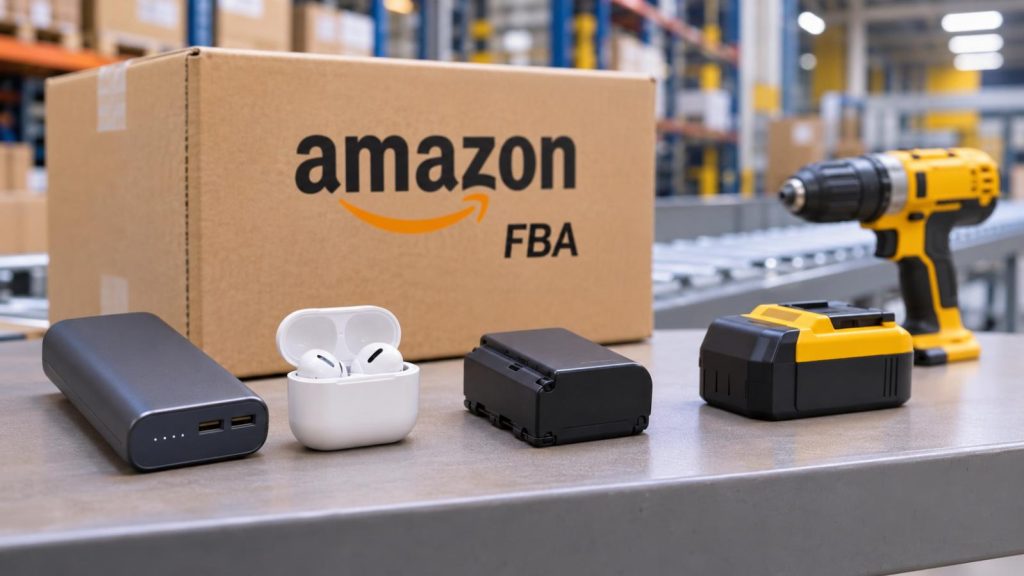
We examine rechargeable battery shipments against three criteria at Fexbuy: classification of batteries, performance of transport packaging, and Amazon FBA inbound standards. Each of these are assessed independently at the factory.
Why Battery Shipping to Amazon FBA Can Fail Packaging Checks
A shipment may be approved at the factory but may still fail freight acceptance or the receiving inspection by Amazon.
Some of the failure points are:
•Exposure to a short circuit: Battery terminals contact another battery or conductive packaging.
•Insufficient restraint: Vibration of the battery causes the cap or connector to contact an opposite terminal.
•False declarations: UN numbers, battery specifications or shipping documents do not correspond.
•Non-rigid retail packaging: Battery packaging relies on a zipper bag or shrink wrap.
Amazon allows suitable manufacturer packaging, boxes, clamshells and blister packs. The sellable unit must be protected, and the shipping carton must meet the requirements of transport.
Classify Rechargeable Batteries Before Selecting Packaging
The first step in battery shipping to Amazon FBA is to determine the chemistry of the battery and its configuration as well as the watt-hours.
UN3480 vs UN3481: Packaging Differences
| Configuration | UN Number | IATA Packing Instruction | Main Consideration |
| Standalone lithium-ion batteries | UN3480 | PI 965 | Stronger air transport restrictions |
| Batteries packed with equipment | UN3481 | PI 966 | Battery restraint and equipment separation |
| Batteries contained in equipment | UN3481 | PI 967 | Accidental activation prevention |
These classifications apply to lithium-ion batteries, including lithium-polymer types. Other rechargeable chemistries require separate classification.
Watt-Hour Rating and SOC Requirements
Battery energy is calculated as:
Wh = Nominal Voltage (V) × Capacity (Ah)
A 3.7 V, 5,000 mAh battery has a nominal rating of 18.5 Wh.
Per 2026 IATA regulations:
Batteries must adhere to the following limits: 20 Wh/cell and 100 Wh/ battery.
•PI 965: Generally, lithium-ion batteries must be packed at a state of charge (SOC) of 30% or less.
• PI 966: Section I batteries and II batteries exceeding 2.7 Wh must be packed at a SOC of 30% or less. Section approval will override this requirement.
•PI 967: A reduction of SOC is recommended for batteries that are part of equipment, not universally required.
Capacity and configuration also determine applicable package quantity limits, marking, and documentation requirements.
Choosing Packaging Materials for Short-Circuit and Impact Protection
Packaging selection should begin with the likely failure mode—not material price.
Battery Packaging Material Comparison
| Packaging Method | Technical Function | Limitation |
| Blister / Clamshell | Individual positioning and rigid protection | Limited flexibility for large packs |
| Corrugated Box + Dividers | Compartment separation and structural support | Requires suitable board strength |
| Foam Inserts | Shock absorption and movement restraint | Adds packaging volume |
| Molded Pulp Inserts | Form-fitting positioning | Must be validated for the load |
| UN Specification Packaging | Demonstrated regulatory performance | Required only under applicable provisions |
Terminal Insulation and Internal Restraint
For exposed terminals, protective methods may include:
•Nonconductive terminal caps or secure insulating covers.
•Individual inner packaging to prevent electrical contact.
•Rigid dividers that maintain separation during vibration.
•Cushioning that prevents movement without stressing connectors.
The outer carton alone should not be relied upon to prevent terminal short circuits.
Drop and Stacking Requirements
For applicable air shipments:
•PI 966 Section II: The completed package must be capable of withstanding a 1.2 m drop test.
•PI 965 Section IB: Packaging must demonstrate the capability to withstand a 3 m stacking load for 24 hours.
•UN specification packaging: Required for certain fully regulated configurations, including PI 965 Section IA.
These requirements are not universal Amazon retail-packaging tests. Packaging evidence must correspond to the applicable instruction and actual packed configuration.
Match Packaging to the Battery Product and Shipping Mode
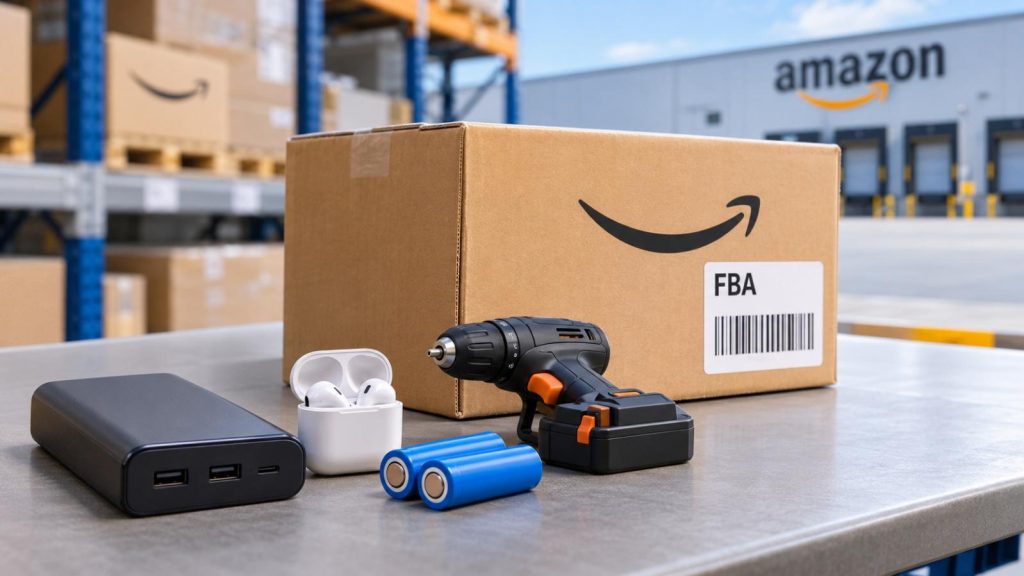
Different Amazon FBA SKUs require different packaging decisions.
Power Banks & Replacement Batteries
Most power banks are classified as UN3480 batteries. Classification of power banks (and replacement batteries) affects air cargo acceptance, package quantities and marking.
When selecting a replacement battery pack, first confirm connector insulation and the proper pack arrangement, then select the appropriate carton.
Wireless Earbuds and Other Equipment
Complete systems containing wireless earbuds shipped with a charging case are regulated under UN3481 PI 966. The charging case, if shipped separately, falls under UN3480.
Battery-powered Tools and Equipment
Batteries and tools must be shipped in a manner to prevent activation. Tools must be shipped with batteries secured in place.
Batteries: Ships to FBA
All batteries shipped to FBA must comply with IATA and IMDG.
Batteries are subject to a quality check against our shipping standards.
Quality Check Standards
Battery Condition: Batteries which are irregular or defective (i.e. leaking, bloated, or have a defective cell, short circuit, or external defects) must not be shipped.
- Terminal Protection: Battery connector insulation must be covered.
- Clearance: No battery may be in direct contact with any other battery or other conductive materials.
- Carton Clearance: The minimum closure between carton seams is 1 inch.
- Defects: Correct all defects in the shipment. Defects must be corrected for all future shipments.
- Records: Retain all records documenting our adherence to the above.
UN38.3 requires that the lithium batteries be shipped in a safe manner and therefore covers the safe transportation of the battery and not the case that contains the battery.
We verify the following safety shipping documents for UN38.3 packages:
•Summary of UN38.3 testing.
•Description of the battery.
•Packaging and/or Evidence of Packaging.
•Lithium Battery Markings.
• Cargo-only Aircraft Markings.
•Class 9 Labels.
•Commercial documentation (i.e. Commercial Invoice and/or Packing List).
•Dangerous Goods Declaration.
•Battery documentation.
•FBA Labels.
•Carrier Shipper’s Declaration for Dangerous Goods (SDD).
•Transport documentation for Dangerous Goods.
•Inventory Labels.
•Both markings are Required.
Minimize Shipping Costs
Because both the weight and size of the shipping package affects shipping costs, if your shipment and battery characteristics change, shipping costs will also change.
To receive a shipping quote, it is required to provide the:
•UN classification of the battery.
•Gross and Net weights of the battery.
•Number of batteries per carton.
•Dimensions and photos of shipping cartons.
•How the batteries are packaged.
•Shipping volume, requirements and destination FBA warehouse.
At Fexbuy Logistics we coordinate review of battery shipments, dangerous goods documentation, FBA preparation and international freight.
For your next shipment of batteries to Amazon FBA, we can review the shipment with you and help you in identifying suitable transport arrangements before the shipment is sent.
FAQs
Q1. Can Fexbuy arrange Battery Shipping to Amazon FBA?
Yes. Fexbuy supports lithium battery freight coordination, dangerous goods documentation, FBA preparation, customs clearance, and delivery planning. Acceptance depends on battery classification, packaging, destination, and carrier requirements.
Q2. What packaging does Fexbuy recommend for rechargeable batteries?
We recommend rigid outer packaging, protected terminals, secure internal separation, and adequate cushioning. UN specification packaging is used where required by the applicable transport regulations.
Q3. Can Fexbuy ship UN3480 and UN3481 batteries to Amazon FBA?
Yes, subject to carrier acceptance and Amazon FBA eligibility. We review the battery configuration, watt-hour rating, packing instruction, shipping mode, and destination before booking.
Q4. Does Fexbuy provide UN-certified battery packaging?
Yes. We support UN specification cartons where required, together with terminal insulation, cushioning, internal restraints, and appropriate dangerous goods labels. Packaging selection depends on the battery classification.
Q5. Can Fexbuy inspect and repack batteries from Chinese suppliers?
Yes. We can review factory packaging, inspect suitable cargo, arrange repacking, add protective materials, and correct shipping labels before international dispatch.
Share:


