


UK PVA Customs Clearance Requirements: What the Importer Must Provide
UK PVA Customs Clearance: What the Importer Must Provide is mainly a question of data accuracy before the customs declaration is submitted. Postponed VAT Accounting (PVA) allows an eligible UK VAT-registered importer to account for import VAT through its VAT Return rather than paying that VAT immediately at import.
PVA does not remove import VAT. It changes how and when the VAT is accounted for. HMRC also makes clear that the decision to use PVA belongs to the importer, not the customs intermediary.
What Must the Importer Provide for UK PVA Customs Clearance?
For UK PVA Customs Clearance: What the Importer Must Provide, the customs broker normally needs enough information to identify the importer, classify and value the goods, and apply the requested VAT treatment.
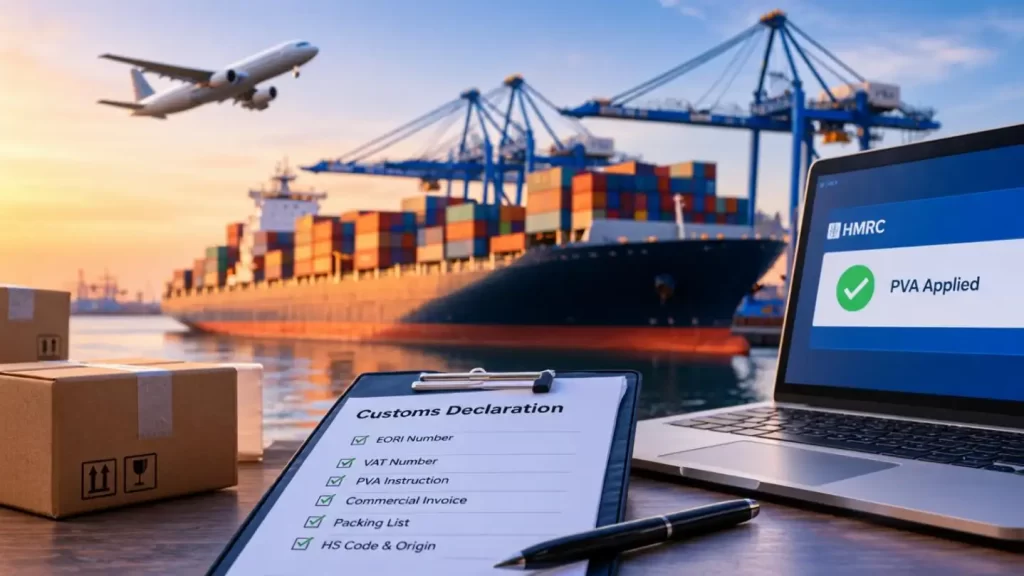
| Information | Why It Matters |
| UK EORI number | Identifies the importer in the customs declaration |
| UK VAT registration number | Connects the VAT-registered business to PVA |
| Written PVA instruction | Confirms how the importer wants import VAT treated |
| Legal company name and address | Confirms importer identity |
| Commercial invoice | Supports description, price, currency and transaction |
| Packing list | Supports packages, quantities and weights |
| Commodity/HS code information | Determines tariff classification |
| Country of origin | Affects duty and trade measures |
| Incoterm | Helps clarify commercial responsibility and valuation |
| Customs value data | Supports calculation of customs duty and import VAT |
| Licences/certificates where applicable | Supports regulated or restricted goods |
A commercial invoice alone is therefore not a complete customs instruction.
EORI and VAT Numbers Perform Different Functions
The EORI number identifies the economic operator for customs purposes. The VAT registration number identifies the VAT-registered business for VAT accounting.
For PVA, HMRC requires the VAT registration number to be entered in the relevant import declaration data, while postponed VAT is recorded against the importer’s EORI.
The basic data relationship is:
Importer → EORI → Customs Declaration → VAT Number → PVA → Monthly PVA Statement
If an incorrect EORI or VAT number is supplied, the importer may later find that the expected import VAT does not appear under the correct account.
Give the Freight Forwarder Written PVA Instructions
One of the most important requirements in UK PVA Customs Clearance: What the Importer Must Provide is a clear instruction on VAT treatment.
Importers using an intermediary should have a written agreement confirming how import VAT will be accounted for. HMRC states that the choice to use PVA is the importer’s decision rather than the intermediary’s.
A practical instruction should identify:
• Importer legal name;
• EORI number;
• VAT registration number;
• Invoice or shipment reference;
• Request to use Postponed VAT Accounting;
• Authority for the representative to make the relevant customs declaration.
Do not assume that a freight forwarder will automatically select PVA.
There is another important timing issue: once an import declaration has been submitted, the chosen method of accounting for import VAT cannot simply be changed on that declaration.
Commercial and Customs Data Must Support the Declaration
The broker also needs transaction-level information.
A commercial invoice should clearly show the seller, buyer, goods description, quantity, unit price, total value, currency and Incoterm.
The packing list should support carton or pallet quantities, net and gross weight, package count and product quantities.
Customs data should also be reviewed before submission:
• Country of origin;
• Customs value;
• Freight and insurance costs where relevant;
• Product description;
• Licences or certificates for regulated goods.
These elements affect not only VAT but also customs duty, restrictions and declaration accuracy.
PVA vs Paying Import VAT at Import
| Factor | PVA | VAT Paid at Import |
| VAT accounting | VAT Return | Paid during import process |
| Upfront import VAT | Generally not paid upfront | Normally payable |
| Evidence | Monthly PVA statement | Usually C79 |
| Instruction | PVA must be selected | Import payment method used |
| VAT liability | Still exists | Still exists |
PVA is therefore an accounting mechanism, not a VAT exemption.
What Happens After Customs Clearance?
Cargo release is not the end of the process.
When PVA is used correctly, HMRC generates a Monthly Postponed Import VAT Statement (MPIVS) showing postponed import VAT entries associated with the importer’s EORI. The statement can be used to complete the VAT Return and, subject to normal rules, support input VAT recovery.
The importer should reconcile:
Customs declaration → EORI → VAT number → Import VAT amount → MPIVS → VAT Return
HMRC currently advises businesses to access and retain their monthly statements through the Customs Declaration Service.
Common UK PVA Customs Clearance Errors
Several mistakes can break this data chain:
• No written PVA instruction was given;
• The wrong EORI was declared;
• The VAT number was missing or incorrect;
• Invoice values did not support the customs declaration;
• The Importer of Record was unclear;
• HS code or origin information was incomplete;
The finance team did not reconcile the MPIVS after import.
For example, a wrong EORI can cause the expected postponed VAT entry to be associated with the wrong customs identity. The solution is not simply to check whether the goods were released, but to compare the declaration against the monthly PVA statement.
A Practical Importer Pre-Clearance Check
Before declaration submission, confirm:
Correct importer → Valid EORI → Correct VAT number → Written PVA instruction → Invoice → HS code → Origin → Incoterm → Customs value → Compliance documents → Broker acknowledgement
After clearance, add one final step:
Check the Monthly Postponed Import VAT Statement.
That is the practical meaning of UK PVA Customs Clearance: What the Importer Must Provide: accurate tax identity, explicit VAT instructions, complete customs data and post-clearance verification must work as one process.
For businesses shipping from China to the UK, a freight forwarder familiar with importer documentation, customs declarations and PVA instructions can help identify missing information before the declaration is filed. Fexbuy supports China-to-UK freight and customs-clearance coordination, providing a practical point of contact for importers preparing shipment and customs data before cargo enters the UK import process.
FAQs
Q1. Can Fexbuy assist with UK PVA customs clearance?
Yes. Fexbuy can coordinate China-to-UK shipping and customs-clearance documentation, including information needed for PVA-related declarations.
Q2. What information should I provide Fexbuy before UK customs clearance?
Provide your importer name, UK EORI number, VAT number, commercial invoice, packing list, product details, HS code information, origin and PVA instruction.
Q3. Should I tell Fexbuy specifically that I want to use PVA?
Yes. Importers should clearly confirm in writing that Postponed VAT Accounting should be used for the shipment.
Q4. Can Fexbuy choose PVA for the importer automatically?
The decision to use PVA belongs to the importer. The importer should provide clear instructions before the customs declaration is submitted.
Q5. Does Fexbuy need both my EORI and VAT number?
For PVA-related UK imports, both may be required because the EORI identifies the customs operator while the VAT number supports VAT accounting.


