


How to Instruct a Freight Forwarder for UK PVA: A Practical Importer Checklist
Knowing How to Instruct a Freight Forwarder for UK PVA is more than sending a message saying, “Please use PVA.” The freight forwarder needs the correct importer identity, UK VAT registration number, EORI number and written instruction before the customs declaration is submitted.

For eligible UK VAT-registered businesses, Postponed VAT Accounting (PVA) allows import VAT to be accounted for through the VAT Return instead of being paid upfront at import. HMRC does not require prior approval to use PVA, but the importer—not the freight forwarder—decides whether it should be used.
Check Whether the Importer Can Use UK PVA
Before discussing How to Instruct a Freight Forwarder for UK PVA, confirm that the transaction is eligible.
The business generally needs to:
• Be registered for VAT in the UK;
• Import goods for use in its business and have the right to dispose of them;
• Include its VAT registration number on the import declaration; and
• Ensure the appropriate importer details are used in the declaration.
PVA does not mean import VAT disappears. It changes how qualifying import VAT is accounted for. The VAT is declared on the VAT Return and, where normal input-tax rules allow, may also be reclaimed through that return.
Give the Freight Forwarder Written PVA Instructions
When a freight forwarder, customs agent, broker or express operator imports goods on your behalf, HMRC requires written confirmation if you want PVA used. The intermediary must receive that confirmation before proceeding with the import declaration.
A practical instruction should identify the shipment rather than simply state “use PVA.”
| Information | Why It Matters |
| Importer legal name | Identifies the business responsible for the import |
| UK VAT number | Required for PVA processing |
| GB EORI number | Connects the declaration with the importer’s customs records |
| Shipment reference | Links the instruction to a specific consignment |
| Commercial invoice | Supports value and goods description |
| HS commodity code | Determines customs classification and duty treatment |
| Country of origin | Supports tariff and origin treatment |
| Incoterm | Clarifies import and customs responsibilities |
| PVA instruction | Confirms how import VAT should be accounted for |
The instruction can state clearly: “Please account for import VAT using UK Postponed VAT Accounting for this shipment.”
For recurring shipments, also clarify whether the authority applies to one consignment or an agreed series of imports.
Make Sure the Customs Declaration Actually Uses PVA
Understanding How to Instruct a Freight Forwarder for UK PVA also means understanding what happens after the instruction is sent.
For PVA, HMRC guidance requires the VAT registration number to be entered at header level in Data Element 3/40. Import VAT is then recorded against the relevant EORI at declaration level. The declaration should not use payment method G in Data Element 4/8 for VAT being accounted for through PVA.
This creates an important distinction:
Freight forwarder knows you want PVA ≠ customs declaration was submitted correctly for PVA.
The importer should therefore ask the forwarder or customs declarant to confirm:
• Which VAT number was entered;
• Which EORI was used for the importer;
• Who appears as the consignee/importer;
• Whether PVA was selected;
• The customs entry or movement reference after clearance.
The accounting method cannot simply be changed after the import declaration has already been submitted, so these checks are best completed before customs entry.
PVA vs Paying Import VAT at Import
| PVA | Import VAT Paid at Import |
| Import VAT accounted for through VAT Return | VAT paid during import clearance |
| Recorded on Monthly Postponed Import VAT Statement | Import VAT evidence follows the applicable payment record/C79 route |
| No upfront payment of the postponed import VAT | Creates an import-stage VAT cash payment |
| Requires correct declaration treatment | Requires appropriate payment arrangements |
The distinction affects both cash flow and accounting evidence. PVA should therefore be treated as a customs-declaration decision, not merely an accounting preference selected after the goods arrive.
Verify PVA After Customs Clearance
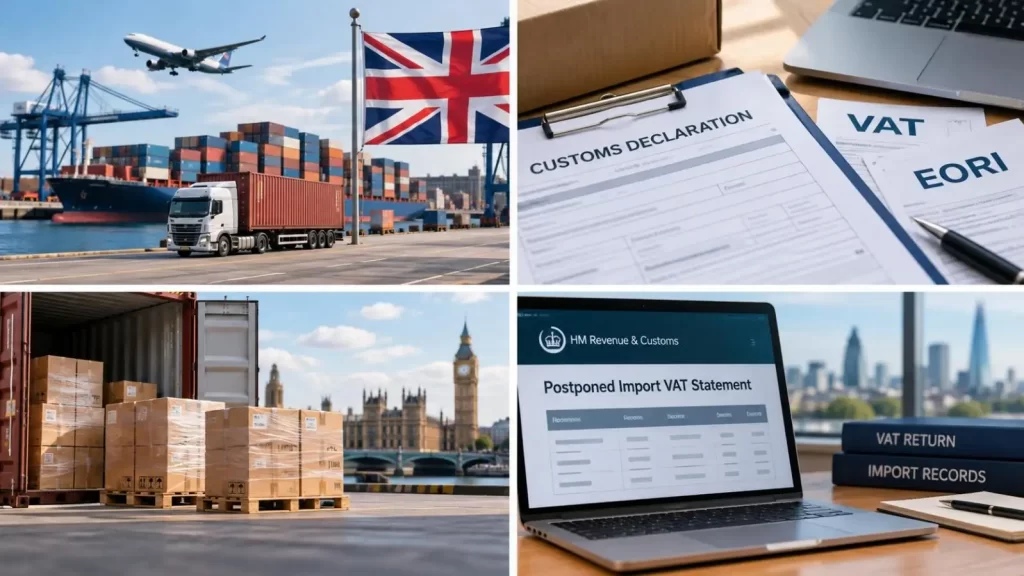
After clearance, the importer should reconcile the shipment against the Monthly Postponed Import VAT Statement (MPIVS).
HMRC states that these statements contain details of PVA imports made under the business’s EORI. Individual entries can show the import date, entry number, declarant reference, declarant EORI and import VAT amount.
Use a simple verification chain:
Shipment Reference → Customs Entry → Importer EORI → MPIVS → VAT Return
If a shipment is missing from the statement, check the customs entry with the forwarder before assuming that PVA was applied correctly.
Common UK PVA Instruction Mistakes
Several problems repeatedly cause reconciliation difficulties.
• Wrong VAT number: The declaration may not connect correctly with the intended VAT registration.
• Wrong EORI: PVA statement information is generated from declarations associated with the relevant EORI.
• Verbal instruction only: HMRC requires written confirmation when someone imports goods on your behalf.
• Waiting until after clearance: The VAT-accounting choice needs to be made through the import declaration.
Assuming the forwarder automatically chooses PVA: The decision belongs to the importer, while the intermediary implements the instruction.
What to Ask a Freight Forwarder Before Shipping
When evaluating a China-to-UK logistics provider, ask operational questions rather than simply asking whether it “supports PVA”:
• Can you arrange a customs declaration using the importer’s PVA instruction?
• How do you verify VAT and EORI details before declaration?
• Who will act as the customs declarant?
• Will you provide the customs entry reference after clearance?
• How are invoice, HS code, Incoterm and origin data checked?
• What happens if customs data need clarification before submission?
These questions help determine whether the forwarder has a process for connecting transport documents, customs data and VAT instructions.
Final Check Before Cargo Leaves China
For How to Instruct a Freight Forwarder for UK PVA, the safest workflow is as follows: confirm VAT registration and EORI, identify the correct importer, provide the PVA instruction in writing, check the commercial and customs data, obtain the declaration reference and reconcile the shipment with the MPIVS.
Fexbuy provides freight forwarding services for customers shipping goods from China to the UK, including transporting goods and handling related UK customs and documents. Fexbuy also provides information related to UK logistics and the importation of goods into the UK which address the UK customs declarations, EORI and VAT, among others.
For customers shipping goods from China to the UK who need to coordinate the freight route with customs documents and PVA instructions, they can contact Fexbuy to discuss their shipment before the cargo is shipped: https://www.fexbuylogistics.com/.
FAQs
Q1. Can Fexbuy arrange freight shipping from China to the UK?
Yes. Fexbuy provides international freight forwarding services for China-to-UK shipments, including transport coordination and customs-related support.
Q2. Can Fexbuy support shipments using UK PVA?
Fexbuy can coordinate customs documentation and PVA-related shipping requirements when the importer provides the necessary VAT and EORI information.
Q3. What information should I give Fexbuy for a UK PVA shipment?
Provide your legal company name, UK VAT number, GB EORI number, commercial invoice, HS code, Incoterm, origin information, and written PVA instruction.
Q4. Should I send my PVA instruction to Fexbuy before shipment?
Yes. The instruction should be provided before the customs declaration is submitted so the shipment can be prepared with the correct VAT treatment.
Q5. Can Fexbuy help check customs documents before shipping?
Fexbuy can assist with shipment documentation and customs-related information, helping identify missing or inconsistent details before cargo departure.


