


Portable Power Station Shipping to USA: Cost & Transit
Portable Power Station Shipping to USA is a regulated dangerous-goods operation rather than standard electronics freight. Portable power stations contain rechargeable lithium-ion batteries, often with capacities well above 100Wh, so classification, documentation, packaging, carrier approval, customs clearance, and final delivery must be planned as one connected process.
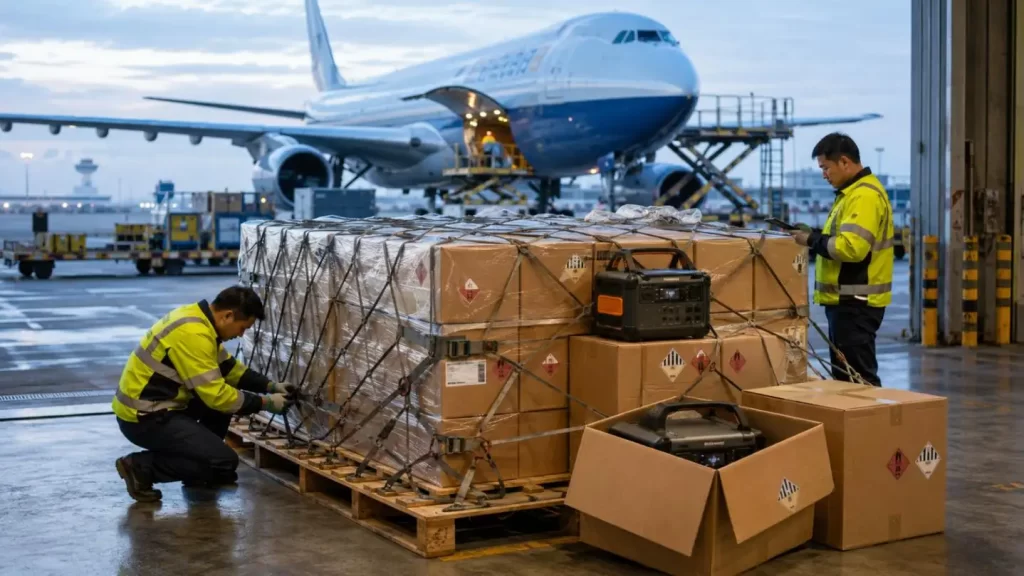
At Fexbuy, we evaluate the battery specifications before recommending a route. A low freight rate has little value if the shipment is rejected by the airline, delayed at the port, or held because the product model does not match its battery documents.
Start With the Correct Battery Classification
The first decision in Portable Power Station Shipping to USA is whether the shipment should be declared as UN3481 or UN3480.
| Classification | Typical Configuration | Main Consideration |
| UN3481 | Lithium-ion battery contained in equipment | Commonly applicable to complete portable power stations |
| UN3481 | Lithium-ion battery packed with equipment | Battery and compatible equipment packed together |
| UN3480 | Lithium-ion battery shipped independently | Common for replacement or standalone battery packs |
| Damaged/defective battery | Swollen, leaking, recalled, or physically damaged | Requires specialist evaluation and cannot use a standard channel |
Classification cannot be determined from the product name alone. Fexbuy reviews:
•Battery chemistry and model
•Nominal voltage and amp-hour capacity
•Watt-hour rating
•Net battery weight
•Whether the battery is installed or removable
•Number of units and batteries per package
•Product condition and shipping configuration
The Watt-hour rating is calculated as:
Wh = Nominal voltage × Capacity in Ah
Most portable power stations exceed the 100Wh threshold used for certain small-battery exceptions. This does not make them prohibited, but it generally means more complete dangerous-goods controls apply.
Documents Required Before Booking
Under 49 CFR 173.185, lithium battery designs offered for transport must satisfy UN 38.3 testing requirements. The regulation also requires protection against short circuits, damage, shifting, and accidental activation.
For Portable Power Station Shipping to USA, the pre-booking file normally includes:
| Document | Operational Purpose |
| UN 38.3 test summary | Confirms the tested battery design and model |
| Battery specification sheet | Verifies chemistry, voltage, Ah, Wh, and battery weight |
| SDS/MSDS | Supports carrier review of chemical and hazard information |
| Commercial invoice | Provides customs value, description, origin, and HTS data |
| Packing list | Confirms quantity, carton size, and gross/net weight |
| DG declaration | Required when applicable to the classification and mode |
| Transport appraisal | May be requested by the selected carrier or export channel |
The model number and technical data must be consistent across the product label, UN 38.3 summary, SDS, invoice, and booking form. Mismatched reports are a frequent cause of rejected bookings.
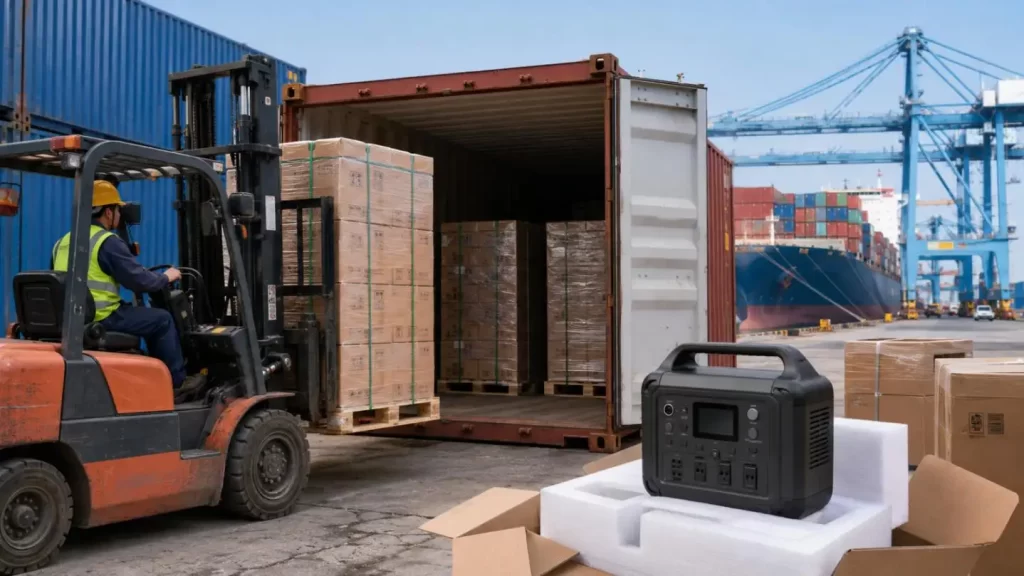
Packaging and Label Control
Depending on the classification and packing instruction, preparation may require:
•Strong, rigid outer packaging
•Terminal and short-circuit protection
•Cushioning that prevents movement and impact
•Protection against accidental equipment activation
•Applicable lithium battery and Class 9 labels
•Cargo Aircraft Only marking when required
•Visible UN numbers and overpack markings
•UN-specification packaging where applicable
Packaging must be accepted by the carrier before cargo is delivered to the airline or consolidation warehouse. Some carriers can be more strict with their rules than the minimum rules set by IATA or DOT.
Air Freight vs. Sea Freight
When considering the batteries used, how many we want to ship, the regulations of the destination, and how quickly we need to ship them, this is what we need to consider to decide on the best way to ship a Portable Power Station to the USA.
| Method | Planning Time, Door to Door | Relative Cost | Suitable For | Key Constraint |
| DG air freight | 7-15 days | High | Samples and urgent replenishment | Limited DG space and strict approval |
| Sea freight LCL | 35-55 days | Medium | Medium-volume orders | Limited DG consolidation schedules |
| Sea freight FCL | 30-55 days | Lower per unit | Large or regular orders | Requires sufficient volume |
| Dedicated battery line | 12-30 days | Medium-High | Qualified small and medium shipments | Route and specification restrictions |
| Express courier | Case-specific | High | Approved samples | Standard accounts may not accept the cargo |
Air freight is normally the mode of shipping chosen when the cost of freight outweighs the availability of inventory. LCL is appropriate when a shipment cannot fill a container, and FCL provides better cargo control and unit economics for larger shipments. Standard express service should not be assumed available without written DG approval.
How Shipping Costs Are Calculated
There is no reliable universal per-kilogram price for Portable Power Station Shipping to USA. Fexbuy calculates the shipment as a complete logistics project:
Total Logistics Cost = China Pickup + DG Handling + Packaging + Main Freight + Customs Clearance + Duties And Fees + Final Delivery + Insurance
Important cost variables include:
•Chargeable weight for air freight
•CBM or weight/measurement for LCL
•Container type for FCL
•DG documentation and handling fees
•Origin and destination terminal charges
•Customs brokerage and bond requirements
•Import duty, MPF, and ocean HMF
•Customs examination or storage
•Residential, commercial, or FBA delivery
•Delivery appointments, liftgate, or pallet requirements
A professional comparison should therefore use landed logistics cost per unit, not the base freight rate alone.
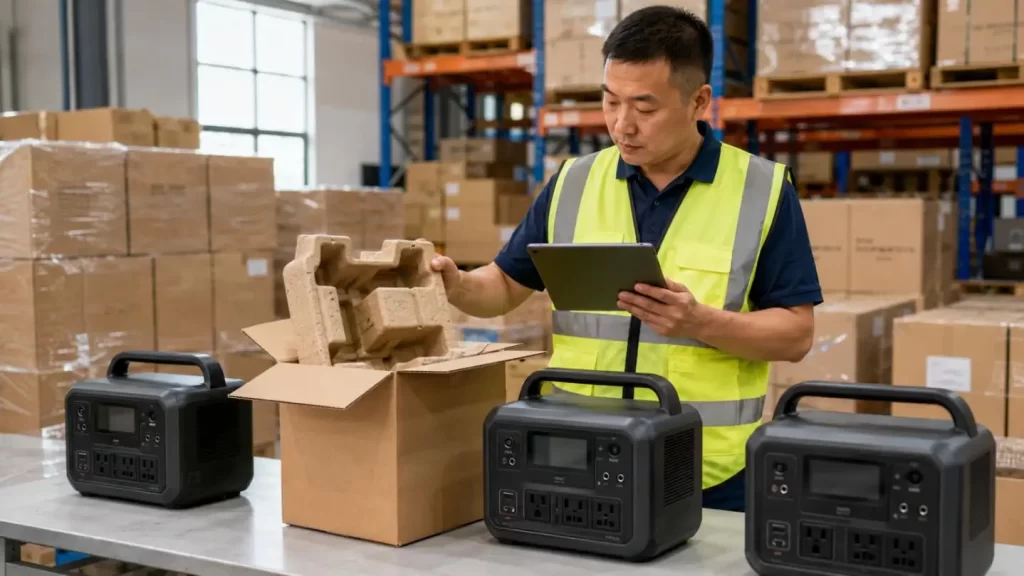
Transit Time and Delay Risks
The quoted transit time should include the entire shipping process, not just the flight or sailing time. The Process of Portable Power Station Shipping to USA includes reviewing documents, obtaining DG approval, picking up the cargo in China, export clearing, international transport, U.S. import clearing, and delivering the cargo.
The main delays include:
•UN classification errors
•Incomplete or inconsistent battery reports
•Constraints on airline or DG consolidation
•Customs inspection
•Port congestion
•Errors in HTS classification
•Unclear Importer of Record
•FBA labeling or appointment issues
Unfortunately, delays in document review can be costly and require reworking of cartons and labels.
U.S. Customs and Delivery Planning
The buyer and the shipper must first agree on the Importer of Record and on DDP or DAP terms before the goods can be shipped. The commercial invoice must include the product description, the quantity, the transaction value, the country of origin, and the appropriate HTS classification.
It should be noted that the final classification of the goods may lead to the Imposition of Section 301 duties. Transport approval is distinct from U.S. product-market compliance, and electric-safety FCC and other documents may be required by retailers and marketplaces.
The plan must also account for carton labels, pallet standards, appointment booking, warehouse acceptance, and the handling of returns as well as delivery for FBA.
Plan Portable Power Station Shipping with Fexbuy
Fexbuy does not compare rates for Portable Power Station Shipping to the USA; we perform a technical review instead. We assist our customers in reviewing battery documents and shipping verifications, and assess air and sea routes considering customs, warehousing and the final delivery.
To evaluate your shipment, please include your product model, Wh rating, quantity, carton dimensions, gross weight, pickup city and U.S. ZIP code. More details can be found on Fexbuy Battery Transport Services.
FAQs
Q1. Can Fexbuy arrange Portable Power Station Shipping to USA?
Yes. Fexbuy can coordinate compliant air freight, sea freight LCL or FCL, dedicated battery routes, customs clearance, and final delivery. Availability depends on the battery specifications, shipment size, and carrier approval.
Q2. What documents does Fexbuy require before booking?
Fexbuy typically reviews the UN 38.3 test summary, SDS/MSDS, battery specification sheet, commercial invoice, packing list, product photos, and applicable dangerous-goods documents.
Q3. Can Fexbuy determine whether my product is UN3480 or UN3481?
Fexbuy can review the battery installation and packing configuration to support classification. Complete power stations with installed batteries are commonly assessed as UN3481, while standalone battery packs may be UN3480.
Q4. Does Fexbuy provide dangerous-goods packaging?
Fexbuy can coordinate DG packaging, including rigid outer cartons, cushioning, short-circuit protection, product securing, lithium battery marks, and other labels required by the selected route.
Q5. Does Fexbuy offer both air and sea shipping?
Yes. Fexbuy provides DG air freight and sea freight services. Air freight is usually selected for urgent shipments, while LCL or FCL sea freight is generally more economical for commercial volumes.
Share:


