


How to Ship a Large Solar Energy Storage Cabinet from China to the USA
When shipping a Large Solar Energy Storage Cabinet from China to the USA, there are 3 things to check: battery compliance, physical loading limits and access to the destination. Even before booking the shipment Flexbuy takes care of these checks.
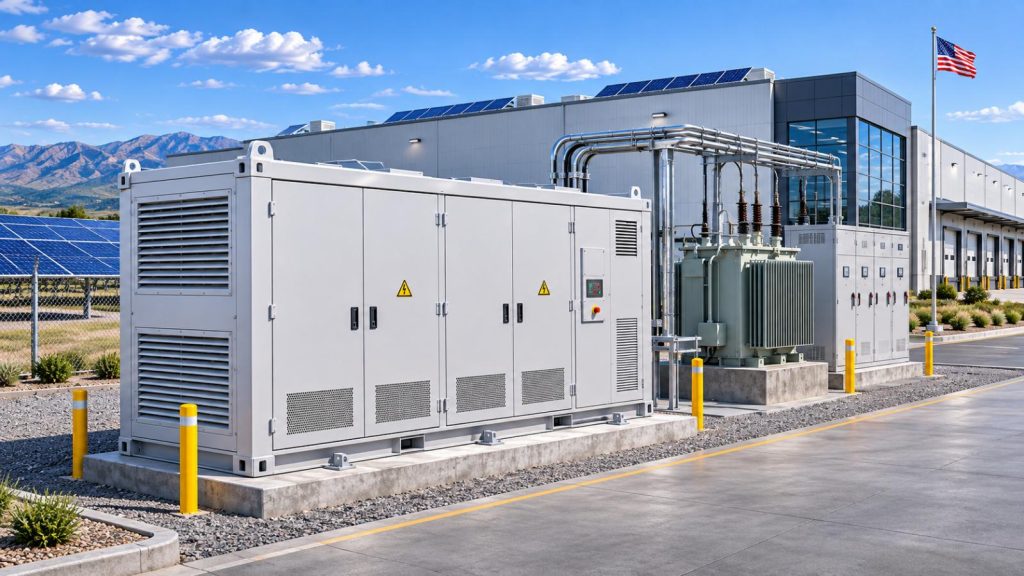
1. Understand the Equipment Being Shipped
A Large Solar Energy Storage Cabinet contains battery racks, a battery management system (BMS), cooling, and protective devices. Its power conversion system (PCS) may ship separately; step-up transformers typically do.
An installed battery cabinet is classified differently from an empty enclosure or loose battery modules.
Factory Data Required Before Booking
• Packing dimensions and gross mass, including skids or transport frames.
• Center of gravity, lifting drawings, and approved tie-down points.
• Battery chemistry and installed configuration, UN38.3 test summary (if applicable).
• Isolation and securing instructions for battery racks, DC terminals, coolant circuits and removable assemblies.
We also check the container dimensions and verify the door clearances and concentrated floor loads.
2. Classify the Batteries Before Selecting a Vessel
The Large Solar Energy Storage Cabinet may be regulated as Class 9 dangerous goods. The shipper must determine the correct classification from the actual configuration.
| UN Entry | Typical Application |
| UN3480 | Lithium-ion batteries shipped on their own |
| UN3481 | Lithium-ion batteries packed with or contained in equipment |
| UN3536 | Qualifying lithium batteries installed in a cargo transport unit under Special Provision 389 |
UN3536 is not a default label for any battery cabinet. Batteries must supply power outside the transport unit and be secured against movement, short circuits, and accidental operation. See PHMSA’s interpretation.
From January 1, 2026, Amendment 42-24 of the IMDG code became effective and binding on all ocean shipments. Carriers may require dangerous goods declarations and battery testing records and approval of packaging. SDS alone do not determine transport classification.
3. Choose Ocean Freight for a Large Solar Energy Storage Cabinet
For a Large Solar Energy Storage Cabinet, the lowest quoted ocean rate is irrelevant if the cargo cannot be loaded and secured safely.
| Shipping Option | Selection Criteria |
| Standard FCL | Fits door opening, internal clearance, payload and floor-load limits |
| Open-top container | Requires overhead lifting but remains within permitted dimensions |
| Flat rack | Oversized height/width or loading geometry; engineered lashing required |
| Breakbulk | Exceptional dimensions or mass beyond practical container solutions |
Packing and Lifting Details
Use manufacturer-approved lifting points, suitable spreader beams and a transport base designed for the load. Restrain movement in every direction; protect terminals and delicate components from impact and moisture. Confirm whether racks, coolant, and auxiliary assemblies need transport-specific preparation.
Power transformers need their own handling plan. Check shipping mass, lifting-jack locations, center of gravity, removable bushings, and whether insulating liquid requires leakage controls or additional transport review. Do not assume a transformer and battery cabinet can share the same equipment.
4. Prepare U.S. Entry Documents
Align the invoice, packing list, bill of lading, origin, and equipment descriptions. The applicable HTSUS classification and duty treatment depend on the imported configuration; a complete BESS, battery modules, and a standalone transformer should not automatically use the same code.
The Importer Security Filing (ISF) must generally be submitted 24 hours before vessel loading for applicable U.S.-bound ocean imports. As the importer on record, you are responsible for the accuracy of the entries, even when a customs broker prepares the entry.
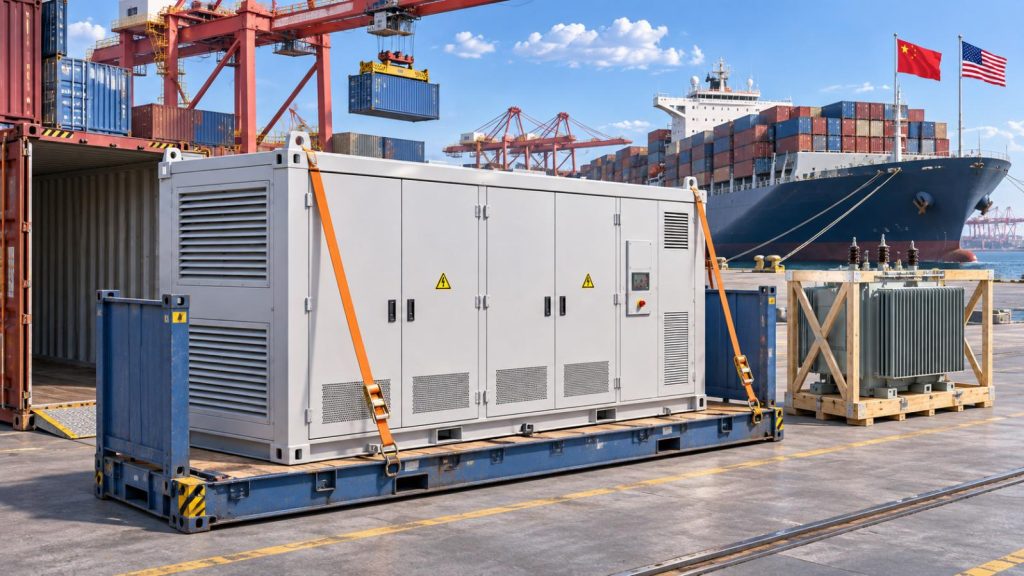
5. Plan U.S. Heavy Haul and Site Delivery Early
A large Solar Energy Storage Cabinet cleared U.S. port however still needs an approved route to its final destination, especially if it needs to cross multiple state lines. Some of the projects in Texas, California and Arizona may require different state permits and road restrictions.
Prior to departure, you need to confirm:
• Permitted axle loads and oversize/overweight permits
• Restrictions for bridges and tunnels, height and width of route, turning radius
• Whether project site is accessible and unloading crane capacity
• Receiving hours
• If cabinet(s), PCS units, and transformers should arrive together or in phases
Fexbuy’s U.S. partners can arrange pick-up, eligible storage and delivery to approved facilities.
6. Large Solar Energy Storage Cabinet Shipping Costs and Delays
Budget separately for ocean freight, dangerous-goods handling, packing, terminals, duties, trucking, permits, cranes, and storage.
Transit time depends on carrier acceptance, vessel schedules, inspections, and final-mile access—not sailing time alone. Common preventable delays include incorrect UN classification, conflicting weights across documents, an unapproved lifting plan, and discovering site access limits after vessel arrival.
Discuss Your Project with Fexbuy
For a Large Solar Energy Storage Cabinet, transformer, or associated solar-power equipment, our starting point is the technical drawing and destination—not a generic freight rate.
Fexbuy supports China–U.S. battery freight coordination, document review, and U.S. warehousing and delivery through qualified partners.
Send us your dimensions, gross weight, battery setup and delivery address in the U.S. and we’ll look into a workable transport solution.
FAQs
Q1. Can Fexbuy ship a Large Solar Energy Storage Cabinet from China to the USA?
Yes. Fexbuy coordinates ocean freight, battery logistics, customs support, and U.S. delivery for eligible energy storage equipment. Shipping arrangements depend on battery classification, cabinet dimensions, weight, and carrier acceptance.
Q2. What information does Fexbuy need to quote a Large Solar Energy Storage Cabinet shipment?
We require packed dimensions, gross weight, battery chemistry, UN classification, equipment photographs, lifting specifications, and pickup and delivery addresses. Battery compliance documents and transformer specifications should also be provided when applicable.
Q3. Can Fexbuy handle lithium battery dangerous goods shipping?
Yes. Fexbuy supports lithium battery freight coordination, including document review and dangerous goods booking arrangements. Applicable IMDG requirements, battery configuration, and carrier acceptance must be confirmed before shipment.
Q4. Which ocean freight methods can Fexbuy arrange for oversized energy storage cabinets?
Fexbuy can evaluate standard containers, open-top containers, flat racks, and breakbulk shipping. The appropriate method depends on equipment dimensions, concentrated loads, lifting requirements, and dangerous goods restrictions.
Q5. Can Fexbuy transport power transformers together with solar energy storage cabinets?
Yes, coordinated transportation can be evaluated. However, transformers and battery cabinets require separate assessments of weight distribution, securing points, handling restrictions, and equipment compatibility before a shared shipping arrangement is approved.
Share:


