


Defer VAT Accounting Shipping from China to UK: How Postponed VAT Accounting Works
Generally speaking, for UK businesses importing products from China, Postponed VAT Accounting (PVA) for VAT deferral means the importer does not need to pay import VAT to HMRC upon importation of goods into the UK. Instead, the importer accounts for the import VAT in the subsequent VAT return and, in accordance with the normal rules governing reclaim of input tax, is entitled to reclaim the import VAT. This alters the cash flow of the VAT rather than the VAT itself.
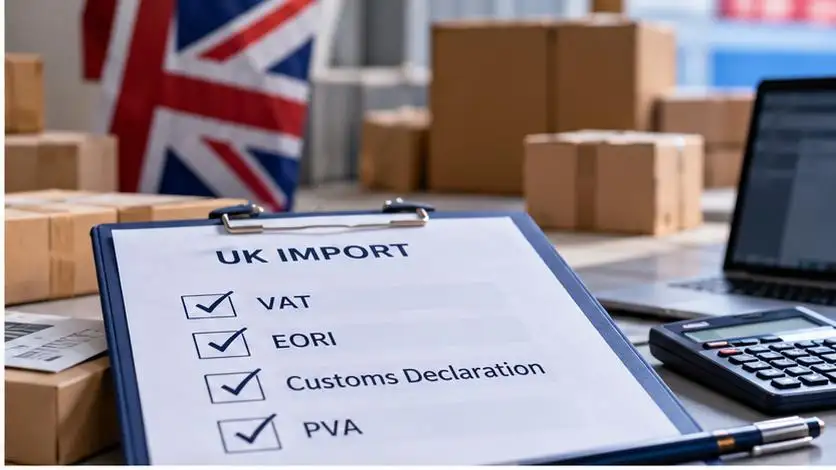
The important question is therefore not simply, “Can VAT be deferred?” Importers need to align the Importer of Record, VAT registration, EORI number, customs declaration, Incoterm and accounting records before the goods enter the UK.
What Does Defer VAT Accounting Shipping from China to UK Mean?
The main mechanism is Postponed VAT Accounting.
A UK VAT-registered business can use PVA when the imported goods are for its business, it has the right to dispose of those goods, and its VAT registration number is included on the import declaration. HMRC does not require a separate PVA approval simply to use the mechanism.
PVA should not be confused with a Duty Deferment Account (DDA).
| Factor | PVA | Duty Deferment Account |
| Main function | Account for import VAT through VAT Return | Delay payment of customs charges |
| Import VAT | Declared through VAT Return | Can be paid later through deferment account |
| Customs Duty | Not postponed by PVA | Can normally be deferred |
| Main cash-flow effect | Avoids upfront VAT payment where applicable | Delays payment of specified customs charges |
A Duty Deferment Account generally postpones qualifying charges until a later payment date. It does not operate in the same way as PVA.
Start With the Importer of Record
Before arranging Defer VAT Accounting Shipping from China to UK, establish who is legally acting as the importer.
The importer information must be consistent across:
•UK VAT registration number
•EORI number
•Customs declaration
•Commercial invoice
•Incoterm arrangement
•Accounting records
This matters because postponed import VAT is recorded against the EORI used on the customs declaration. An incorrect importer or EORI can cause the transaction to be missing from the expected PVA statement.
How the PVA Process Works
A practical Defer VAT Accounting Shipping from China to UK workflow can be divided into the following seven stages.
1. Confirm VAT and EORI Details
Verify the legal entity importing the goods and confirm the VAT and EORI details on the customs entry are the same.
2. Check the Incoterm
FOB, CIF, DAP and DDP allocate transport costs, risks and import responsibilities differently.
For example, under DAP the UK buyer normally handles import clearance, while a DDP structure places considerably more import responsibility on the seller. However, an Incoterm alone does not determine whether the UK buyer has the VAT evidence required for PVA recovery.

3. Provide PVA Instructions to the Customs Agent
If a freight forwarder or customs representative files the declaration, the importer should explicitly confirm how import VAT must be accounted for.
HMRC guidance now requires written permission where another person or business is authorised to use PVA on the importer’s behalf.
Useful shipment instructions should include:
•Importer legal name
•VAT number
•EORI
•PVA instruction
•HS code
•Incoterm
•Customs value
•Commercial invoice details
4. Complete the Customs Declaration Correctly
The choice to use PVA is made through the import declaration. HMRC states that the accounting method cannot simply be changed after that declaration has been submitted.
This makes customs-data accuracy part of VAT accounting—not merely a shipping-document issue.
5. Retrieve the Monthly PVA Statement
HMRC provides monthly postponed import VAT statements showing import VAT associated with declarations made under the relevant EORI.
Importers should reconcile these statements against shipment references and customs entries rather than relying only on invoices from the freight forwarder.
6. Complete the VAT Return
For PVA transactions, HMRC would require figures to be shown in:
| VAT Return Treatment | Description |
| Box 1 | Import VAT due |
| Box 4 | Recoverable import VAT subject to the normal rules |
| Box 7 | Total value of imported goods excluding VAT |
7. Investigate Missing Entries
If an expected shipment is absent from the statement, verify the EORI used on the customs declaration and ask the customs agent to check how the import VAT was allocated.
How Incoterms Affect VAT Planning
Incoterms should be reviewed together with the VAT structure.
| Incoterm | Import Planning Point |
| FOB | Buyer controls main freight and usually has clearer visibility over import arrangements |
| CIF | Seller arranges freight to destination port, but UK import responsibility still needs confirmation |
| DAP | Buyer normally handles import clearance and import charges |
| DDP | Seller assumes greater customs and tax responsibility; importer and VAT-record structure must be checked carefully |
A common mistake is assuming that a DDP quotation automatically gives the UK buyer usable PVA records. Before shipping, confirm who appears as Importer of Record and whose VAT/EORI numbers are entered in the declaration.
Common PVA Mistakes
Several errors can disrupt Defer VAT Accounting Shipping from China to UK:
•Treating PVA as a VAT exemption;
•Confusing PVA with a Duty Deferment Account;
•Entering the wrong VAT or EORI number;
•Failing to give the customs representative clear PVA instructions;
•Using an Incoterm inconsistent with the intended importer structure;
•Failing to reconcile customs entries with monthly PVA statements.
Consignments valued at £135 or less also require separate attention because different UK VAT rules can apply, particularly for direct-to-consumer and online marketplace sales.
Documents to Check Before Shipping
A compliant shipment should normally be planned around the following data:
VAT number → EORI → Importer of Record → HS code → customs value → commercial invoice → Incoterm → customs declaration → PVA statement → VAT Return
This chain is important because a shipping error at declaration stage can later become an accounting problem.
Planning China-to-UK Shipping With Fexbuy
Effective Defer VAT Accounting Shipping from China to UK starts before the cargo leaves China. Importers should first determine the correct transport mode, Incoterm, Importer of Record and customs/VAT arrangement, then make sure those decisions are reflected consistently in the shipping documents.
Fexbuy provides China-to-UK logistics options including air, sea and other cross-border solutions, with DDP, DDU, FOB and CIF arrangements available for different shipment structures. Its UK logistics information also addresses EORI, VAT and customs-clearance planning.
Businesses planning shipments from China to the UK can visit Fexbuy to discuss the freight route and customs arrangement that best fits their importer structure:
FAQs
Q1. Does Fexbuy provide shipping from China to the UK?
Yes. Fexbuy provides China-to-UK logistics solutions using different transport modes depending on shipment requirements.
Q2. Can Fexbuy support PVA-related shipments to the UK?
Fexbuy can coordinate shipping and customs-clearance requirements where the importer intends to use Postponed VAT Accounting. The importer should provide correct VAT and EORI details.
Q3. Does Fexbuy decide whether a UK importer qualifies for PVA?
No. PVA eligibility depends on the importer’s VAT status, customs declaration and UK tax rules. Fexbuy can support the logistics and customs coordination process.
Q4. What information should I provide Fexbuy for a PVA shipment?
Typically, provide the importer’s legal name, VAT number, EORI number, commercial invoice, HS code, customs value and preferred Incoterm.
Q5. Can Fexbuy arrange DDP shipping from China to the UK?
Fexbuy offers shipping structures including DDP for suitable shipments. Importers should confirm the Importer of Record and VAT treatment before shipment.
Share:


