


Lithium Battery Transport Company in Shenzhen: Export Logistics for Battery Manufacturers
Booking a 960 Wh e-bike battery pack as regular electronics at a Shenzhen factory is impossible. Other checks on classification, packaging and carrier acceptance are necessary before pick up.
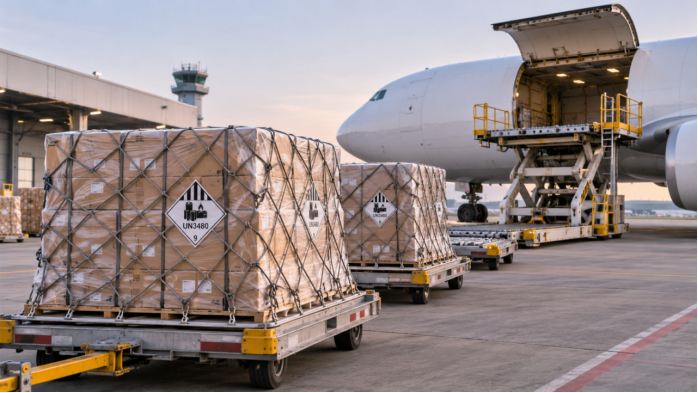
We at Fexbuy, as Lithium Battery Transport Company, facilitate the above mentioned steps for clients exporting batteries from China to the USA, Europe and elsewhere.
Start with the Battery, Not the Shipping Quote
We need the model and chemistry of the battery, its voltage and capacity, net mass, how it is packed, its condition and the country of destination before we provide rates.
• Normal production: Check if the test report for the battery matches the design.
• Proto-types or damaged batteries: Indicate separately, as standard procedures may not apply.
• Installed versus spare batteries: Do not assume the same UN number applies.
UN Classification: What Are You Actually Shipping?
| Shipment Configuration | UN Classification | Booking Implication |
| Standalone lithium-ion battery packs | UN3480 | Air PI965; standalone cargo restrictions |
| Batteries packed with equipment | UN3481 | Air PI966; separate batteries in the package |
| Batteries contained in equipment | UN3481 | Air PI967; batteries installed in the device |
| Lithium-metal batteries | UN3090 / UN3091 | Chemistry-specific requirements |
| Lithium-ion-powered vehicle | UN3556 under 2026 IMDG | Different from shipping a spare battery |
Energy rating:
Wh = Nominal Voltage × Rated Capacity (Ah)
A 48 V, 20 Ah pack is 960 Wh, above the 100 Wh battery threshold used to distinguish air-shipping sections.
Power banks primarily supplying external power are generally classified as batteries, not equipment containing batteries.
2026 Rules: Testing, Air Acceptance, and Sea Transport
UN38.3: Verify the Tested Battery Design
The battery design generally must pass applicable transport tests covering:
• Altitude simulation and thermal cycling
• Vibration and mechanical shock
• External short circuit
• Impact/crush, overcharge, and forced discharge, as applicable
A UN38.3 test summary should be available. Passing UN38.3 does not automatically authorize transport.
IATA: State-of-Charge and Air Cargo Restrictions
A Lithium Battery Transport Company must distinguish three air-shipping configurations:
| IATA Instruction | 2026 SoC Requirement |
| PI965 – Standalone batteries | Maximum 30%; normally cargo aircraft only |
| PI966 Section I | Maximum 30% |
| PI966 Section II | Maximum 30% for batteries over 2.7 Wh |
| PI967 – Contained in equipment | Maximum 30% SoC or 25% indicated capacity recommended |
Shipments exceeding applicable limits require specified approval pathways. Airlines may impose additional restrictions.
IMDG: Sea Freight Compliance
IMDG Code Amendment 42-24 became mandatory on January 1, 2026.
Verify package marking, dangerous-goods declarations, container loading, segregation, and vessel acceptance.
Applicable lithium-ion-powered vehicles now use UN3556 rather than the former generic UN3171 designation in international sea transport.
Export Packaging and Documentation: Prevent Rejection Before Booking
| Checkpoint | Verification Requirements |
| Battery identification | Model, Wh, chemistry, quantity, net weight |
| Testing | UN38.3 summary matching the shipped design |
| Technical documents | SDS and manufacturer specifications |
| DG packaging | Insulated terminals, cushioning, restraint, approved packaging where required |
| Labels and declarations | Applicable Class 9 marks, battery marks, and DG documents |
| Customs | Invoice, packing list, HS code, consignee, Incoterm |
Rejection can follow an invoice describing “electronic accessories” while DG documents identify standalone batteries, or a revised pack using an obsolete test summary.
A Lithium Battery Transport Company should resolve such discrepancies before cargo enters the dangerous-goods warehouse.
Air Freight vs FCL vs LCL: Match Transport to the Cargo
| Transport Method | Best Application | Main Constraints |
| Air Freight | Urgent approved battery shipments | SoC, package limits, airline acceptance, DG charges |
| Sea Freight FCL | Regular high-volume battery exports | Container loading, placarding, port acceptance |
| Sea Freight LCL | Smaller commercial consignments | Consolidator approval, compatibility, surcharges |
FCL gives more loading control; LCL may lower base freight but adds consolidation restrictions.
Trade terms are important. For example, FOB transfers vessel-loading risk and export responsibilities, while under DDP, a seller takes on broader import and delivery responsibilities.
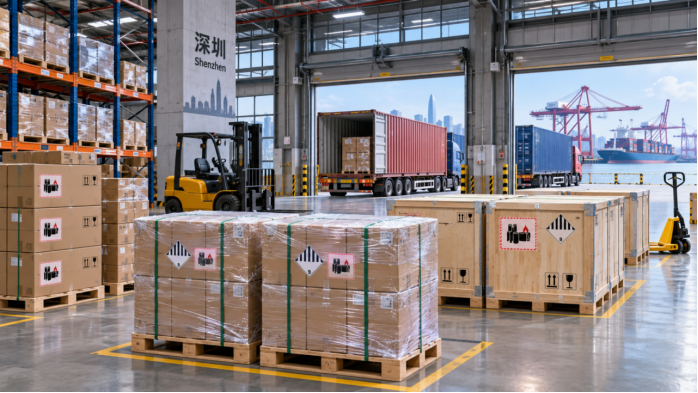
Shenzhen-to-USA Battery Export: A Case Study
Let us take e-bike replacement battery packs shipped from Shenzhen to a USA distributor.
Our process includes:
- Review the factory: Verify 960 Wh/pack, chemistry, net weight, and design
- Pre-booking audit: Assess UN3480, UN38.3, SDS and packaging
- DG check: Verify terminal insulation, marks & labels, and Shipping Declaration
- Choose route: Obtain sea-freight carrier acceptance; assess FCL/LCL and volume
- Hand off to Customs: Ensure invoice; importer; HS classification; calculate duties
- Final delivery: Ensure authorized warehousing and delivery
Acceptance is product and carrier dependent
What Drives Lithium Battery Shipping Costs?
A useful Lithium Battery Transport Company quotation separates:
• Origin: Factory pickup, DG packaging, documentation, warehousing
• International freight: Air/ocean rates, DG surcharges, carrier fees
• Destination: Port charges, customs brokerage, duties and taxes
• Delivery: Storage, inland trucking, final-mile distribution
Compare offers using net DG weight, gross weight, carton dimensions, Incoterm, and destination postcode.
Do not compare an FOB port quote directly with a DDP door-delivered quote. Their scopes and tax responsibilities differ.
How to Evaluate a Lithium Battery Transport Company in Shenzhen
Pre-booking classification reviews, carrier acceptance, DG packaging arrangements, customs responsibilities and written rework fees are reviewed.
At Fexbuy, our battery logistics services include:
• UN38.3 guidance, SDS review, and DG classification support
• Dangerous-goods packaging coordination
• Air freight and DG FCL/LCL sea freight
• Destination customs and delivery planning
Services remain subject to cargo classification, route restrictions, and carrier acceptance.
Plan Your Battery Export With Fexbuy
Send us your battery specifications, the quantity you wish to ship, your destination, and your delivery terms. We can look into the shipment requirements and plan the best route for the shipment.
Explore Fexbuy Battery Transport Services to discuss your next shipment.
FAQs
Q1. What lithium battery transport services does Fexbuy provide?
Fexbuy supports lithium battery exports from Shenzhen, including DG classification review, packaging coordination, air and sea freight, customs clearance, and international delivery planning.
Q2. Can Fexbuy ship UN3480 and UN3481 lithium batteries?
Yes. Fexbuy evaluates UN3480 standalone batteries and UN3481 batteries packed with or contained in equipment. Acceptance depends on battery specifications, packaging, destination, and carrier regulations.
Q3. Does Fexbuy help manufacturers prepare UN38.3 and SDS documents?
Yes. Fexbuy reviews UN38.3 test summaries, SDS/MSDS, battery specifications, and applicable dangerous goods documentation before shipment.
Q4. Does Fexbuy offer air and sea freight for lithium batteries?
Yes. Fexbuy arranges eligible lithium battery shipments by air and sea, including FCL and LCL services. Transport options depend on battery classification and carrier acceptance.
Q5. Can Fexbuy arrange lithium battery shipping from Shenzhen to the USA?
Yes. Fexbuy supports China-to-USA battery logistics, including factory pickup, export documentation, international freight, customs coordination, and destination delivery.
Share:


